
Abstract:
This week, Europe’s largest satellite factory was officially unveiled in Belgium, marking a new step in Europe’s challenge to Elon Musk’s Starlink and reducing its reliance on US space infrastructure.
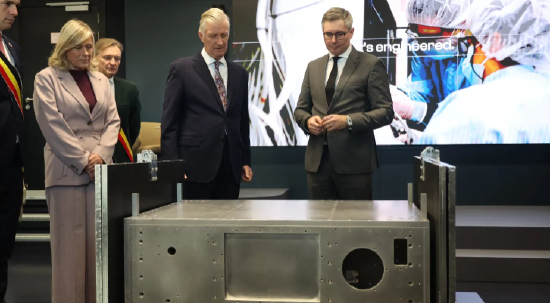
Belgian private satellite manufacturer Aerospacelab won a contract worth 2.4 billion euros (approximately $2.6 billion) in September and will be responsible for manufacturing 264 of the 348 IRIS² satellites planned to be deployed by the European Union. IRIS² is a competition project launched by the European Union for SpaceX’s Starlink business.
Aerospacelab said the project will "form the backbone of Europe's autonomous, secure and resilient connectivity infrastructure by 2030". The factory will be named Ectro from November 30.
This new factory is located in the south of Belgium. It adopts an oval design and has a construction area of 20,000 square meters. It was opened by King Philip of Belgium. According to the Belgian Royal Court, the factory can produce up to 500 satellites per year and will become the world's third largest satellite production base.
According to reports, employees are expected to move into the super factory in January next year, and production is scheduled to start before the end of 2028.
Satellite communications are becoming increasingly important to daily life and national security.
Satellite communications can provide Internet access services to remote areas and defense equipment such as warships and fighter jets, and enable governments and militaries of various countries to communicate securely when terrestrial communications networks cannot be covered or are destroyed.
The situation in Ukraine in particular highlights the importance of such capabilities. The Ukrainian military relies heavily on Starlink communications services in its fight against Russian forces. Recently, Ukrainian officials reported new restrictions on the use of Starlink in Russian-occupied areas, further highlighting that geopolitical conflicts can be affected by the decisions of commercial enterprises to serve the service.
However, Europe still has a long way to go before it can challenge Starlink’s dominance.
SpaceX stated that it currently has more than 11,000 Starlink satellites deployed in low-Earth orbit, making it the world's largest satellite constellation, and plans to expand the number of satellites to up to 100,000.
One of the competitors is Amazon. Its satellite business Amazon Leo has currently deployed more than 400 satellites and plans to first build an in-orbit constellation consisting of more than 3,200 satellites.
At the same time, France's Eutelsat operates more than 600 satellites in low-Earth orbit through its OneWeb satellite constellation. The company also forms the SpaceRISE consortium with SES and Hispasat to develop and operate the IRIS² project.
The European Commission calls IRIS² a "strategic asset aimed at achieving European space sovereignty in the face of commercial satellite constellations such as Starlink."
The project aims to conduct its first satellite launch by the end of 2029 and begin initial services shortly thereafter.
In August this year, the European Commission and the SpaceRISE consortium announced that they would expand the size of IRIS²'s main satellite constellation from 282 to 348, increasing the secure communications capabilities it provides to EU governments by 60%.
The European Commission stated that application needs in the defense and security fields were the main driving factor for expanding the scale of the project.
Comments