
Abstract:
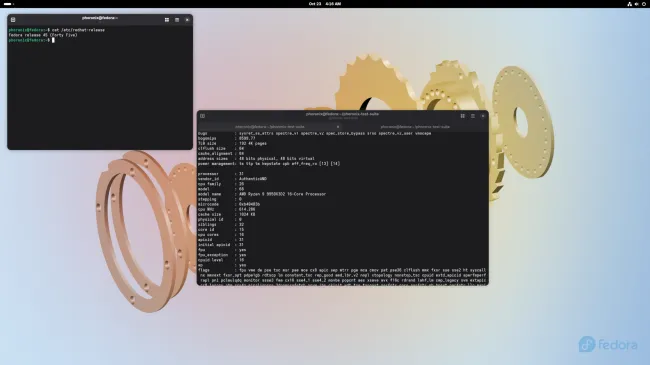
After two delays, Fedora 45 was finally officially released on November 3, 2026. This is a new round of six-month updates for the Linux distribution, which brings a series of changes in kernel console replacement, storage management, security policies and hardware compatibility, as well as updates to the desktop environment, compilers and development tool chains.
One of the most noteworthy changes in Fedora 45 is the introduction of KMSCON, which replaces the traditional Linux kernel console. KMSCON is a console system running in user space that provides graphical display support using Kernel Mode Settings (KMS). Separating console functions from the kernel helps change the way traditional consoles are implemented, and also provides a more flexible basis for subsequent function expansion.
In terms of installation and storage management, Fedora 45's Anaconda installer adds support for the Stratis storage system. Stratis is a local storage management solution for Linux that can provide a management experience similar to a modern storage pool on the underlying storage device, supporting functions such as snapshots, thin provisioning, and file system management. This makes it easier for users to use Stratis to manage storage resources when installing the system.
In terms of hardware support, the new version further improves support for laptops equipped with Qualcomm Snapdragon X series processors. As ARM-based PCs gradually enter the mainstream market, Fedora is also continuing to improve Linux's compatibility with such devices, especially startup, driver and hardware function support.

Security is another important update in Fedora 45. The new version limits the scope of use of the ptrace function by default. ptrace is a process tracking mechanism provided by Linux. Debuggers can use it to inspect and control other processes, but malicious programs may also use this mechanism to spy on the running status of other processes. By tightening default permissions, Fedora hopes to reduce the risk of unauthorized access between different processes.
In addition, Fedora 45 enforces package signature checking by default to increase the trustworthiness of software sources. Software packages need to pass signature verification during installation or processing to prevent unauthorized or unknown software packages from entering the system.
The software construction process is also undergoing changes. Fedora 45 begins requiring reproducible package builds. The so-called reproducible build refers to building under the same source code, build environment and parameter conditions at different times or on different machines, and the same binary result should be obtained in the end. This mechanism helps verify that packages have not been tampered with and increases transparency and security throughout the distribution supply chain.
Another noteworthy new feature is the DRM Panic front-end. When a serious error occurs in the Linux kernel, traditional kernel crash information is often displayed in text form, which is not easy for ordinary users to understand. DRM Panic can use graphics display hardware to present more intuitive crash information, making it easier for users to identify system faults and assisting in subsequent fault diagnosis.
Learn more:
https://fedoramagazine.org/announcing-fedora-linux-45/
Comments