
Abstract:
The Linux distribution Fedora 45 will be officially released soon. According to the latest arrangements announced by the Fedora project team, the new version is scheduled to be officially launched on Tuesday, November 3, 2026. Previously, Fedora 45 has failed to be released as scheduled twice in a row, mainly because the candidate version was not completed in time and multiple critical vulnerabilities that hindered the official release have not been resolved. However, after the development team's intensive repairs over the past week, the relevant issues have been resolved, and Fedora 45 was officially released in the latest release evaluation meeting.
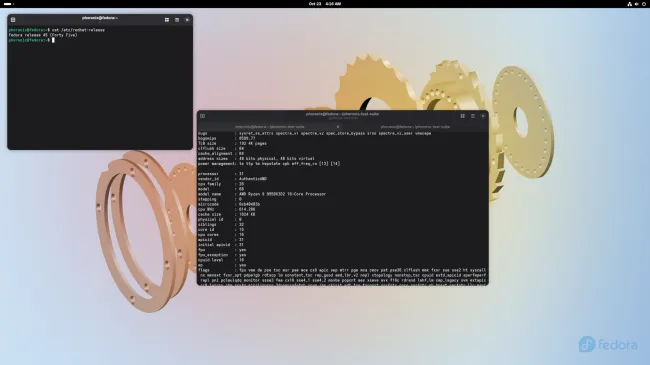
Currently, Fedora 45 Release Candidate 1.4 has been recognized as a stable version. If users do not want to wait for the official release, they can download and install this version in advance. The ISO image used in this candidate version will also become the version distributed to mirror stations around the world when it is officially released on November 3.
Fedora 45 brings a number of underlying system improvements this time. One of the more important changes is the introduction of KMSCON, which replaces the original console implementation of the Linux kernel. KMSCON is a user-space console system based on Linux Kernel Mode Setup (KMS) that can handle terminal display tasks using modern graphical display interfaces. This adjustment means that Fedora is changing the traditional kernel console implementation to provide a more flexible foundation for future graphical display and terminal management.
In terms of installation programs, Fedora 45 further enhances the Anaconda installer's support for the Stratis storage system. Stratis is a modern storage management solution for the Linux ecosystem that simplifies storage pool, file system and volume management. This integration will make it easier for users to configure Stratis storage environments when installing the operating system, especially for users who require complex storage layouts.
For laptops equipped with Qualcomm Snapdragon X series processors, Fedora 45 has also been specially optimized. As the market for ARM-based Windows laptops gradually expands, the Linux community is working hard to improve the hardware compatibility of Qualcomm platforms. The new version further improves support for Snapdragon X laptops and is expected to improve the experience of related devices in the Linux environment.
In terms of security, Fedora 45 introduces a number of noteworthy adjustments. These include limiting ptrace functionality by default. ptrace is an important mechanism for process tracking and debugging in Linux systems. Developers can use it to check the running status of other processes, but this mechanism may also be abused by malicious programs. By tightening restrictions by default, Fedora hopes to reduce the security risks caused by unauthorized access and debugging between processes.
In addition, the new version will also enforce software package signature checking by default to further enhance security during software installation. Software package signatures can help the system verify the source and integrity of software packages, reducing the risk of malicious software packages or tampered software entering the system.
Fedora 45 will also further promote the reproducibility of package builds. Repeatable builds mean that a package should produce consistent build results given the same source code, build environment, and parameters. This has important implications for verifying software supply chain security, discovering anomalies in the build process, and improving distribution transparency.
In terms of kernel fault diagnosis, the new version also introduces the DRM Panic front end. When a serious failure occurs in the Linux kernel graphics display subsystem, this function can provide a more intuitive and friendly error display interface to help users understand system problems without having to rely entirely on traditional kernel crash information.
The desktop environment and development tools also received large-scale updates. Fedora Workstation 45 will be equipped with the GNOME 51 desktop environment, and will also update a large number of basic system components and development tools, including Go 1.27, Python 3.15, GCC 16.2, Glibc 2.44, LLVM 23 and RPM 6.1, etc.
Among them, the updates to GCC 16.2 and LLVM 23 will provide developers with a new generation of compiler and tool chain support, while Glibc 2.44 further updates the core runtime library of the Linux system. RPM 6.1 involves the underlying infrastructure of the Fedora software package management system, which is of great significance to the software package construction, management and release process.
In general, Fedora 45 is not a simple desktop environment upgrade, but a comprehensive update involving system security, storage management, graphical console, hardware compatibility and software development tool chain. In particular, support for the Snapdragon X platform and adjustments to the default security policy reflect Fedora's continued adaption to new generation computing platforms and modern Linux security needs. The official version will be released on November 3, and users will be able to obtain the complete installation image through Fedora official channels.
Comments