
Abstract:
Intel is preparing two new processor series for entry-level laptops, namely Moon Lake and Wildcat Lake Refresh. According to the latest news, both will revolve around Intel's 18A process technology. Moon Lake is positioned at a lower level and may even completely cancel traditional performance cores and retain only low-power energy-efficiency cores; Wildcat Lake Refresh will increase the number of performance cores and expand the configurable power range to provide stronger processing capabilities for laptops with limited budgets.
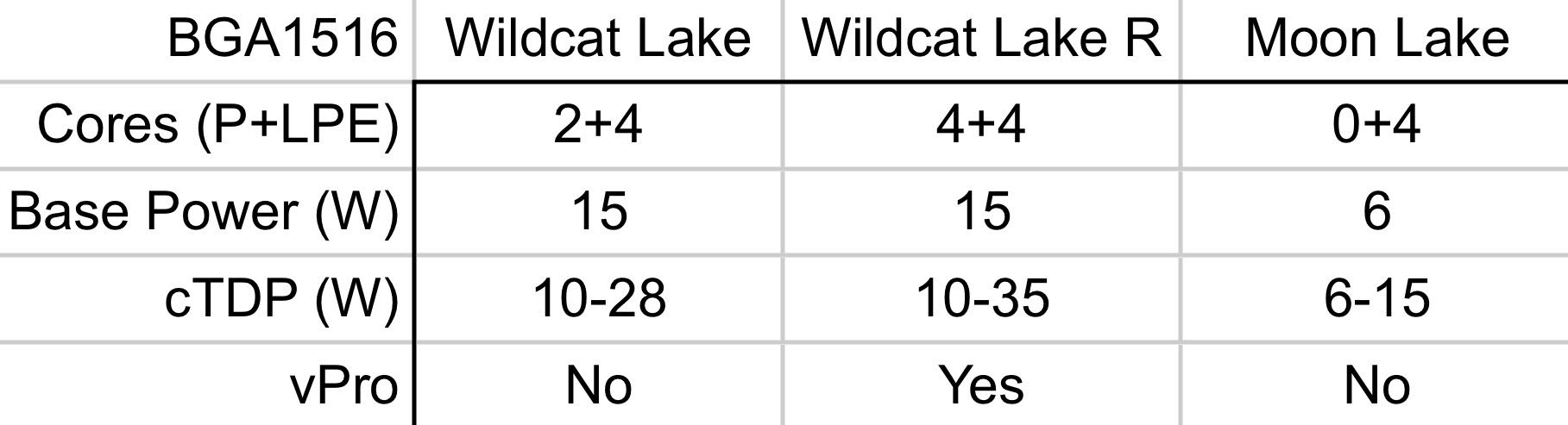
According to information disclosed by whistleblower Jaykihn on October 29, Moon Lake will use the same BGA 1516 package as Wildcat Lake and adopt a separate chip design. Its computing chip is manufactured based on Intel's 18A process and is expected to be equipped with up to four Darkmont microarchitecture low-power energy-efficiency cores. There will no longer be traditional performance cores. The basic power consumption is about 6 watts, and the configurable power consumption can reach up to 15 watts.
If this configuration is finally confirmed, Moon Lake will become a special product launched by Intel for ultra-low power devices in recent years. Traditional notebook processors are usually equipped with both performance cores and energy efficiency cores. The former is responsible for high-load tasks, and the latter is responsible for background processing and lightweight work. Moon Lake may run entirely on low-power cores to reduce chip area, power consumption and overall machine cost.
This type of design is especially suitable for entry-level notebooks, Chromebooks, and lightweight computing devices that do not require high performance. For tasks such as web browsing, document processing, online video playback, and basic office work, low-power cores are usually able to provide sufficient performance while potentially reducing heat dissipation requirements and extending battery life.
However, the elimination of performance cores also means that Moon Lake may not be suitable for continuously running high-load tasks. In the face of complex software compilation, large-scale image processing, multi-tasking office or other applications that require strong single-thread performance, its performance may significantly lag behind processors equipped with performance cores. The final experience will also depend on factors such as core frequency, cache capacity, memory bandwidth, and operating system scheduling policies.
The specific configuration of the graphics section has not yet been confirmed. It is reported that Moon Lake may use the Xe3 architecture to integrate the graphics card, but the number of graphics cores is still unclear. If its positioning is indeed lower than the existing Wildcat Lake, graphics performance and media processing capabilities may also be limited.
In contrast, Wildcat Lake Refresh is closer to an upgraded version of the existing Wildcat Lake. According to the current specification information leaked, the new series will be equipped with up to 4 Cougar Cove performance cores and 4 Darkmont low-power energy-efficiency cores, while the existing Wildcat Lake configuration is up to 2 performance cores and 4 low-power energy-efficiency cores.
This means that the main upgrade direction of Wildcat Lake Refresh is to increase the number of performance cores rather than to completely replace the processor architecture. More performance cores are expected to improve the performance of multi-threaded applications, making entry-level notebooks more comfortable when handling complex office tasks, running multiple programs at the same time, and performing light creative work.
The new series is expected to continue to use Xe3 integrated graphics, and the number of graphics cores may not change significantly. Therefore, its graphics performance improvement may not be as significant as the CPU part. For thin and light notebooks that mainly rely on integrated graphics cards, actual game performance and graphics computing capabilities will still be affected by the size of the graphics card, memory configuration, and power consumption limitations.
In terms of power consumption, the base power consumption range of Wildcat Lake Refresh is expected to be 10 to 35 watts, which is higher than the 10 to 28 watts of the existing Wildcat Lake. A higher power consumption limit allows notebook manufacturers to release more processor performance when cooling conditions permit, but it may also increase the design pressure on the cooling system and affect battery life.
In addition, Wildcat Lake Refresh is expected to add vPro platform support. vPro is a set of platform technologies provided by Intel for enterprise computing devices, involving remote management, security functions and enterprise-level device management capabilities. Relevant support is expected to allow the new processor to enter more enterprise office notebooks and commercial terminal products, instead of being limited to entry-level devices for ordinary consumers.
Both processors will use separate chip designs. Compared with the traditional solution of integrating all functions on a single silicon chip, the discrete design can divide computing, input and output and other functions into different chips, and then combine them through inter-chip interconnection technology. In this way, the configuration of each part can be adjusted according to different product positioning, and there is also an opportunity to reduce manufacturing costs.
Wildcat Lake has already adopted this idea, combining computing chips based on Intel's 18A process with input and output chips manufactured using other processes. By matching different processes, Intel can prevent all functions from having to be manufactured using the most advanced processes, thereby controlling the overall cost of low-priced processors.
Intel 18A belongs to the company's advanced process node and is also one of Intel's important technologies to promote local advanced semiconductor manufacturing. This process introduces RibbonFET full surround gate transistor and PowerVia back power supply technology, aiming to improve transistor density, power supply efficiency and performance. Using 18A for entry-level processors means that Intel is trying to further decentralize advanced manufacturing technology to lower-priced product markets.
However, advanced manufacturing processes do not automatically mean that entry-level processors must have higher actual performance. For this type of chip, product cost, core number, cache, memory bandwidth, packaging design and overall machine heat dissipation are equally important. Even if Moon Lake uses the 18A process, its absolute performance may be significantly lower than high-end processors due to its small number of cores and strict power consumption restrictions.
From a product layout perspective, Intel seems to be further segmenting the low-price notebook market. Wildcat Lake is mainly aimed at budget laptops, student equipment and lightweight commercial systems; Wildcat Lake Refresh may increase performance cores to meet users who require stronger CPU performance; Moon Lake further explores low-power, low-cost devices, providing new options for Chromebooks and other entry-level products.
This also reflects that competition in the low-price PC market is changing. As Apple MacBook Neo, Windows notebooks equipped with Qualcomm processors and other low-priced computing devices enter the market, traditional entry-level notebooks no longer rely solely on old processors and low-cost manufacturing processes. Intel hopes to use the 18A advanced process, discrete chip design and different core configurations to maintain product competitiveness while controlling costs.
At present, the above-mentioned Moon Lake and Wildcat Lake Refresh specifications still come from whistleblowers, and Intel has not officially announced the complete product parameters, final naming, selling price and launch date. Current information shows that Wildcat Lake Refresh may be launched in the first half of 2027, but this time remains to be officially confirmed.
If the relevant plans are finally implemented, Intel will form a more detailed echelon of entry-level processor products: Moon Lake prioritizes extremely low power consumption and low cost, while Wildcat Lake Refresh improves processing capabilities by adding performance cores. For consumers, when purchasing low-price notebooks in the future, in addition to the processor model, they also need to pay attention to the number of performance cores, actual power consumption limits, integrated graphics card configuration, and overall machine heat dissipation design to determine whether different products truly meet their needs.
Comments