
Abstract:
The French Court of Justice in Paris recently rejected the pay TV operator Canal+’s request for a fine against the US Internet infrastructure company Cloudflare. Canal+ previously asked the court to fine Cloudflare 50,000 euros per website per day for failing to block websites suspected of piracy of sports events through its public DNS resolution service 1.1.1.1 as required by the court. The court ultimately held that Cloudflare had taken reasonable technical measures and there was no need to impose additional fines.
This ruling was made on September 17, 2026, involving two cases involving Formula One (F1) and the World Motorcycle Championship (MotoGP). The incident reflects that French copyright owners are expanding the scope of application of anti-piracy measures. They no longer only require Internet service providers to block relevant websites, but also begin to put pressure on Internet infrastructure providers such as public DNS resolution services, VPNs, search engines, and content distribution networks (CDNs).
In April this year, the Paris Justice Court required Cloudflare to take effective measures to prevent French users from accessing 21 domain names suspected of providing pirated content for F1 events, as well as 16 domain names related to pirated broadcasts of MotoGP events. The relevant order involves both Cloudflare's public DNS resolution service and CDN service, but the court did not specify which specific technical means must be used. It only required Cloudflare to use any effective method to prevent users in France from accessing these websites.
Cloudflare subsequently chose to perform blocking measures primarily through its CDN service, rather than implementing domain name filtering in its public DNS resolution service 1.1.1.1.
CDN is a network infrastructure used to speed up the delivery of website content. Cloudflare has deployed a large number of network nodes around the world. Websites can use its services to improve access speeds, alleviate traffic impacts, and obtain certain security protection. When a website serves content through Cloudflare's CDN, Cloudflare is able to restrict content delivery based on the visitor's region, thereby preventing users from specific countries or regions from accessing the website.
DNS has a different task. When users visit a website, the domain name is usually converted to the corresponding IP address through DNS. 1.1.1.1 provided by Cloudflare is a recursive DNS resolution service open to the public. Users can set it as the DNS server used by devices or routers to obtain domain name resolution services.
If the DNS resolution service refuses to resolve a domain name, users may not be able to access the website normally through the domain name. However, DNS blocking does not mean that the website itself is shut down. Users may still access relevant content through other DNS servers, alternative domain names, or other technical means.
Canal+ believes that Cloudflare only implements blocking through CDN and actually fails to fully comply with the court order. The company again petitioned the court in May to impose daily fines on Cloudflare to force it to enforce blocking measures more comprehensively.
According to Canal+, Cloudflare only blocked 3 of the 21 domain names involved in the F1 case; only 3 of the 16 domain names involved in the MotoGP case were blocked. Canal+ also pointed out that some of the websites came back online after a week, with one changing its CDN service provider and another restoring access through a mirror website.
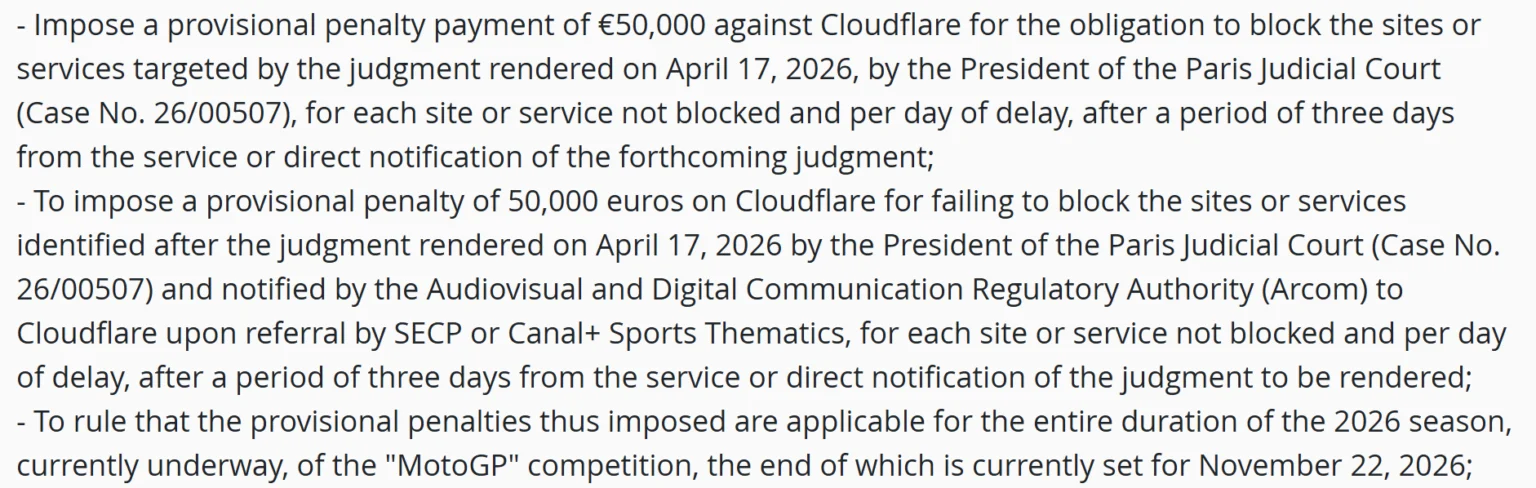
Canal+ therefore asked the court to impose a fine of 50,000 euros per day on each website that remains accessible, and to apply the same penalty to additional websites that media regulator Arcom subsequently notified Cloudflare. The company also asked Cloudflare to bear €20,000 in legal costs.
If the standards proposed by Canal+ are implemented, fines may accumulate with the number of websites that can still be accessed and the duration, which will put considerable financial pressure on Cloudflare.
However, the Paris Justice Court ultimately did not accept the request. The court pointed out that Cloudflare did implement relevant blocking measures through CDN services, and the method it adopted was not disputed. Cloudflare previously explained that compared with public DNS filtering, restricting access to specific regions through CDN is more effective and more consistent with its technical architecture.
Cloudflare also said that the design of its public DNS resolution service was not suitable for implementing country-specific content blocking as required by the French court. Since 1.1.1.1 is a global public service, blocking a domain name at the resolution level may affect users using the service around the world, not just users in France.
Cloudflare has long opposed the use of global public DNS resolution services for regional content blocking. The company believes that requiring a global service to implement a large number of different domain name filtering rules based on different jurisdictions not only involves technical and administrative issues, but may also have implications beyond the jurisdiction of the court.

However, Cloudflare has not completely refused to cooperate with anti-piracy measures. The company has implemented geographical restrictions on some websites through CDN services and disclosed related operations in its transparency report.
In this ruling, the Paris Court also noted that data provided by Canal+ stated that Cloudflare had taken measures against 72.6% of related domain names. The court viewed this ratio as evidence that Cloudflare was genuinely willing to assist in combating infringements, rather than as a basis for finding that it had knowingly violated the order.
It is worth noting that TorrentFreak’s report pointed out that the court ruling did not explain the correspondence between the 72.6% ratio and Canal+’s previous claim that only three domain names were blocked in each case. However, the court ultimately found that Cloudflare had taken reasonable steps and further daily fines were not necessary.
The court did not hold Cloudflare responsible for pirated websites that had changed CDN service providers or switched to mirror websites. The judge held that when a website operator voluntarily transfers to another CDN service provider, or restores access through a mirror website, Cloudflare should not automatically be responsible for these subsequent actions.
The court pointed out that Canal+ can take legal action against the new CDN service provider and report the relevant mirror websites to the French media regulator Arcom in order to continue to promote blocking measures.
In terms of legal basis, Canal+ has cited the EU Court of Justice's previous jurisprudence on Internet intermediaries blocking infringing content and believes that relevant measures must achieve the purpose of effectively preventing infringement. However, the Paris Court of Justice interpreted this principle differently and held that Internet intermediaries bear the obligation to take reasonable measures rather than the absolute responsibility to ensure that all infringing websites are inaccessible under any circumstances.
The court ultimately found that Cloudflare had taken reasonable action through its CDN and therefore the daily fine proposed by Canal+ was neither necessary nor proportional. The court also rejected Canal+’s request for Cloudflare to pay €20,000 in legal fees.
This means that under the two orders involved in this ruling, Cloudflare does not need to bear additional fines for failing to block relevant websites through 1.1.1.1. However, this does not mean that the French court has fully recognized Cloudflare’s position of rejecting DNS filtering, nor does it mean that all future blocking requests against Cloudflare will have the same result. Canal+ can still appeal the ruling.
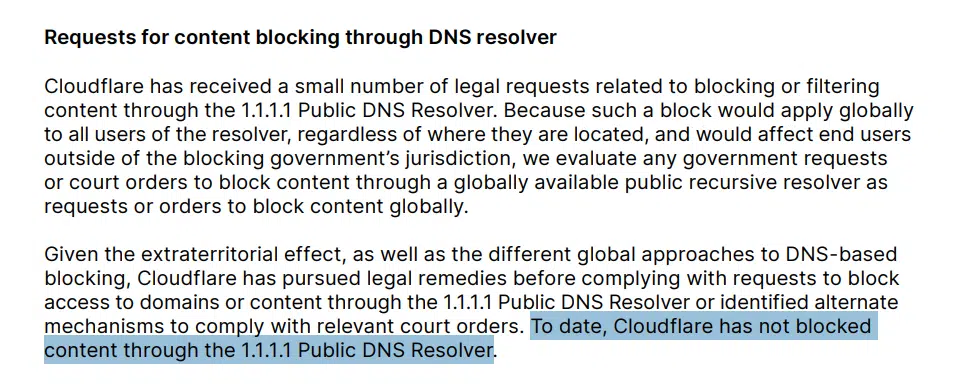
According to Cloudflare’s previous transparency report, as of now, the company has not blocked any content through the 1.1.1.1 public DNS resolution service. Even after receiving relevant requests from countries such as France and Italy, Cloudflare still insists on fulfilling some of its blocking obligations through other technical means.
Unlike DNS services, Cloudflare's CDN geo-blocking has been implemented in France. According to its transparency report for the second half of 2025, the company implemented geographical restrictions on 1,238 domain names in France; in the first half of 2025, it took similar measures on 662 domain names. These actions indicate that Cloudflare does not completely refuse to implement the court's anti-piracy order, but prefers to choose a technical path that it believes is more suitable.
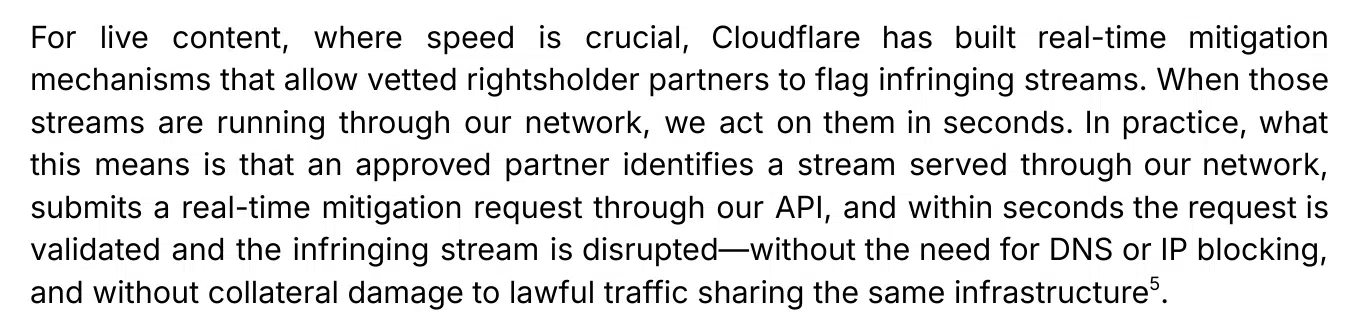
Cloudflare also submitted opinions to the European Commission on combating counterfeit goods and online piracy, reiterating that global public DNS resolution services should not be used as a content blocking tool. Regarding live broadcast piracy of sports events, the company emphasized that it has established a real-time intervention mechanism to allow audited copyright owners and partners to report infringing live streams distributed through the Cloudflare network. The company says that in cases where the live stream in question does pass through its network, it can intervene within seconds without having to rely on DNS or IP address blocking.
However, there are limitations to the scope of this approach. If a pirated website uses another service provider's CDN, or moves the content outside the Cloudflare network, Cloudflare will be limited in the measures it can take directly. For copyright owners, this means that anti-piracy efforts often need to track website operators, domain names, hosting providers and content distribution networks simultaneously, rather than making requests to just one infrastructure company.
In addition, the French court’s ruling cannot simply be understood as meaning that users can bypass all website blocks by simply changing their DNS to 1.1.1.1. If a website still uses Cloudflare's CDN and has implemented geographical restrictions for France, users may still be unable to access the website content even if the domain name is successfully resolved through 1.1.1.1.
Only when the website uses other infrastructure and is not subject to corresponding geographical blocking, changing the DNS may affect whether users can access the website through the domain name. Meanwhile, blocking measures implemented by French ISPs themselves are also likely to remain in effect. Therefore, DNS resolution and actual website content access are two different links, and the two cannot be confused.
This case may also have an impact on other public DNS services. Swiss non-profit organization Quad9 is also facing pressure from sports rights owner beIN Sports. beIN Sports asked the court to impose a daily fine of €10,000 per domain name that is still accessible for its failure to block relevant pirate websites through its DNS service. Rulings on related cases are also expected to be announced in the near future.
Unlike commercial companies, Quad9 is a non-profit DNS service provider. If the court ultimately requires it to bear large and ongoing fines, it may have a significant impact on its ability to operate. Therefore, how the French courts define the responsibilities of public DNS service providers in anti-piracy operations will also become an important observation point in this case.
From a broader Internet governance perspective, this dispute involves a core issue: how much responsibility Internet infrastructure providers should bear for content regulation.
Copyright owners hope to reduce the channels for the spread of pirated sports live broadcasts by expanding the scope of application of blocking orders; Cloudflare is worried that if global public DNS services are universally required to implement regional content filtering, it may change the way the Internet infrastructure operates and cause cross-border impacts.
The French court chose not to impose additional fines on Cloudflare this time, which means that in these two cases, taking reasonable technical measures is more important than ensuring that infringing content is absolutely inaccessible. However, this conclusion is still limited by the facts of the specific case and the content of the court order, and cannot be directly generalized to all countries or all types of online content.
Currently, Cloudflare can continue to implement geographical blocking of relevant websites in France through CDN, and its public DNS service 1.1.1.1 will temporarily remain unfiltered. Whether Canal+ appeals, and how French courts deal with similar cases from other DNS service providers in the future, will determine whether this legal dispute will expand further.
For Internet users, the operation of 1.1.1.1 will not change significantly in the short term due to this ruling. But for the internet infrastructure industry, the controversy is far from over. What kind of blocking obligations the court will require DNS, CDN and other intermediary services to bear in the future will affect copyright protection, network openness, and the way global Internet services operate.
Comments