
Abstract:
On the afternoon of September 12, Luo Yonghao posted a complaint about his consumer experience on a social platform, once again putting an Internet celebrity brand on the hot search list. What was reviewed this time was Mr. Savage, an internet celebrity ice cream brand.
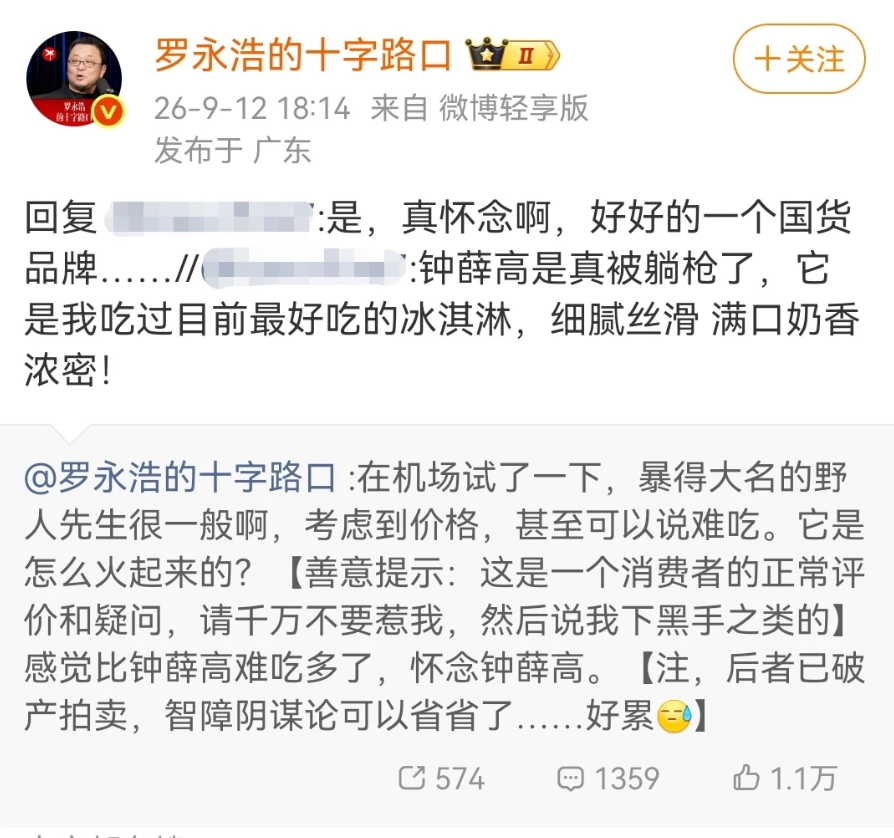
Screenshot of Luo Yonghao’s Weibo
The first reaction of netizens who are familiar with Internet public opinion is not to take sides on the quality of the product, but to think of the well-known public relations overturn many years ago - Xibei aggressively criticized Luo Yonghao for negative reviews. In the end, public opinion backfired and reputation was damaged, leaving a classic negative case for the industry.
History seems to be repeating itself, but the script is completely reversed. Netizens rushed to the comment area of Mr. Savage’s official account to remind:
Don’t answer, don’t answer, don’t answer
.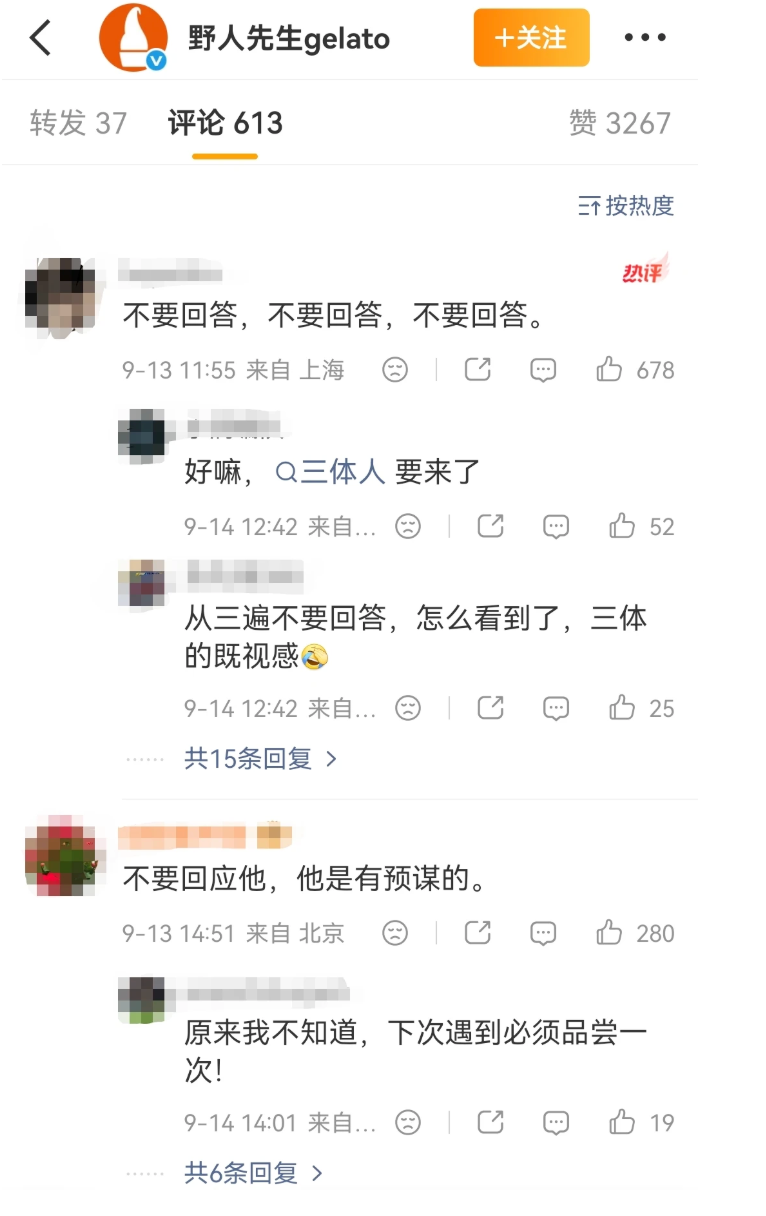
Screenshot of Mr. Savage’s Weibo
Mr. Savage ultimately chose the most restrained strategy: only customer service personnel would simply reply "Relevant opinions will be fed back to the leadership." The brand's official account and management remained silent throughout the process, without excuses, refutations, or public confrontations.
Subsequently, # Savage Mr. Cold Treatment # ranked first among Weibo’s hot searches, and the brand’s short video account gained tens of thousands of new fans. A potential brand crisis settled smoothly in silence, and even achieved reverse exposure.
The same evaluation subject, similar negative review scenarios, and two completely different public relations responses have brought about completely different public opinion outcomes.
Xibei’s tough confrontation turned a negative review from an ordinary consumer into a crisis of trust for the entire network’s brands. Mr. Savage's cold treatment resolved the public opinion storm at the lowest cost. These two sets of comparative cases also provide a very practical public opinion lesson for new consumer brands currently in the traffic whirlpool.
01
One bad review, two endings: Xibei’s lesson and Mr. Savage’s choice
The confrontation between Luo Yonghao and Xibei is still a textbook case of domestic catering public relations. The source of the incident was also a real offline consumption experience. As an ordinary consumer, Luo Yonghao publicly complained about the mismatch between Xibei's dishes, service and pricing, and published a personal negative dining review.

Luo Yonghao, Xibei
Faced with public negative comments from public figures, Xibei did not choose to deal with it coldly. Brand officials and founders chose to leave directly, responded publicly, questioned the rationality of the evaluation, and tried to refute Luo Yonghao's consumption experience from dimensions such as product standards and service processes. From a brand perspective, this is a routine operation to maintain brand image and clarify misunderstandings.
But in the field of public opinion, this move directly changed the nature of the incident: what was originally just a consumer's personal experience complaint was upgraded into a public confrontation between the brand and consumers.
The balance of public opinion tilted rapidly. Volkswagen naturally stands on the side of consumers, and brands come forward to refute users' subjective feelings. It is easy to be labeled as arrogant and a big store bully. The two parties engaged in multiple rounds of online debate, and the topic continued to dominate hot searches. The focus of discussion shifted from the cost-effectiveness of dishes to the brand's attitude towards consumers.
In the end, the popularity of Xibei Road declined significantly, and the reputation of offline stores was under pressure. A large amount of public relations resources were spent, but it failed to quell the controversy. Instead, it consumed the trust accumulated by the brand in the long term and paid a very high price for reputation.
It is precisely because of Xibei's experience that when Luo Yonghao posted a post complaining about Mr. Savage's ice cream, bluntly saying that the product experience was average and even unpalatable combined with the pricing, and compared it with Zhong Xuegao, who has withdrawn from the public eye, the first reaction of the entire Internet was not to judge the ice cream taste, but to wait for the brand's response.
A large number of smart netizens flooded into Mr. Savage’s comment area and repeatedly advised brands not to speak out to avoid repeating Xibei’s mistakes.
Mr. Savage's response completely exceeded the predictions of netizens: he did not take the initiative to confront each other throughout the whole process, did not publish long articles of defense, and did not refute Luo Yonghao's subjective taste evaluation. When asked by the media, customer service simply stated that they would collect feedback and report it to management, without any further explanation.
AI technology self-media "Houchangcun" believes that this almost "inaction" public relations strategy ultimately yielded unexpected results. Public opinion did not continue to ferment and deteriorate, #savage Mr. Cold Treatment # topped the trending searches, and brand short video accounts bucked the trend and gained tens of thousands of followers. Many netizens said that brands know how to exercise restraint and do not bully consumers, but instead increase their goodwill.
The core premise needs to be clarified here: in both incidents, Luo Yonghao’s expressions were based on
real consumer experience
, it is a subjective evaluation of personal feelings, and there is no such thing as spreading rumors, smearing, fabricating food safety issues, etc. When he posted the article, he also took the initiative to mark the attributes, emphasizing that this was just an ordinary consumer evaluation, and delineating the boundaries of the discussion in advance, so as not to give the brand the opportunity to seize the opportunity and label it as malicious slander.This is also the basis for the comparison between the two incidents - the evaluation itself is a subjective complaint at the experience level, rather than a real-life quality scandal.
02
Luo Yonghao has repeatedly commented on the brand: why he can always accurately leverage public opinion
Luo Yonghao has publicly commented on consumer brands many times, always quickly igniting discussions on the entire Internet. Behind this is not simply relying on personal traffic, but accurately stepping on the underlying framework of public opinion:
Speaking as an ordinary consumer, not a professional reviewer or a competitor
.When many Internet celebrity evaluation accounts complain about brands, they are easily questioned for charging fees for competing products and deliberately creating conflicts. The neutrality of the evaluation is doubted from the beginning. But Luo Yonghao's entry point is always from the perspective of ordinary people's consumption: spending money to buy products and expressing the quality based on personal experience. This set of narrative logic can easily make ordinary netizens feel involved.
The public will automatically simplify the incident to "a customer felt bad after eating and said something online" rather than "a big V deliberately found trouble to attack the brand".
At the same time, his expression has clear boundaries: he does not fabricate facts, does not accuse hard violations such as food safety and false propaganda, and only talks about subjective experiences such as taste and cost-effectiveness. There is no absolute right or wrong in subjective feelings. Whether it tastes good or not depends on different people. It is difficult for a brand to falsify a person’s taste experience. If a brand forcefully refutes, it is equivalent to trying to tell the public "your feelings are wrong", which can easily trigger the public's rebellious psychology.
This is the trap that many brands easily fall into when faced with negative reviews from big V brands: they always want to win a debate in the public opinion field and prove that there is no problem with their products. However, the forum of public opinion is not a court, and there is no need for evidence and debate. What netizens are often concerned about is not product parameters, but the brand's attitude towards consumers.
When a brand tries to deny users’ subjective feelings, it will stand on the opposite side of a large number of ordinary consumers.
Of course, this kind of public opinion effect is also inseparable from Luo Yonghao’s own huge traffic base. As a figure who has been active in the public eye for a long time, one of his consumption reviews naturally has the potential to be a hot search. But traffic is just an amplifier. What really triggers public opinion is always the public’s emotional resonance on the issue of “whether a brand respects consumers.” For ordinary consumers, the same complaint may not be on the hot search; but if the brand chooses to be tough, it will also arouse the disgust of netizens, but the magnitude of the dissemination is different.
03
Internet celebrity brands must distinguish between “bad reviews” and “major crises”
With Mr. Savage remaining silent, many brands will have a misunderstanding: all negative voices will not be responded to, and cold treatment is the universal public relations formula. But this is the biggest misunderstanding of public opinion strategy. Cold treatment is only applicable to specific types of public opinion events.
The core judgment criterion is to distinguish the types of public opinion.
If it’s just a
personal subjective experience negative review
: If the taste is not as expected, the price/performance ratio is low, the single service experience is not good, and there are no shortcomings such as food safety, false propaganda, violations of laws and regulations, large-scale collective complaints, etc., then cold treatment is often the option with the lowest risk. The essence of this type of controversy is differences in aesthetics and taste preferences. No matter how long the brand writes a PR, it will be difficult to convince consumers who find it unpalatable. Instead, high-profile responses will continue to heat up the topic, expand the scope of communication, push niche complaints to hot searches across the Internet, and attract more onlookers to join the discussion.A large number of new consumer Internet celebrity brands that rely on short videos and social media to become popular have common public opinion sensitivity issues. The brand team's first reaction when seeing negative comments is often eager to clarify and prove their innocence. They want to quickly eliminate negative comments and try to convince every user who raises objections, especially in the new consumer and new energy automobile industries.
But there is a cruel rule in Internet communication:
Every time a brand responds publicly, it adds traffic to negative topics
.Tucao, which was originally only spread in a small area, will enter secondary communication once the brand comes to an end, attracting more passers-by to watch, and small conflicts will ferment into brand crises. Mr. Savage's silence is essentially a matter of respecting consumers' right to speak out about whether the product is good or bad, and refusing to turn personal taste differences into a confrontation between the brand and the public.
But cold treatment is by no means a panacea. Once public opinion reaches a red line: food safety accidents occur, false propaganda is proven, large-scale consumers collectively defend their rights, and violations of laws and regulations are exposed, silence is tantamount to evading responsibility and will further intensify public anger.
In such incidents, brands must speak out immediately, disclose the investigation process, apologize and provide rectification plans, and quickly stop losses. The two public opinions have completely opposite logics and cannot be generalized.
Internet celebrity brands themselves have their own traffic double-edged sword.
Starting by relying on short video cultivation and social media communication, the cost of brand exposure is low and the volume can be quickly increased; but the corresponding price is that any controversy will be quickly amplified by the Internet. Negative reviews of traditional offline brands are mostly limited to local stores, while negative reviews of internet celebrity brands can spread to the entire network in an instant.
In this environment, the core goal of a brand's public opinion strategy is no longer to "win the debate", but to
control the boundaries of public opinion communication and avoid emotional confrontation
.04
Netizens naturally empathize with consumers and resist brand arrogance
The two incidents reflect the same underlying logic of public opinion that remains unchanged: the Internet public opinion field is naturally biased towards consumers. In the simple public perception, consumers spend money and have the right to evaluate whether something is good or bad. As long as the evaluation does not involve rumors and slander, the public will tend to understand even if the views are extreme.
In contrast, netizens are instinctively wary of brands and resent "stores bullying customers". The larger the brand, the higher the public’s scrutiny of it.
When a brand chooses to refute the subjective feelings of consumers, the public will instinctively understand that the brand is relying on its size advantage to suppress the evaluation of ordinary users. Once this emotion is ignited, the focus of discussion will quickly shift away from the product itself and towards brand attitude issues.
Many brand public relations teams tend to think about issues from an internal perspective, and are used to explaining pricing and quality from the perspective of product raw materials, processes, and cost logic. They believe that as long as the facts are explained clearly, the public will understand the brand.
However, public opinion prioritizes emotions over facts. Netizens do not care about the cost of raw materials or R&D investment. Their most intuitive feeling is: when consumers say it is not delicious, the first reaction of the brand is not to listen, but to refute.
This is why Mr. Savage’s Silent Strategy has received a lot of praise. The brand did not deny Luo Yonghao's taste experience, it just accepted the feedback and did not participate in the debate.
The signal conveyed by this gesture is: we accept different consumer experiences, respect consumer evaluations, there is no fierce conflict, public opinion lacks fuel for continued fermentation, and the popularity of the topic naturally declines quickly.
05
Conclusion
Sibei and Mr. Savage, two cases one after the other, taught all new consumer brands a vivid public opinion lesson. Public relations does not necessarily require writing long, gorgeous articles and actively controlling criticism. Knowing when to speak up and when to exercise restraint is a higher-level ability.
The ultimate goal of public relations is never to eliminate all negative comments, but to maintain the foundation of public trust.
When the dispute only remains at the level of personal experience, does not touch the bottom line of safety and law, restrains, listens, does not actively push, and remains silent, sometimes it is really better than tens of millions of public relations releases. If internet celebrity brands want to be successful in the long term, they must learn to respect consumers' right to speak, distinguish the level of public opinion, and not lose public trust just to win an online debate.
Comments