
Abstract:
On October 20, Reuters published an in-depth article stating that Volkswagen teamed up with Xpeng Motors to save its Chinese business, but the sales of the models jointly launched by both parties fell far short of expectations. In 2023, Volkswagen turned to Xpeng Motors, hoping to use this cooperation to reverse the decline of its business in China. At that time, Volkswagen executives vigorously promoted the cooperation between the two parties, saying that it was a shortcut that would allow Volkswagen to develop models more in line with the needs of the Chinese market at the high-speed pace of the Chinese automobile industry.
Volkswagen faces difficulties in China
However, three years later, the first product launched by the two parties has become a microcosm of Volkswagen's decline in its position in the world's largest automobile market. According to data from automobile consulting agency ThinkerCar, the average monthly sales volume of the pure electric SUV model ID. UNYX 08 from April to August this year was only 267 units. According to Volkswagen's internal planning documents, the company originally planned to achieve monthly sales of 3,622 units of this car this year, but actual sales were less than one-tenth of this target.
The car's weak start reflects Volkswagen's struggle to revive its fortunes in China. For decades, Volkswagen was the sales champion in the Chinese car market, a position it only lost in 2022. The Chinese market is the core challenge of Volkswagen's global crisis: this market that once contributed nearly 50% of the group's profits now accounts for only about 10%. The stunning reversal forced the company to undergo the largest restructuring in its 89-year history.
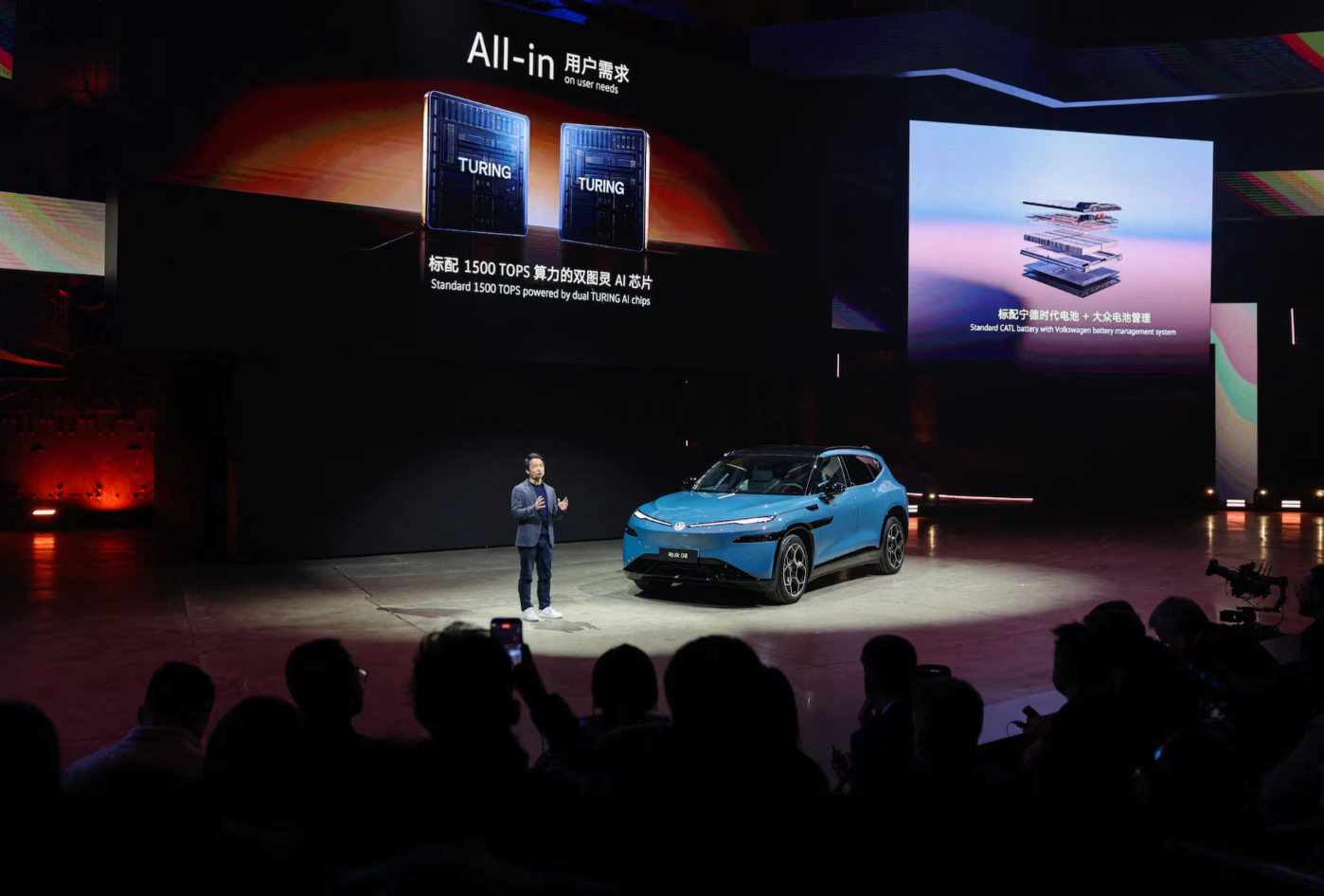
Volkswagen ID. UNYX 08
ID. UNYX 08 also highlights a long-standing problem with Volkswagen’s strategy in China. Volkswagen is aware that the Chinese market is shifting towards higher-tech models and is seeking to partner with local companies to catch up. However, the German automaker has struggled to turn those bets into commercial success.
The Reuters report is based on a review of previously undisclosed company documents and interviews with six people with knowledge of Volkswagen, including current and former executives and advisers. Taken together, VW's ambitions exceed what its products, pricing and sales strategy can achieve.
VW sells the ID. UNYX 08 through a limited sales network that is still in its infancy. This car is also difficult to compete with the newer electric SUVs in the Chinese market with richer software configurations.
VW did not comment on the sales forecast in the document. The company said in a statement that the partnership with Xpeng Motors creates a new electric vehicle architecture that can be used to support locally produced models and accelerate vehicle development. Volkswagen said the project was completed in just 18 months, setting a record. The company also said that the ID. UNYX 08 SUV and the related ID. UNYX 09 sedan are also the result of cooperation between the two parties.
Not cost-effective
The problems with the UNYX 08 begin with the vehicle itself. The car was priced at approximately $34,260 when it was launched. However, similarly priced Chinese rivals offer more advanced features. Xiaomi YU7 is equipped with an advanced sensor system, and JiKr 7X supports fast charging.
According to data from automobile consulting agency ThinkerCar, between April and August this year, Xiaomi YU7 sold nearly 57,000 units, Jikrypton 7X sold more than 21,000 units, while ID. UNYX 08 sold only about 1,300 units.
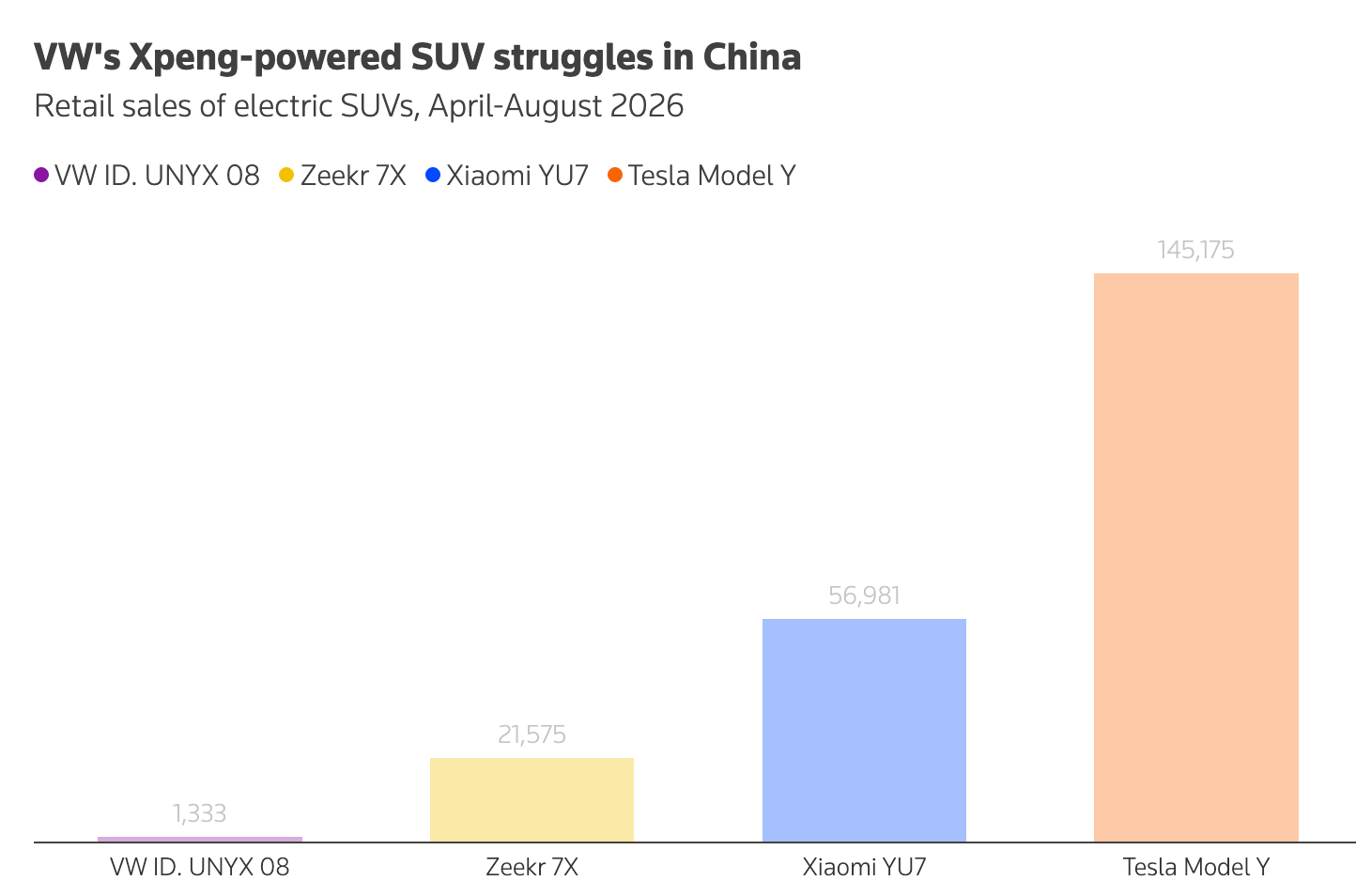
Sales comparison between UNYX 08 and other rival models
"Chinese consumers will ask: Why buy expensive German cars if they can get these technologies at a much lower price?" said Pedro Pacheco, research vice president at Gartner.
Stephen Reitman, an automotive analyst at Bernstein Research, recalled that in April 2024, Volkswagen showed analysts computer renderings of models developed in cooperation with Xpeng Motors. "The next day, we went to the Beijing Auto Show, and basically we could already see this design on the market." Reitman said.
Sales channels are too small
Five people familiar with the matter told Reuters that a risky decision on sales channels further exacerbated the car's difficulties. Volkswagen will sell the UNYX 08 mainly through a new independent dealer network operated by Volkswagen Anhui, rather than through the more than 3,000 dealers operated by Volkswagen and joint venture partners FAW and SAIC. Volkswagen Anhui is a joint venture focusing on electric vehicles.
Two of the people familiar with the matter said that Volkswagen’s sales network in Anhui is much smaller, resulting in many consumers not even knowing that the car exists.
Volkswagen said that sales of Volkswagen Anhui models, including the previously launched ID. UNYX 06 and ID. UNYX 07, are growing. The company said Volkswagen Anhui has expanded its sales outlets to 166 and is cooperating with FAW-Volkswagen to sell related models in some selected dealer stores. Volkswagen said this approach is aimed at reaching more consumers.
For VW, the partnership with Xpeng Motors is the latest in a series of troubled joint ventures, missed opportunities and half-baked initiatives in China that span batteries, autonomous driving, charging infrastructure, software and even flying cars.
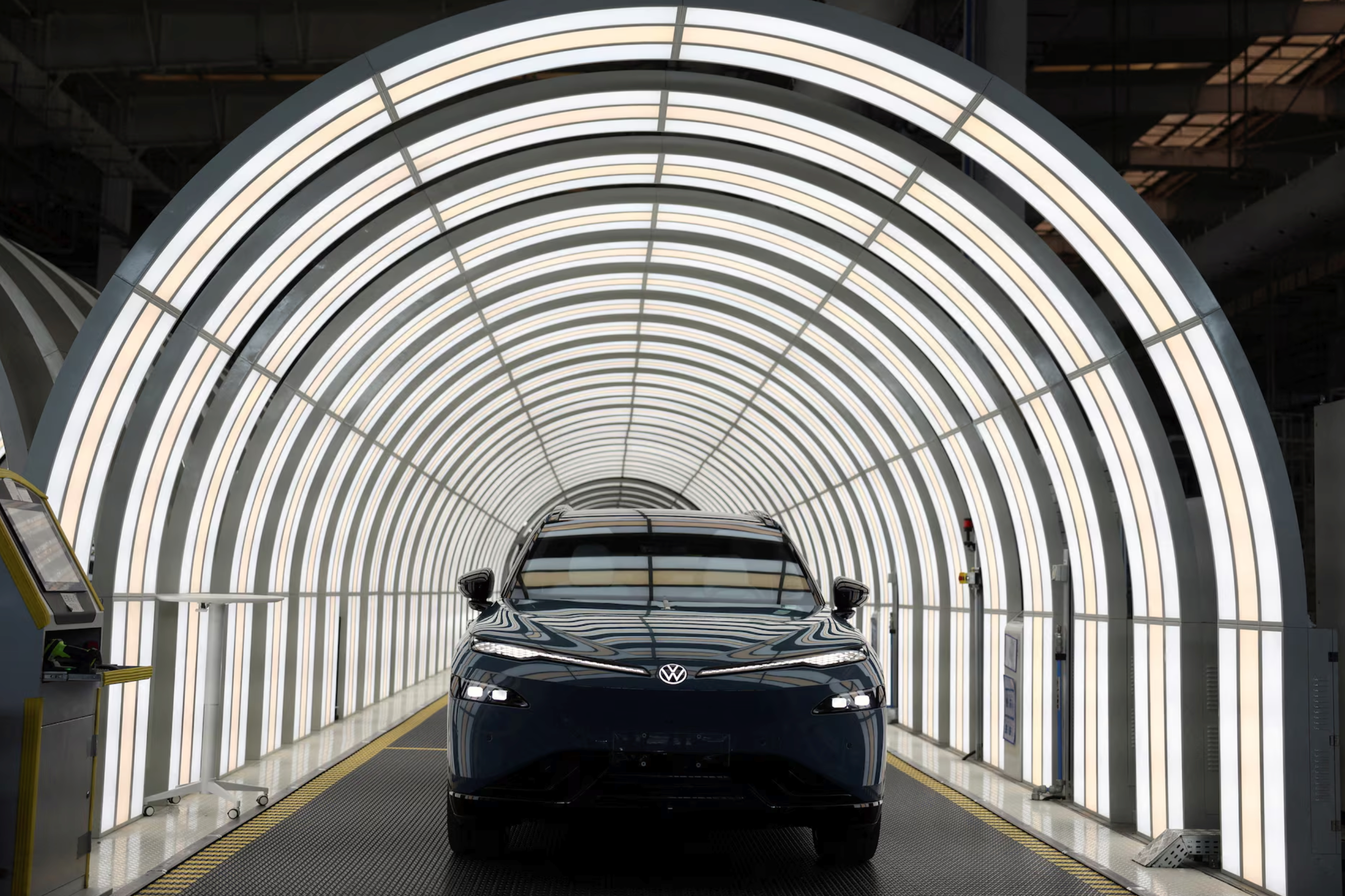
UNYX 08 at Volkswagen Anhui Factory
Stefan Bratzel, founder and director of the Center for Automotive Management, a German research organization, said that Volkswagen "has moved too late to develop the professional capabilities needed today".
This dilemma plagues almost every foreign automaker in China. Lagging behind in software, batteries and vehicle platforms, foreign brands have turned to Chinese partners to stay relevant in the market. However, access to Chinese technologies does not guarantee that they will match the speed, execution or consumer appeal of local competitors.
Chinese auto brands, led by BYD and Geely, have been expanding their market share by launching software-rich models more quickly and often at lower prices, forcing once-dominant rivals such as Volkswagen and Toyota to struggle to maintain their market position.
Radical goals
Despite the poor market response to the ID. UNYX 08, Volkswagen is still setting equally aggressive sales targets for its next model, the ID. The car is expected to hit showrooms this month.
VW predicted in its product planning document earlier this year that average monthly sales of the model would be close to 4,900 units, and annual sales would exceed 90,000 units by 2034.
Two people familiar with VW's planning process said ambitious sales forecasts were crucial to getting new models approved at Wolfsburg headquarters. This mechanism may induce managers to submit overly optimistic forecasts.
Product planning documents show that Volkswagen initially expected sales of ID. UNYX 08 to reach 32,600 units by the end of 2026 and 70,400 units next year. The plans for 2024 also show that Volkswagen had expected annual sales of more than 120,000 vehicles later in the model's product cycle.
But documents show that earlier this year, Volkswagen cut its 2026 forecast by more than 60% to 12,300 vehicles. Still, the company forecast sales of 64,000 vehicles in 2027, about 10% below its original target.
In recent weeks, Volkswagen has been promoting the UNYX 08, and the price is 17% cheaper than when it was first launched in April this year.
"Marriage and Divorce"
The public has long foreseen the disruptive changes in the Chinese market. In 2019, at a presentation to investors and shareholders, Volkswagen China stated that it planned to launch nearly 40 locally produced new energy vehicles by 2025, including pure electric vehicles and plug-in hybrid vehicles, and expected to deliver 1.5 million vehicles in the Chinese market that year.
However, according to company data, Volkswagen's final sales target was less than one-tenth of the original plan. Only 115,500 pure electric vehicles were delivered in the Chinese market last year.
According to information disclosed by three people familiar with the matter, corporate records and public announcements, as China's electric vehicle market accelerates, Volkswagen has begun to explore various cooperation with local Chinese companies, hoping to gain the speed and expertise it lacks.
Two people familiar with Volkswagen's cooperation in China said the company calls this strategy "marriage and divorce": first form alliances with local companies, learn from each other, and then withdraw from cooperation after mastering the required technology and experience.
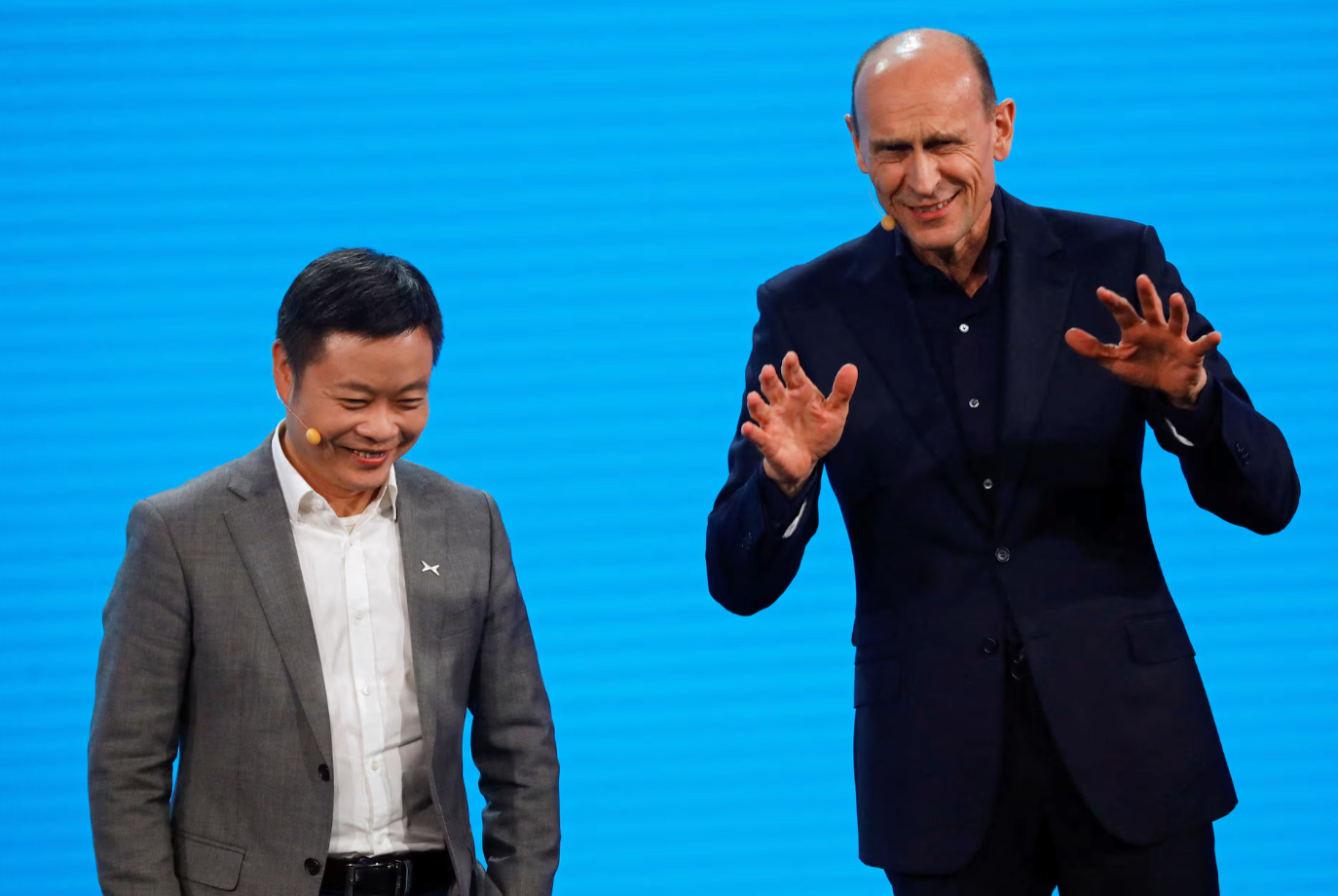
He Xiaopeng and Volkswagen China CEO Bai Ruide
Two people familiar with the matter revealed that around the time Ralf Brandstätter became CEO of Volkswagen China in August 2022, Volkswagen had explored cooperation with BYD, China's largest electric vehicle manufacturer, including considering letting the Jetta brand use BYD's Dolphin platform.
During due diligence, VW employees tasked with reviewing BYD's financials were surprised by BYD's lower manufacturing costs, one of the people said.
However, two people familiar with the matter said BYD has no willingness to cooperate. Reuters was unable to find out why the parties failed to reach a deal.
In addition, in the same year, Volkswagen also explored cooperation with Leapmotor. Eventually, Stratis reached a partnership agreement with Leap Motors later that year.
Volkswagen’s statement did not mention negotiations with BYD and Leapmotor. BYD did not comment, and Leapmotor did not respond to relevant questions.
Some cooperation that has been implemented has not only failed to solve old problems, but has created new ones. Reuters reported in July that Volkswagen's canceled flying car project was involved in a legal dispute with its Chinese partner.
Volkswagen’s joint venture with Chinese startup Dupu New Energy to build fast-charging stations also went awry. The collaboration, which began in 2020, ended in shareholder disputes, lawsuits and supplier complaints about unpaid payments, company documents show. In 2024, Dupu New Energy sued Volkswagen China and the executives and directors of the joint venture, accusing them of harming the company's commercial interests.
Volkswagen told Reuters that China's Supreme People's Court dismissed Dupu New Energy's lawsuit in March. Neither Dupu New Energy nor the court responded to requests for comment.
The next Nokia?
In 2019, one out of every five passenger cars sold in China was a Volkswagen. According to the China Passenger Car Association, Volkswagen's share of the Chinese market has dropped to 10% in the first eight months of this year.
What makes Volkswagen's plight unique is its deep dependence on the Chinese market and the difficulty of executing a decisive transformation in a market now dominated by Chinese companies. That makes its bet on Xpeng Motors crucial.
One former VW figure likened the situation to that faced by Nokia, Kodak and BlackBerry: VW management believes its brand can endure even as the market shifts to Chinese rivals with more advanced technology and shorter innovation cycles.
Bill Russo, founder of Shanghai consulting firm Automobility, believes that this comparison is warning, but it cannot be used to conclude that Volkswagen has no hope of recovery. He said there is still a chance for the public to recover.
But the risk, he added, is that "the market is changing faster than companies can reinvent themselves."
Comments