
Abstract:
The "little blue light" for L2 level smart driving has been officially banned. On October 20, the First Department of Equipment Industry of the Ministry of Industry and Information Technology issued the "Installation Requirements for External Lighting and Light Signaling Devices on Cars and Trailers (Draft for Comment)". It is clarified that vehicles that do not have L3 and above autonomous driving systems are prohibited from installing ADS sign lights. At the same time, the special light color requirement for ADS sign lights is blue-green. Previously, L2 level assisted driving signal lights were mostly blue.
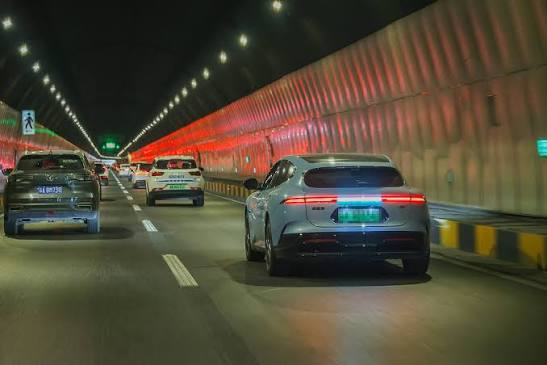
According to the above-mentioned "Draft for Comments", when level 3 and above autonomous driving functions are activated, all ADS sign lights should automatically light up at the same time and remain lit when the autonomous driving system is activated. It is prohibited to light up when the vehicle's driving automation system is in L2 and below autonomous driving functions. When the autonomous driving system is disengaged, all ADS indicator lights should automatically turn off at the same time. It is prohibited to manually turn on or off the ADS logo light.
At the same time, vehicles equipped with L3 and above autonomous driving systems that comply with GB 44721 regulations are equipped with optional front ADS logo lights, rear ADS logo lights and side ADS logo lights; for trailers used with L3 and above automated driving tractors, rear ADS logo lights and side ADS logo lights are optional.
In July this year, many car companies have successively received news of banning the "little blue light" for L2-level assisted driving. Subsequently, the China Automotive Standardization Institute officially issued an announcement stating that some vehicle products are equipped with "small blue lights" to indicate to other road participants that the vehicle's driving assistance system is in working condition. However, the current "little blue lights" are prone to misuse of light, which can easily lead to safety risks. The "little blue light" that is turned on at night can easily cause glare and dazzling appearance to other road participants, especially interfering with surrounding drivers' judgment of road conditions. Vehicles with this indicator light are more likely to be blocked by other car owners and followed at close range, increasing the risk of road traffic.
The announcement also stated that the National Automotive Standardization Technical Committee is developing and revising relevant standards under the guidance of the competent authorities, and is also cooperating with work related to strengthening the review and testing verification management of "radical" product innovation designs, further standardizing the installation and use of vehicle lamps, and improving the safety performance of automotive products.
An automotive expert told China Business News that referring to European regulations, only L3 and above self-driving vehicles are equipped with smart driving warning lights. For L2 and below assisted driving systems (DCAS), the installation of exterior warning lights for external communication is not authorized. Based on the above factors, he believes that it is necessary to disable the L2 small blue light.
In addition to banning ADS sign lights of L2 level and below, the new standard also stipulates the projection of text and emoticons on lamps. The "Draft for Comments" mentions that, except for the light-emitting unit of the illuminated logo, each lamp should not use a translucent surface or projection to display any text. At the same time, the luminous pattern formed after the light-transmitting surface of the lamp or the light source is lit should not constitute or combine human faces, animal faces or other anthropomorphic graphics with expressive meanings.
In addition, the new standard intends to prohibit turning off lamps through gestures and voice. When using voice-activated lights, vehicles should provide instructions to clearly indicate the location of the manual switch.
The above preparation instructions mentioned that it is recommended that the new standard be implemented from January 1, 2028. For new models applying for type approval and models that have received type approval, regarding specific provisions such as headlight dimming devices, the standard sets a gradual transition period of up to 49 months to ensure that companies have sufficient time to carry out technology iterations and product switching.
In addition, according to the preparation instructions of the "Draft for Comments", a number of vehicle companies, lighting companies, and testing and certification agencies participated in the preliminary research of the new standards, including Yinwang Intelligent Technology Co., Ltd., BYD Automobile Industry Co., Ltd., SAIC Volkswagen Co., Ltd., etc. The vehicle manufacturer is mainly responsible for formulating technical requirements such as mandatory/optional configuration, quantity, installation location, and lighting logic of lamps on the vehicle, as well as providing confirmation and verification test samples. Parts (lamps, light source) companies are mainly responsible for the formulation of basic parameters of lamps (such as single lamp, luminous surface, light-transmitting surface), optical characteristics, combination logic, luminous logo, display interaction and other related technical content, as well as the provision of confirmation and verification test samples.
Comments