
Abstract:
Tesla Austin Robotaxi driverless taxi operating hours have been slightly relaxed, and the closing time has been postponed from 22:00 to 23:00, but it is still unable to achieve the goal of overnight operation. The reason for this is that there are still flaws. Musk admitted frankly on social platforms:
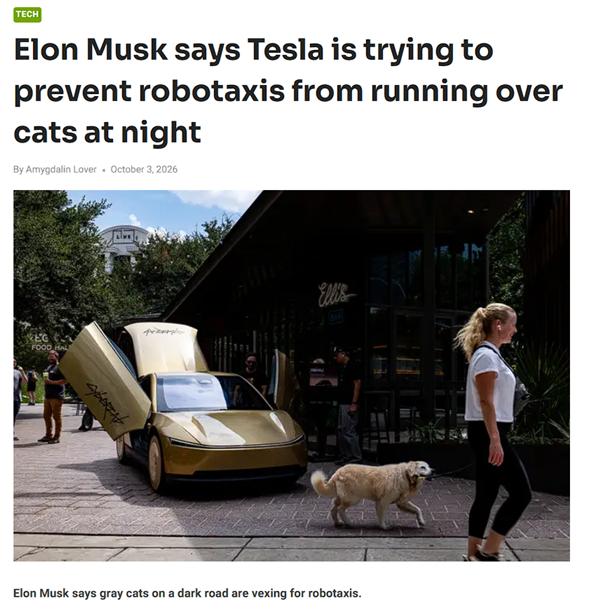
It is difficult to recognize small animals (gray kittens) that are similar to the color of the road at night, which is the biggest obstacle to Robotaxi's inability to operate all night
.
Musk said that the team's current main safety issue is to prevent vehicles from running over pets in dark light environments. The most difficult scene is "a gray kitten lying on the gray asphalt road at night. The two colors are so close that it is difficult for a pure visual system to distinguish."
Tesla’s self-driving taxi uses a purely visual solution, relying entirely on cameras to collect images. It is not equipped with lidar. The camera imaging is highly dependent on the contrast between light and objects. On poorly illuminated roads, the gray kitten almost blends into the road surface, making it difficult for AI to identify this small obstacle.
In response to this problem, Musk proposed relying on AI photon counting algorithms to improve dark light recognition capabilities. However, this capability is currently only the theoretical upper limit of the software and has not yet been implemented in real vehicles.
This incident has once again triggered a debate on the autonomous driving route. Those who support the lidar solution believe that lidar is not affected by color contrast and is easier to identify such low-contrast objects, which is a safe guarantee.
In addition, Tesla Robotaxi is also facing regulatory pressure.
The U.S. National Highway Traffic Safety Administration (NHTSA) is currently investigating 3.2 million Tesla vehicles, focusing on verifying accidents related to the FSD system in low-visibility scenarios
.
Comments