
Abstract:
Google is starting to experiment with Flatpak packaging support for Chrome/Chromium on the Linux platform. If this change is finally implemented, it will provide a new official installation option in addition to the existing RPM and DEB native installation packages, and is expected to improve the long-term lack of official Flatpak support for Chromium-based applications.
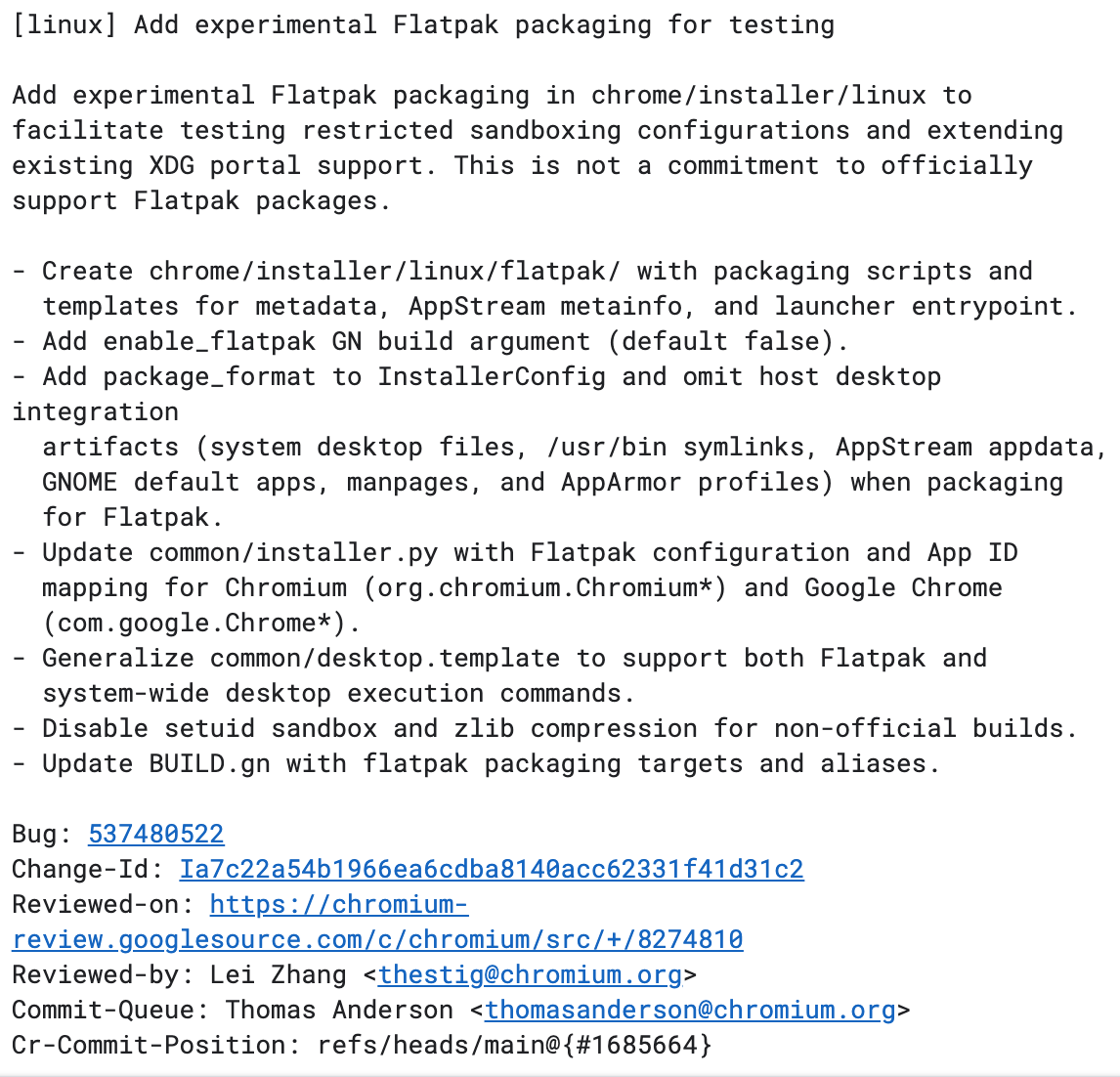
Currently, Linux users can already install Chrome through Flatpak, but the relevant version is maintained by the Flathub community and is not officially released by Google. Chrome developer Tom Anderson emphasized that this work does not yet mean that Google has committed to officially supporting the Flatpak software package; its main purpose is to internally test "restricted sandbox configurations" and expand existing XDG Portal support capabilities.
Among the mainstream browsers, Mozilla Firefox is currently one of the few products that provides a mature and official Flatpak version. GNOME Web, KDE Falkon, Opera GX, and Zen Browser, a Firefox branch with an Arc-like design style, are also available through Flatpak. In contrast, Chromium-based browsers such as Microsoft Edge and Vivaldi have not yet launched officially maintained Flatpak versions. Although Brave provides a Flatpak installation method, the company does not recommend it because its performance is still not as good as the native software package.
Chromium browsers have not generally adopted official Flatpak packaging. The key obstacle lies in the compatibility of the sandbox mechanism. To prevent malicious websites from breaking through tab isolation and accessing user systems, the Chromium browser itself has a built-in sandbox system that limits the operations that each tab and process can perform.
Flatpak itself also adopts a sandbox design. When two layers of sandboxes are nested, compatibility issues often occur. To get around this limitation, community maintainers often resort to Zypak. This is a compatibility layer widely seen in Chromium and Electron applications on Flathub. It intercepts system calls and makes Chromium mistakenly think that its native sandbox is still enabled normally, allowing the application to run in the Flatpak environment.
At the same time, browser support for new generation image formats is also advancing. Mozilla is planning to add JPEG XL support to Firefox. The format is competitive in terms of lossy images, lossless graphics, animation display, compression efficiency and encoding speed: its image performance is better than traditional JPEG, lossless graphics rendering effect is better than PNG, animation capabilities are better than GIF, and it is ahead of AVIF in terms of original compression efficiency and encoding speed.
Currently, browser support for JPEG XL is still limited, with Safari being the only major browser that provides official support by default. Firefox is expected to add support for this format in Firefox 157, released next month.
Learn more:
https://chromium-review.googlesource.com/c/chromium/src/+/8274810
Comments