
Abstract:
In the past two days, I believe everyone has been blown away by GPT-6 Astra's various incredible gameplay-complete 3D modeling in one sentence, create a complete game from scratch, dismantle thousands of parts at a glance, and even use it to control robots... In short, it is incredibly powerful. Netizens have an exaggerated saying: As long as you learn slowly, you don’t have to learn. But GPT-6 Astra does give people a feeling that as soon as it comes out, the complexity that originally plagued many fields will suddenly appear to be solved.
This trend should not be underestimated, but the current capabilities of the model should not be over exaggerated. In this article, we will take stock of GPT-6 Astra’s various incredible gameplay and its current limitations.
3D modeling,
Is it suddenly becoming easier?
Astra’s most intensive screen-swiping capability in the past two days is probably 3D.
Someone used it to directly generate 3D trains:
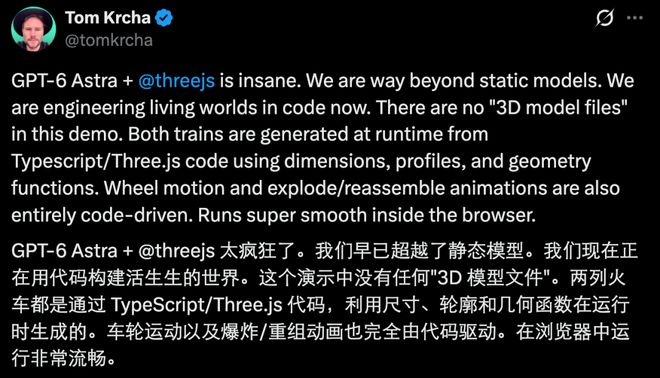

Both trains are generated directly by Astra using TypeScript and Three.js code when running in the browser. The body size, outline, and various geometric structures come from the size parameters, profile, and geometry function in the code; the wheel movement is the code, and the animation of the entire train exploding, parts falling apart, and reassembling is also all code.
Moreover, these models can be disassembled into parts after they are made. A camera can be disassembled into 122 component groups and 1877 individually modeled parts. The entire task took about 3 hours to run. The author said that he had never realized that Three.js (a JavaScript library used to create and display 3D graphics in the browser) could be used like this.

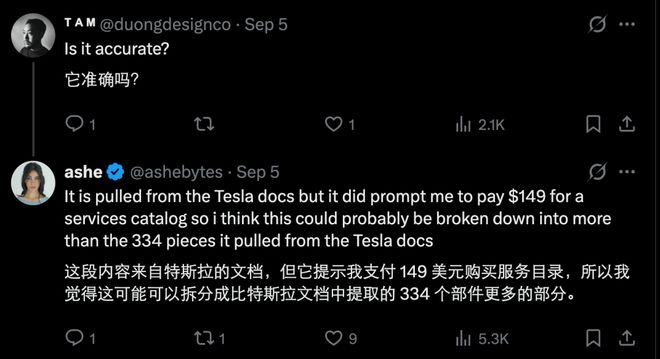
The camera can be dismantled, and so can the Tesla. Someone disassembled it into 334 modeling parts, and the names, numbers, and basic structures of these 334 parts are official and not fabricated by AI. Of course, it's just a very rough frame-level teardown, nowhere near the level of detail required for a 3D teardown.

Interestingly, this author was not satisfied after dismantling Tesla, and even built a website to "dismantle a man (male)": the 2234 modeling parts of the whole body can be viewed one by one, and can be mapped to the source files.

Seeing these cases, some people shouted, "The sky is falling for 3D modeling students."
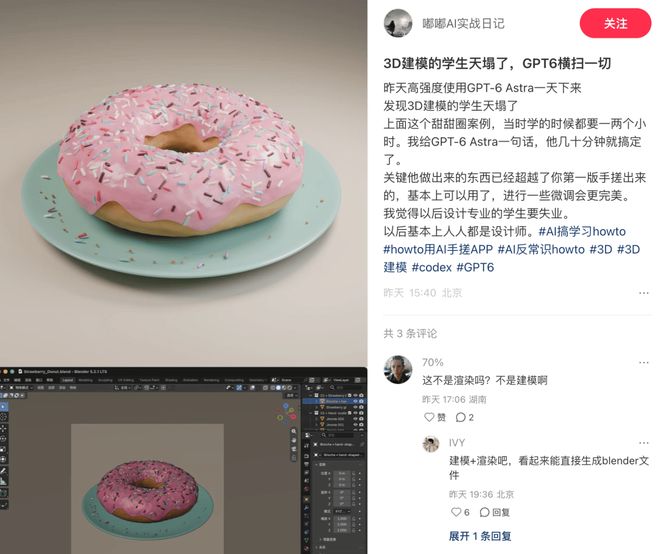
But some people say that the current direct results of AI are not yet commercially available.

Moreover, stability is also a big problem. After all, it still needs people to fix bugs.

The significance of these demos is not just to prove that Astra can model. More importantly, it demonstrates a new way of interaction: people no longer need to learn complex 3D software, but directly describe the world they want, and let AI be responsible for translating ideas into spatial structures.
In the past, 3D modeling was the threshold to enter the digital world; in the future, it may become a basic ability for AI to understand and generate the real world. Of course, there is still a long way to go before truly industrial-grade applications, but the path is becoming increasingly clear.
No need to learn software?
Astra, go in yourself
In OpenAI’s official positioning, computer use and browser use are GPT-6 Astra’s trump card capabilities. In a Canva painting example, we see this in action.
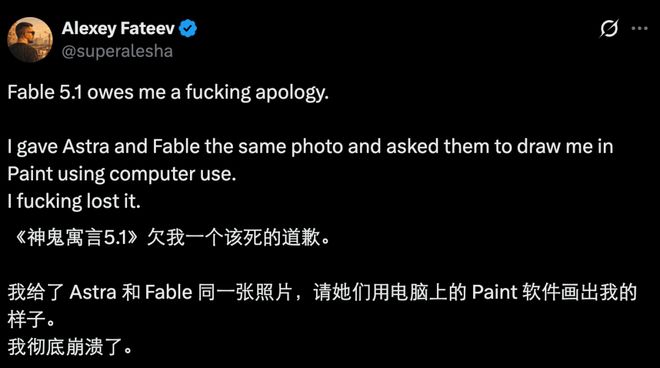
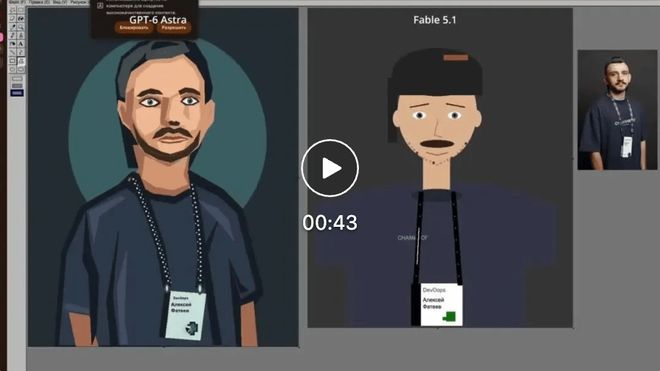
In this case, the netizen asked Astra to draw him in Canva (replicating the portrait from a reference photo). During the drawing process, Astra can directly control the Canva interface in the browser: select tools, precise click/drag, draw layer by layer (from background to body, arms, to facial details), and finally complete a highly similar pixel-style semi-realistic portrait.

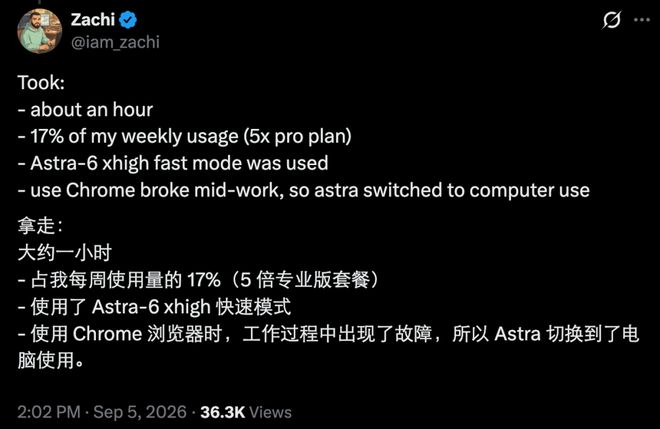
This also involves long-term multi-step operations (author feedback is about 1 hour), tool switching (Chrome switches to computer use mode after a problem occurs midway), as well as extremely high interface understanding and fine control accuracy.

Fable 5.1 next door also got the same prompt, but the result disappointed netizens:

He is not the only one doing this experiment. Another netizen also took the same photo and asked two AIs to draw it, and the results were similar: Astra is more realistic, Fable 5.1 is more free and easy...
Video link: https://mp.weixin.qq.com/s/6tOR2GptUa97ffW-jWJF2Q
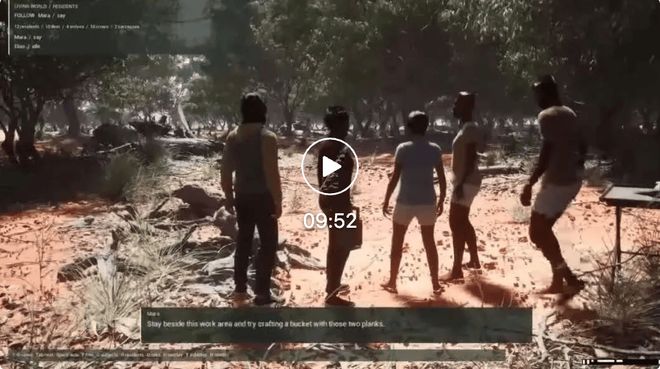
However, some netizens pointed out that the final visual effects of these things are not the focus. What is important is that Agents supported by Astra can already operate Blender, Unreal Engine, and browsers by themselves, and directly turn prompts into project files.
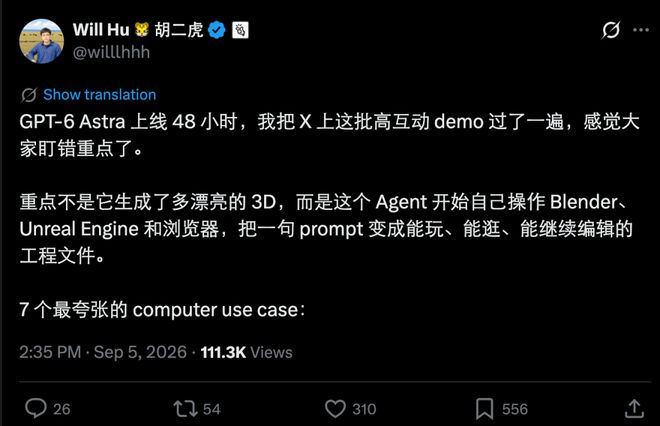

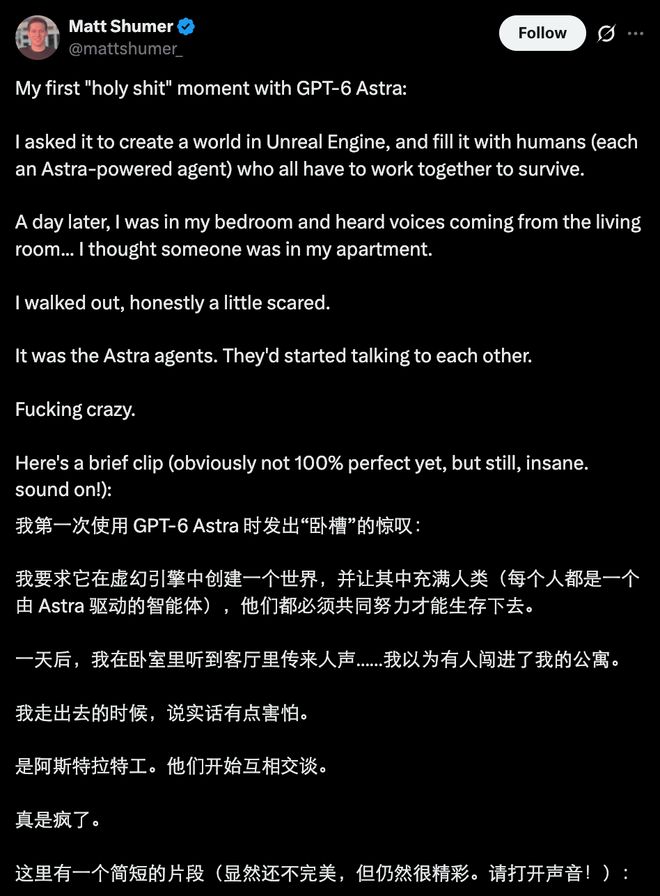
In the past few days, "Astra uses Blender to rebuild the San Francisco Palace of Fine Arts", "An old steam train drawing turned into 3295 editable objects in Blender" and "600 Astra Agents living in the same Unreal world" are all typical cases in this direction.
Video link: https://mp.weixin.qq.com/s/6tOR2GptUa97ffW-jWJF2Q
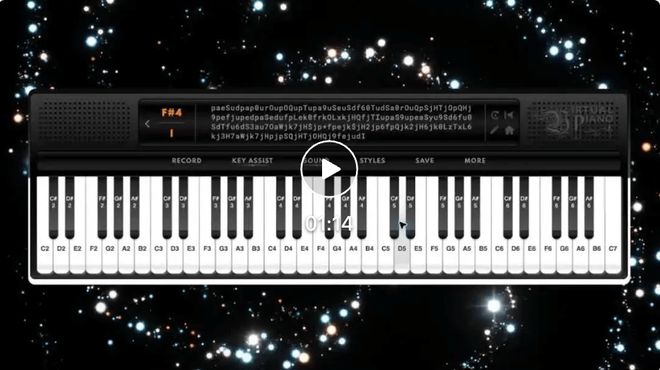
Another interesting case is "playing the piano". OpenAI employee Victor E. Nunez asked Astra to find an online piano and play "River Flows in You" using Computer Use. During the execution process, Astra searched and opened an online virtual piano website by itself, and then used Computer Use to directly control the computer interface: click the mouse as the "right hand" and click on the piano keys. Keyboard control is treated as "left hand + quick paragraph". The two performed at the same time, accurately controlling the rhythm and note duration, and completely performed the song "River Flows in You".
Video link: https://mp.weixin.qq.com/s/6tOR2GptUa97ffW-jWJF2Q
What’s more interesting is that Astra recorded the screen itself and edited this demonstration video. The whole process is end-to-end: from understanding the task → finding the website → loading the instrument → playing in real time, without manual intervention in the intermediate steps.
These cases show that GPT-6 Astra has reached a new height in agentic computer use, with speed, accuracy, multi-tool parallelism and real-time feedback capabilities all reaching a very high level.
Perhaps, in the future, people can stop thinking about how to re-create the capabilities of a certain professional software into AI functions and just hand over the software to AI. Being able to operate any software designed for humans greatly expands the application scenarios of AI.
Outside the screen,
Astra begins to control the robot
No matter how outrageous the previous demos were, they essentially all took place on the computer.
The test done by netizen Jay Chooi was different: they actually connected Astra to the robotic arm.

One of the tasks is to have the robotic arm put blocks into a bowl. GPT-6 Astra was done 20 times, and the success rate reached 95%; the control Fable 5.1 was 40%. At the same time, its output token number is only about 16% of the latter, and its cost is only about 43% of the latter.
More importantly, there is no demonstration or fine-tuning of Astra for this task. Jay Chooi later specifically added that this was a zero-shot test. The model is responsible for giving the position and attitude of the end effector of the robotic arm, and then converting it into robotic arm motion through the automatic inverse kinematics solver.
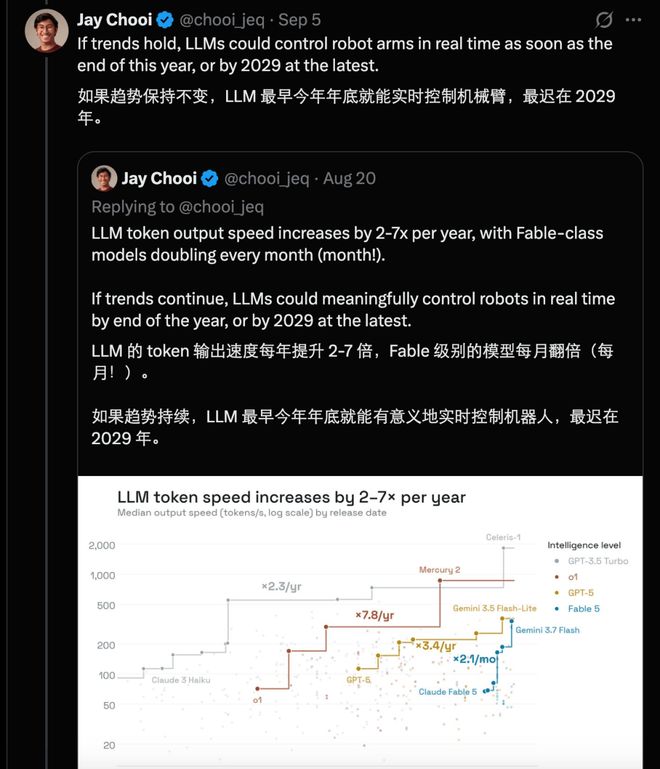
As the output speed of large model tokens accelerates, Jay Chooi optimistically predicts that LLM will be able to control the robotic arm in real time as early as the end of this year, and as late as 2029.
Yu Xiang, a former research scientist at NVIDIA, further pointed out that the next frontier of robotics may be how to truly use advanced AI models for control. Merely using them as agents to invoke perception and planning modules is not enough. We need new ways to connect these models to the physical world.

Such results also make people curious. What did OpenAI add in post-training to make the model so versatile? Or is there a breakthrough in pre-training?

Still studying?
After reading this, some people lamented that AI is no longer satisfied with generating a picture, but has begun to try to "reconstruct the world."

A question naturally arises: when AI can model, write code, operate software, and even begin to touch the physical world, how many of the skills we have learned so hard today will still exist in their current form?

There is certainly no answer to this question now. There are still a lot of things about Astra that are unstable, rough, or even unusable at all, but what is really unsettling and exciting these two days may be exactly this: for the first time, many complex operations that must be mastered by humans by default have become possible to be packaged as a whole for AI.
As for "should I still learn it in the future?", the answer is definitely that I still have to learn it. It’s just that we may have to rethink what is worth learning.
Comments