
Abstract:
OpenAI announced a series of new products and features for developers, enterprises and high-intensity users at the DevDay 2026 developer conference held on September 29. One of the most watched changes was the launch of the ChatGPT Pro 500 package priced at US$500 per month. At the same time, the original usage quota of the Pro 200 package of US$200 per month will be reduced. OpenAI has also made large-scale upgrades to the Codex, Agents API and API platform.
The new Pro 500 package is priced at US$500 per month, which is equivalent to US$6,000 per year. It is currently the highest-priced ChatGPT package provided by OpenAI for individual users. The core selling point of this package is not to simply increase the number of messages, but to provide high-speed computing capabilities called "Ultrafast", especially for tasks that require a large amount of computing resources such as GPT-6 Astra, Codex, and ChatGPT Work.
OpenAI stated that Ultrafast mode can significantly improve the model generation speed, which can reach up to about 8 times the normal speed in Codex and other scenarios. For professional users with long-running code generation, debugging, and agent tasks, this means the time spent waiting for model output can be significantly reduced. However, high-speed computing also means higher computing costs, so this capability is currently mainly put into the $500 high-end package.
At the same time, OpenAI did not simply retain the original Pro 200 package. The company announced that starting from October 30, the Work and Codex usage quota obtained by Pro 200 users will be reduced by half. Users who have previously subscribed to Pro 200 can continue to use their original quota during the transition period, and OpenAI will also provide one-time quota compensation to existing users affected by the adjustment.
OpenAI stated that this adjustment does not mean that the Pro 200 package will be cancelled, but that the computing resources between different subscription levels will be re-divided. Pro 500 will be aimed at professional users who require large amounts of computing resources and the highest operating speed, while Pro 200 will continue to provide higher usage quotas, but will no longer enjoy the same scale of computing resources as before.
In addition to ChatGPT subscription business, API is also the focus of this DevDay. OpenAI has launched a new Decisions API, mainly used to handle a large number of repetitive business decision-making tasks. This interface does not allow the model to generate long answers, but allows the model to select results from multiple preset options, so it is more suitable for scenarios such as classification, routing, and automated decision-making.
The Decisions API uses GPT-6 Luna as the base model. OpenAI stated that this interface is optimized for low-latency scenarios and can complete a judgment faster than the traditional Luna API. Therefore, it is suitable for embedding into enterprise workflows, allowing AI to automatically decide which system, which model or which processing process a request should be handed over.
For example, companies can use the Decisions API to determine whether a customer email should go to the refund department, technical support department, or sales team, or let it decide whether a request needs to call a more powerful AI model. Since the output range can be pre-defined, this approach can reduce the uncertainty caused by open-ended generation.
OpenAI also upgraded the Agents API. The new Agents API adds the Computer Use capability, allowing AI agents to directly operate the computer interface instead of just calling traditional APIs. At the same time, OpenAI has added functions such as multi-agent collaboration, tool search, and context compression, allowing developers to build more complex long-running agents.
Computer Use is of particular interest because it allows AI to complete tasks in a manner similar to how humans operate computers. After combining the multi-agent function, a complex task can be split into multiple different agents for execution, and then coordinated by the main agent.
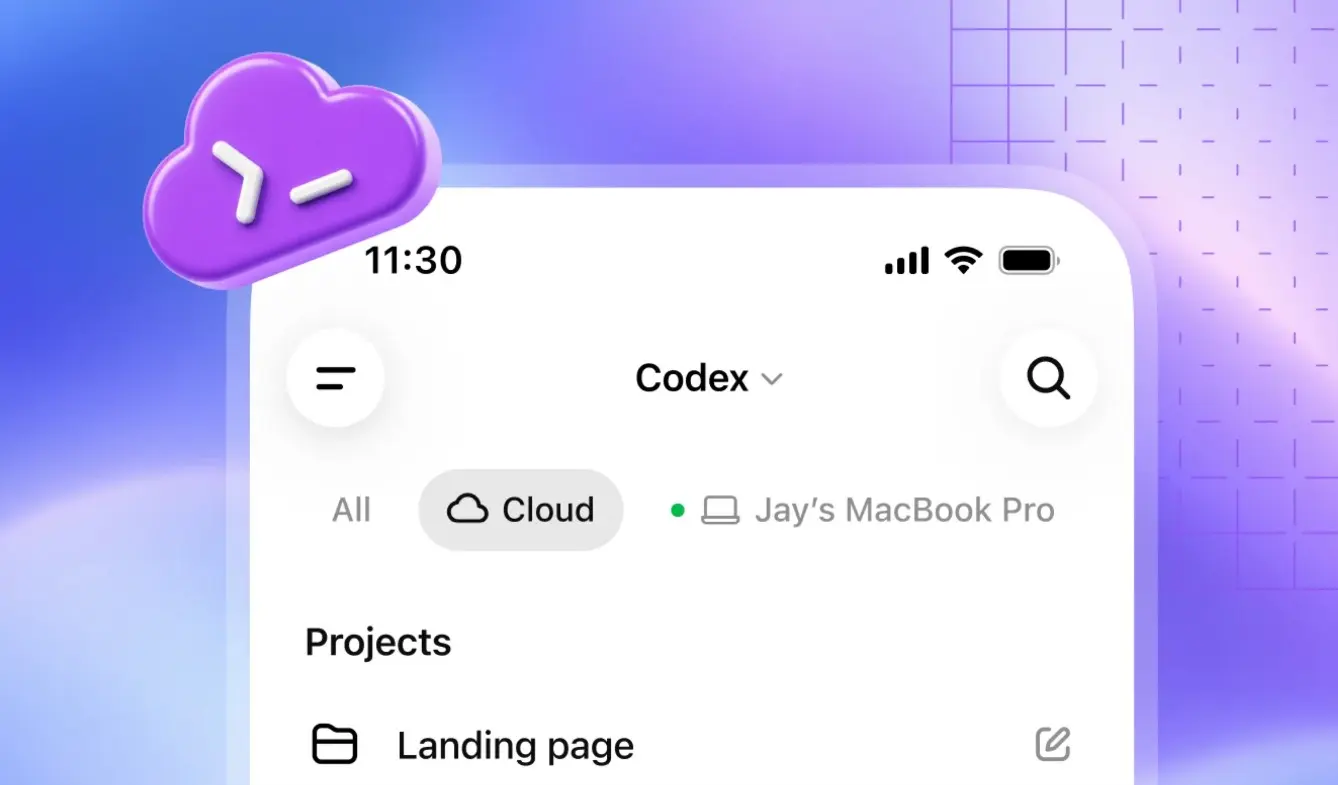
Codex has also received a series of major upgrades. OpenAI now allows Codex to run in the cloud and provide a reusable development environment. This means that the development team can create a configured development environment that can be used repeatedly by different members or different agents without having to configure dependencies and tools from scratch each time.
The Codex CLI has also added a voice control function, and developers can directly describe tasks to Codex through voice. At the same time, the new Agents view can help users track multiple running coding tasks at the same time, allowing Codex to gradually transform from a programming assistant that only handles one task at a time into a coding agent that can manage multiple workflows at the same time.
OpenAI also launched Codex Security Cloud. This function can scan the entire GitHub code repository, look for potential security vulnerabilities, and prepare fixes based on the problems found. It can scan on user request or run automatically on a schedule. OpenAI also provides its Daybreak Blue defense model for use in relevant security workflows.
For development teams, this means that the purpose of Codex is expanding from "helping to write code" to code review, security detection, bug fixing and ongoing maintenance of the entire software project. AI is no longer just a matter of developers inputting a piece of code and giving suggestions, but can directly carry out long-term work around the complete code warehouse.
OpenAI also announced that it will further integrate Codex with existing enterprise software environments. Amazon Bedrock Managed Agents on AWS will support the core functionality of the Agents API, allowing enterprises to run OpenAI agents in Amazon cloud environments without having to migrate entire workflows to OpenAI's own infrastructure.
This DevDay also announced a number of new features for enterprise collaboration, including ChatGPT Work, shared workspaces, and continuously updated documents and pages. OpenAI hopes to use these features to further transform ChatGPT from a traditional personal AI assistant into a team work platform.
At the same time, Dots launched by OpenAI this time is also an important product of DevDay. Dots are powered by GPT-6 Astra and can run continuously and perform tasks autonomously. Each Dot has its own computer and browser, and can connect to more than 4,000 services in the OpenAI ecosystem. Unlike ordinary ChatGPT, which must wait for the user's next command, Dots can continue to work around a long-term goal.
These products collectively reflect that OpenAI is changing the product positioning of ChatGPT and Codex. In the past, AI was mainly responsible for answering questions, generating text and writing code. Now OpenAI is trying to let AI directly enter the software workflow, with the ability to operate browsers, computers, code warehouses and enterprise applications.
At the same time, OpenAI continues to expand the product line of the GPT-6 series. On DevDay, the company released GPT-6.1 Sol. This model is mainly optimized for agent programming, computer operation, and long-term professional workflow. In some tests, it has been close to the flagship GPT-6 Astra, but the standard API price is about one-fifth of Astra.
From the overall layout, OpenAI’s DevDay does not simply release a new model, but also promotes product upgrades from multiple directions such as subscription, API, agents, programming tools, and enterprise collaboration. The $500 Pro 500 is responsible for satisfying professional users who require the highest computing speed, GPT-6.1 Sol is responsible for more cost-effective high-intensity work, Dots and Agents API further expand the autonomous execution capabilities of AI, and Codex is gradually developing from a programming assistant to an agent platform capable of long-term maintenance of software projects.
As these functions are gradually opened, OpenAI's product focus is clearly shifting from "smarter chatbots" to "AI systems that can continue to complete work for users."
Comments