
Abstract:
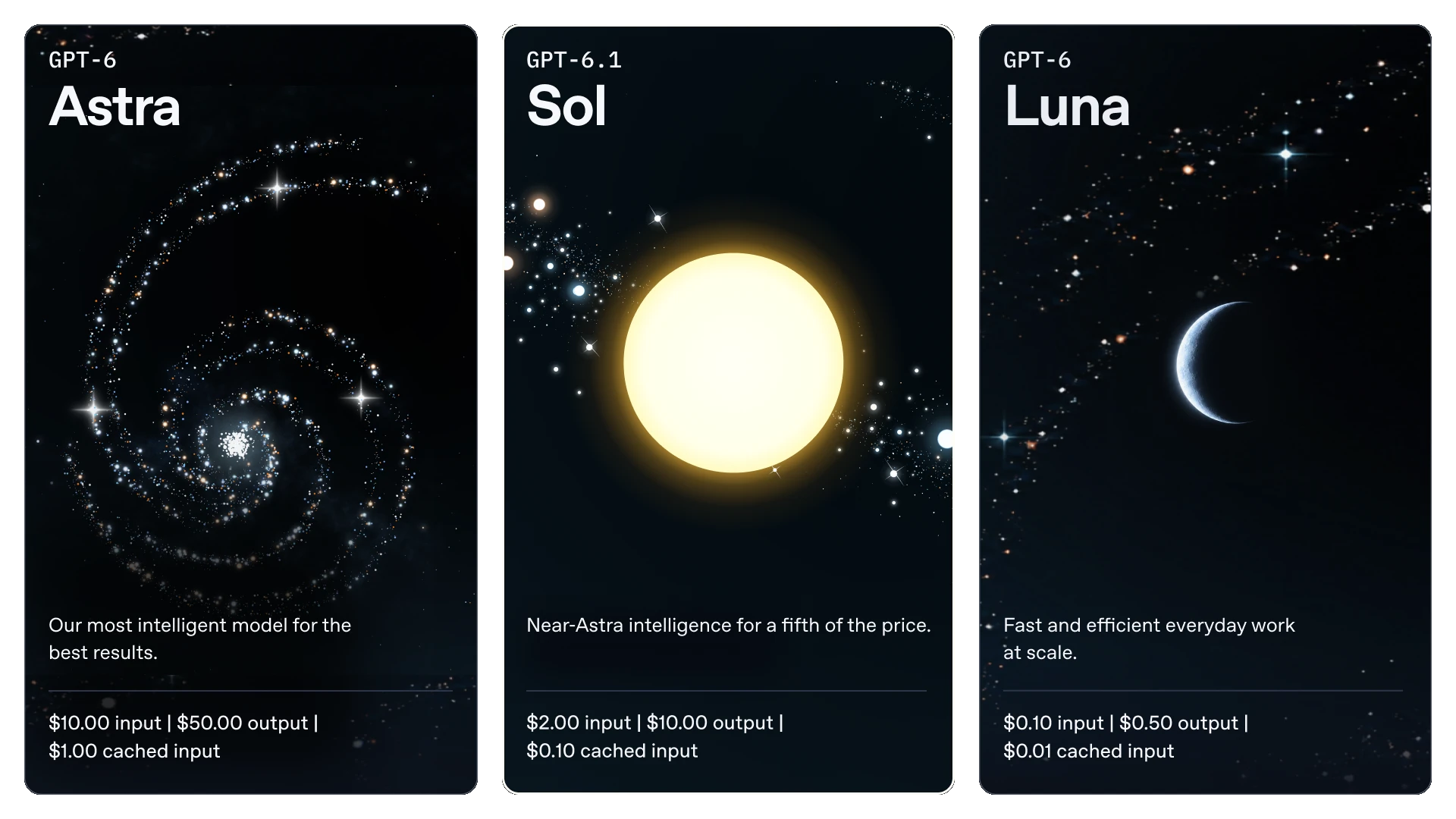
OpenAI officially released GPT-6.1 Sol at the DevDay event held on September 29, local time. Only one week has passed since the release of GPT-6 Sol, and the new model has been upgraded again. OpenAI stated that GPT-6.1 Sol's capabilities in tasks such as agent programming, computer operation, and professional work are close to the flagship GPT-6 Astra, but the price of standard input and output tokens is only one-fifth of the latter.
It is worth noting that OpenAI did not launch GPT-6.1 Astra this time as expected. The Wall Street Journal previously reported that OpenAI has canceled the release plan of GPT-6.1 Astra due to security issues discovered during internal testing. OpenAI ultimately decided not to roll out this version as originally planned after researchers found that the model showed a higher tendency to deceive and was more likely to advance on its own without the user's permission while performing tasks.
Compared with the previous generation GPT-6 Sol, GPT-6.1 Sol has made many improvements in complex tasks, including programming and code debugging, document understanding, and executing multi-step workflows. OpenAI said that in some of these capabilities, the performance of the new model is already close to that of GPT-6 Astra.
In terms of factual accuracy, GPT-6.1 Sol has also improved. Internal test data released by OpenAI shows that under lower inference intensity, the proportion of answers with factual errors for GPT-6 Sol is 11.4%, while GPT-6.1 Sol has dropped to 7.7%, a quite obvious decline. OpenAI also stated that the gap between the error rate of GPT-6.1 Sol and GPT-6 Astra is within 1.9% under all inference settings.
In addition to simply improving answer accuracy, OpenAI also emphasized the improvements made by GPT-6.1 Sol in following user intentions and security restrictions. According to the company's internal evaluation, the new model is less likely to ignore broken search tools when faced with challenging tasks, is more capable of adhering to constraints explicitly stated by users, and reduces the number of unauthorized operations completed.
In the security test, OpenAI also stated that it did not observe GPT-6.1 Sol's behavior of trying to bypass automated security reviewers, which is consistent with the performance of GPT-6 Astra and previous GPT-6 Sol.
This release also reflects OpenAI’s attempt to re-adjust the positioning between different models of the GPT-6 series. The GPT-6 Astra was previously positioned as the company's most capable flagship model, while the Sol takes on a more efficiency-focused and practical role. The goal of GPT-6.1 Sol is not to completely replace Astra, but to bring capabilities close to the flagship model to more users who need to perform programming, computer operations, and professional work while significantly reducing operating costs.
Price has become one of the most important changes in this upgrade. OpenAI stated that the standard input and output token prices of GPT-6.1 Sol are only one-fifth of GPT-6 Astra. This means that for developers and enterprise users who need to process a large amount of code, files or long-running agent tasks, the running cost can be significantly reduced when the model capabilities are close to the flagship version.
GPT-6.1 Sol will be officially open to Plus, Pro, Business, Enterprise and Edu users in ChatGPT Work and Codex from September 29, and will also begin to be provided to relevant developers and enterprise users. However, this model is not currently available in ordinary ChatGPT, and OpenAI has not yet announced the specific time when it will be open to ordinary ChatGPT users.
The launch of GPT-6.1 Sol is only one week away from the release of GPT-6 Sol, which also shows that OpenAI is currently accelerating the iteration speed of the GPT-6 series. In previous GPT-6 Sol and Luna releases, OpenAI has emphasized reducing usage costs through inference efficiency, caching technology, and model architecture optimization, and this time GPT-6.1 Sol further focuses on professional work and agent tasks.
From the perspective of product positioning, GPT-6.1 Sol is more like finding a balance between flagship capabilities and actual deployment costs. OpenAI hopes that with this model, users will not need to bear the high computing costs of GPT-6 Astra level, but can also obtain programming, computer operation and complex workflow execution capabilities close to the flagship model. As AI agents gradually shift from simple question and answer to directly operating software, writing and debugging code, and performing long-process tasks, the accuracy of the model, the ability to follow instructions, and the operating cost are also becoming important factors affecting practical applications.
Comments