
Abstract:
OpenAI’s next-generation flagship model GPT 6.2 Astra is suspected to have entered a small-scale grayscale test. Recently, a number of overseas developers discovered a new model identifier called "gpt-6.2-astra" in Codex usage statistics, and the call proportion of some accounts reached 19.8%. At the same time, OpenAI officially announced the results of an unreleased internal model in the three-dimensional engineering design benchmark test, which was approximately 47.3% higher than the current GPT 6 Astra, triggering speculation that a new generation model is about to be released.
According to technology media TestingCatalog, starting from October 31, independent records of GPT 6.2 Astra appeared on the usage analysis page of some Codex users, but the model selection interface still showed GPT 6 Astra.
A screenshot posted by X platform blogger Token Gremlin shows that about 19.8% of the model calls of a certain account are included in GPT 6.2 Astra, and about 80% are still attributed to GPT 6 Astra. There are differences in the proportion of calls in the screenshots of different users, and some developers speculated that OpenAI may be conducting A/B testing through background request routing.
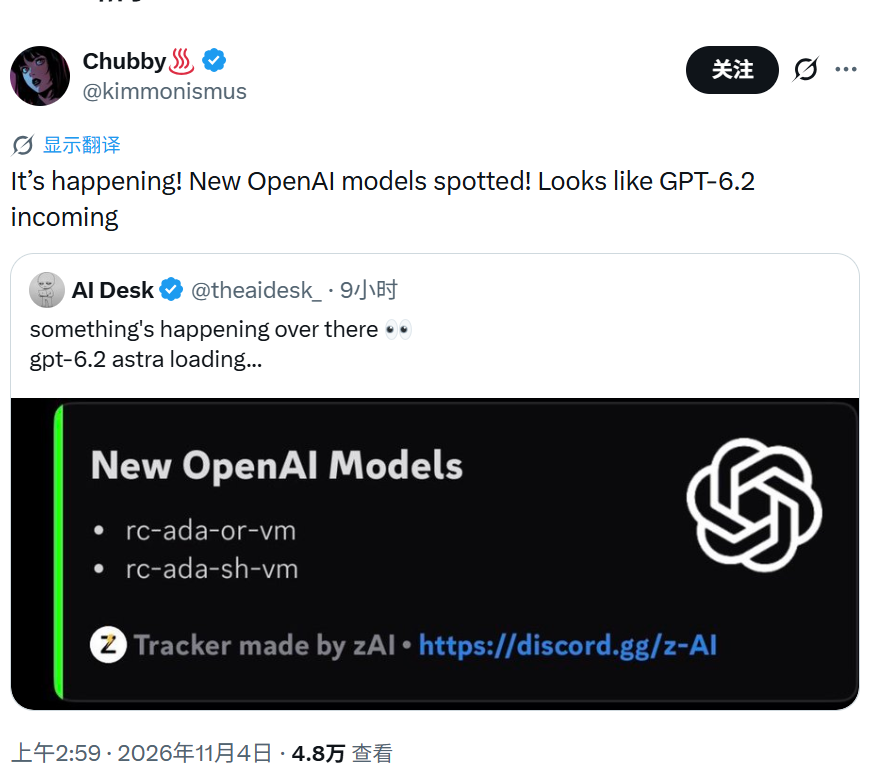
In addition, on November 3, overseas model tracking account LuminaBench claimed that two new logos, "rc-ada-or-vm" and "rc-ada-sh-vm", briefly appeared in the OpenAI API model list, and then disappeared. Some developers speculate that these codenames may be related to the release candidate version of the new model, but there is currently no evidence to confirm that they correspond to GPT 6.2 Astra.
It is worth noting that OpenAI has not officially announced GPT 6.2 Astra, nor has it confirmed the release time of the above grayscale test and new model. Some model demonstration videos circulated on social platforms also have disputes over their authenticity and cannot be used as a basis for verification of the performance of the new model.
As rumors of gray testing continue to ferment, OpenAI released a technical blog post titled "Accelerating Engineering Development for the Physical World" on November 3, revealing the latest progress of AI models in the fields of mechanical design, electronic engineering and physical manufacturing.
The most popular among them is the test results of a set of models that have not yet been released.
In the BenchCAD 2.0 engineering benchmark test, the current GPT 6 Astra achieved an average score of 0.594 under the highest inference settings, while an average score of what OpenAI calls an "updated internal model" reached 0.875, a relative improvement of approximately 47.3%.
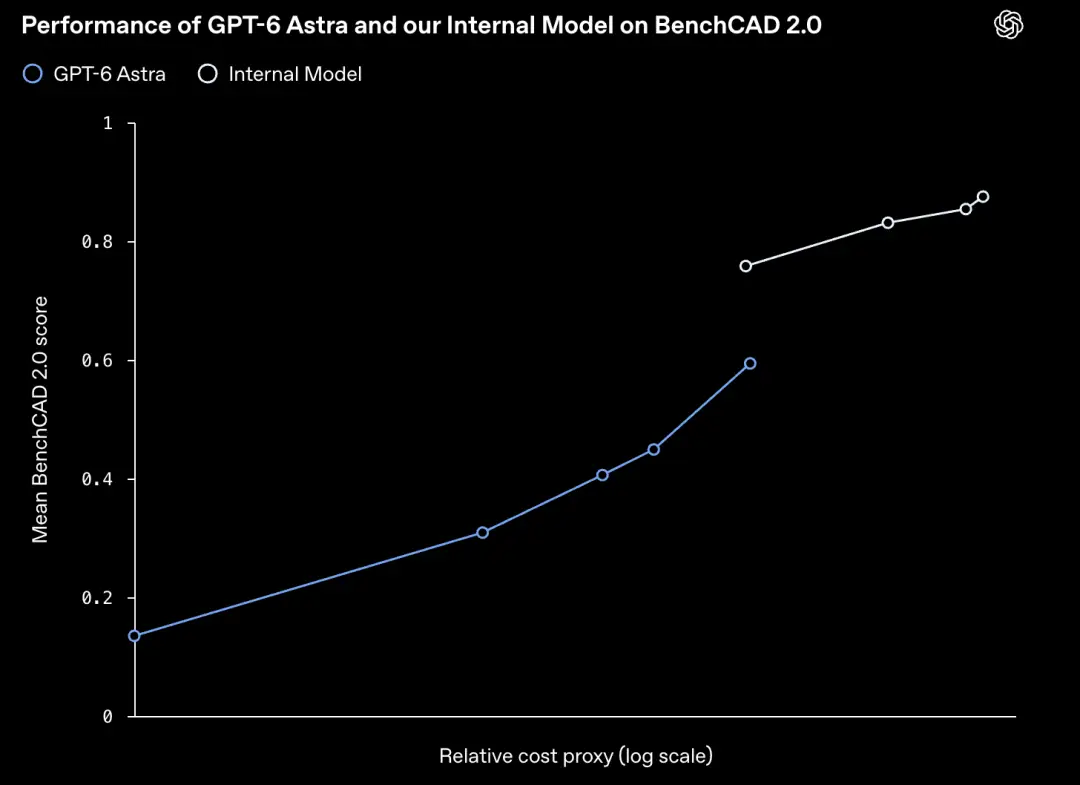
BenchCAD 2.0 mainly evaluates the model's ability to reconstruct three-dimensional mechanical parts and assemblies and identify circuit board connection relationships. OpenAI believes that this result initially shows that the new generation model is expected to further improve the iterative efficiency of professional engineering design.
However, OpenAI did not disclose the official name of this internal model, nor did it explain whether it is the recently rumored GPT 6.2 Astra. The above results are the results of specific engineering benchmark tests and cannot directly represent the overall success rate of real manufacturing tasks.
In addition to announcing model running scores, OpenAI also demonstrated a case in which GPT 6 Astra participated in physical hardware design.
According to the official introduction, two engineers used GPT 6 Astra to complete the design of a portable AI device in less than a week. The device can interact with Codex through voice, and the model participates in the design of the shell structure, internal mechanical components, PCB circuit board, electronic components, user interface and firmware software.
During the entire design process, engineers did not directly manually modify the design generated by the model. The foundry then produced a small batch of physical prototypes in less than a month.
But OpenAI also admits that converting designs into manufacturable products still requires multiple rounds of manual review and iteration. GPT 6 Astra does not always accurately account for production process constraints, manufacturing tolerances and assembly details.
OpenAI also disclosed that since February this year, the number of tokens consumed by its hardware team using AI models has increased 23 times. Codex and ChatGPT are being used for computer-aided design, manufacturing drawing generation, engineering simulation and design review.
In terms of external cooperation, OpenAI announced a new research collaboration with Mazda to explore the use of AI to assist vehicle aerodynamics and crash safety design. GPT 6 Astra can generate different front-end geometries and combine it with airflow simulation to help engineers evaluate design options.
Mazda chief engineer Akihiro Nakata said that with the help of AI to explore and simulate dozens of design variants, engineers can more clearly understand which styling features will affect aerodynamic performance, and in which areas designers have greater styling freedom.
OpenAI has also expanded its cooperation with IndyCar team Chip Ganassi Racing to try to convert 3D scan data of existing parts into editable CAD models and 2D manufacturing drawings to reduce engineers’ duplication of work in reverse modeling and prototype development.
From the new model logo appearing in the Codex backend to the official internal model engineering benchmarks, a series of recent information shows that OpenAI is continuing to advance the programming, computer operation and physical engineering design capabilities of large models.
However, it remains to be officially confirmed by OpenAI whether GPT 6.2 Astra has entered official gray testing, whether the new internal model corresponds to this version, and when the new model will be released.
Comments