
Abstract:
Anthropic engineer Addy Osmani announced on the social platform
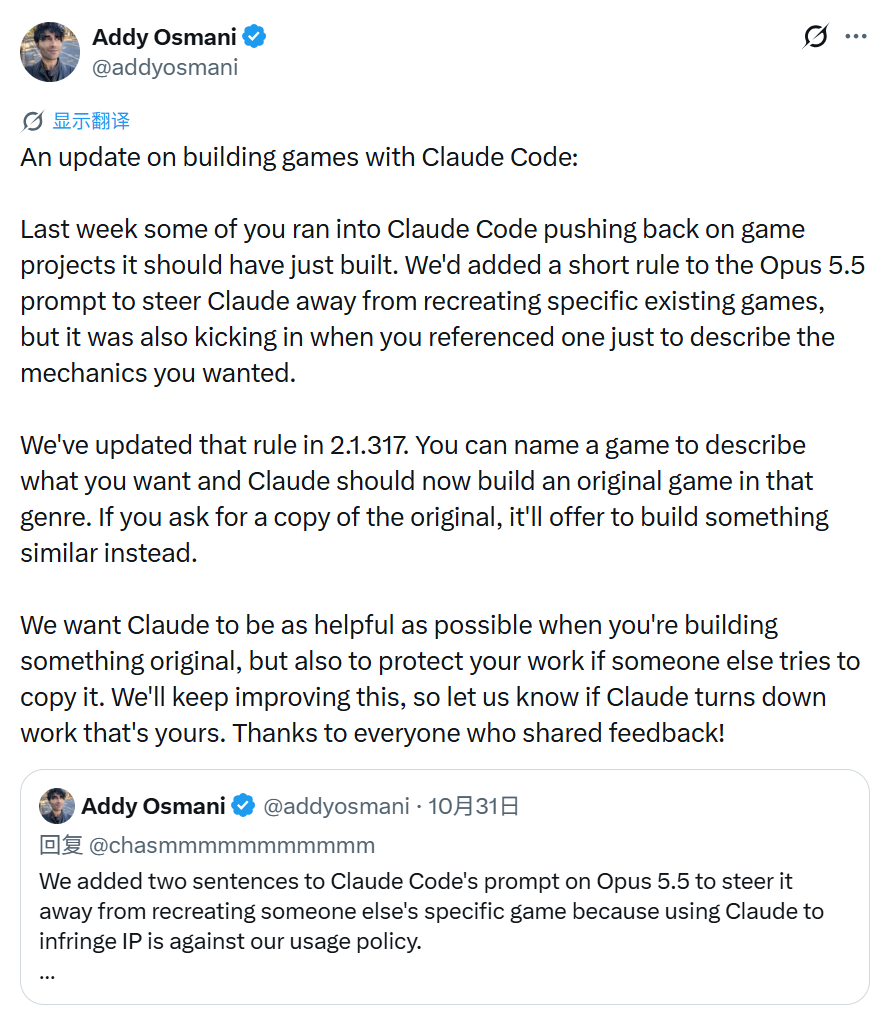
Previously, in order to prevent users from using Claude Code to copy existing games, Anthropic added two rules to the system prompts of Opus 5.5, requiring models to avoid copying other people's game works. The restriction sparked dissatisfaction among developers last week because Claude Code could refuse to perform development tasks even if a user simply mentioned a game as a gameplay reference.
Osmani admitted that the previous restrictions were too broad, resulting in the rejection of some game development projects that should have been completed normally.
In response to this problem, Anthropic has adjusted relevant rules. According to the latest instructions, users can now directly mention an existing game and let Claude develop an original game of the same type by referring to its gameplay mechanism. But if the user explicitly requests to copy the original work, Claude will still refuse to copy it directly, and instead proposes to develop a game with a similar experience.
Osmani said that Anthropic hopes that Claude can help developers create original works as much as possible, while protecting the intellectual property rights of existing game developers and preventing others from using AI to copy their results.
This adjustment also reflects the difficulties faced by AI programming tools between copyright protection and creative freedom. As the code generation capabilities of AI models continue to improve, developers can quickly create games through natural language. However, how to distinguish between borrowing gameplay mechanisms and copying existing works is still a problem that AI tools need to solve.
Osmani stated that Anthropic will continue to improve relevant restrictions and invite developers to provide feedback on Claude's wrongful refusal to develop its own game projects.
Comments