
Abstract:
Anthropic, an artificial intelligence company, recently disclosed that traditional software development infrastructure has become a new bottleneck because Claude generates code so quickly. To solve this problem, the company completed a bold reform in just five months: abandoning Git as the core version control system, developing independently and fully migrating to a new platform called Scion.
Anthropic said that within the company, writing code is no longer the main limiting factor in software development and research work. As Claude became more and more involved in code generation and system building, the real bottlenecks began to shift to traditional development infrastructure such as version control, continuous integration (CI), and build systems.
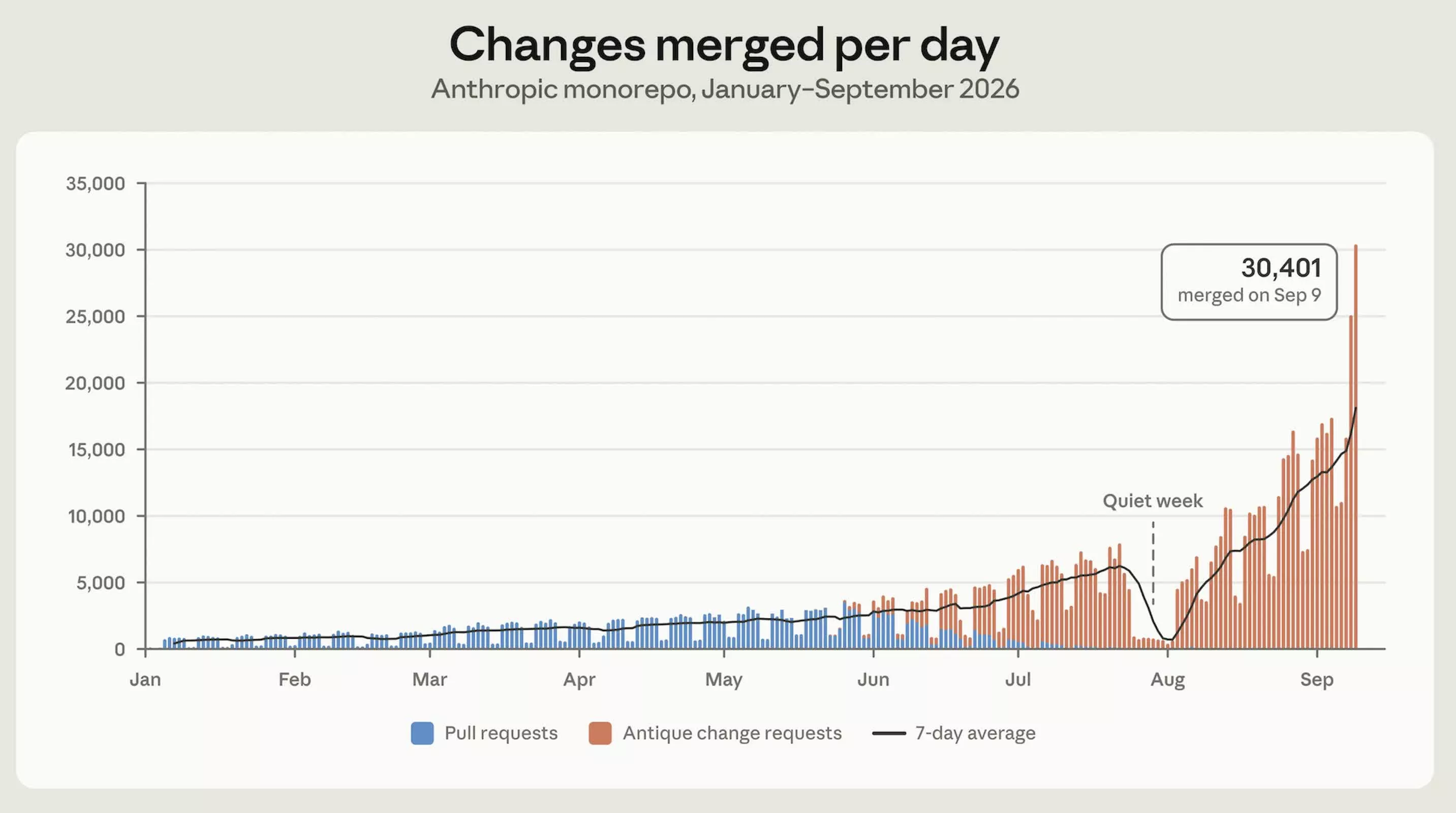
Data shows that Anthropic’s internal code submission volume has experienced explosive growth in a short period of time. In May 2026, the company merged an average of about 2,500 code changes per day; by September, this number had exceeded 30,000, an increase of more than tenfold. The company expects this growth trend to continue in the future.
The expansion of code size also puts huge pressure on infrastructure. Anthropic revealed that the historical data of the main branch of its single code warehouse is close to 100GB, and the compressed working copy exceeds 25GB. The continuous integration system alone needs to perform approximately 25 million code checkouts every day, and this does not include the additional demands generated by development environments, AI agent sandboxes, and research tasks.
According to Anthropic, one of the most important design concepts of Git is the distributed architecture. Each client has a complete copy of the warehouse and can view history, generate differences and switch versions in an offline environment. This design has proven to be extremely successful in the era of traditional software development, and is also an important reason why Git has become an industry standard.
However, the company believes that this model designed for human developers is encountering new challenges in the AI era. In Anthropic's view, a large number of AI-driven development tasks and automation systems are almost always running online and no longer require a complete local copy of the warehouse. Therefore, many of Git's traditional advantages have become obstacles to expansion.
To this end, Anthropic has developed a new Scion system. Unlike Git, Scion adopts a significantly centralized architecture design, and most computing tasks are completed on the server side, including code submission, merging, historical query, conflict handling and other operations. The client keeps only a limited cache and fetches data as needed.
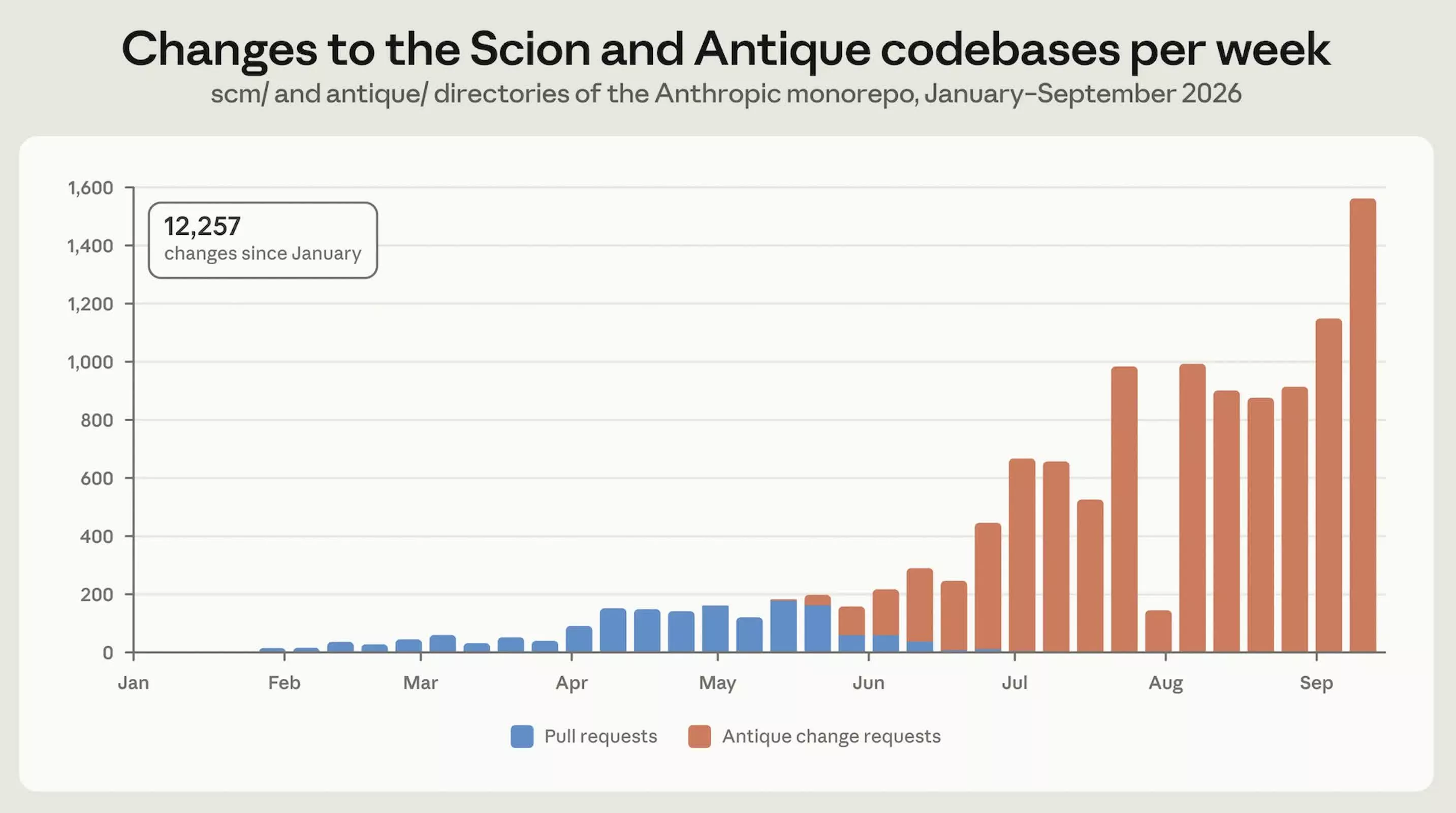
While completing the development of Scion, Anthropic also launched a set of supporting tools, including a code review platform called Antique, a code search system, a more complete permission management mechanism, and a new workflow for AI-scale development environments.
Anthropic stated that the entire project was completed within 5 months by a team of 7 people, and Claude himself also played an important role in the development process. In a sense, it was the ability of AI to generate code that promoted the birth of Scion, and Scion became the infrastructure that supports AI to further generate more code.
From a performance perspective, Scion has brought significant improvements. Anthropic claims that the CPU and memory consumption of the new system is only about one-twentieth of the original Git mirror infrastructure. The code checkout time in the continuous integration environment has been shortened from minutes to seconds, while helping the company save about 25% of CI computing resources.
However, Anthropic emphasized that Scion is not a universal replacement for Git. The company believes that Git is still the best choice for the vast majority of software projects. Scion is mainly designed for very large single code bases and large-scale development environments that rely heavily on AI-generated code.
Anthropic predicts that as AI programming tools become more popular, other companies may face similar problems in the future. While few organizations currently reach the scale of tens of thousands of code merges per day, as agents and automated development further advance, traditional development toolchains designed for human developers may need more adjustments.
The decision to abandon Git is also regarded by the industry as a landmark case in which AI begins to reshape software engineering infrastructure. As AI gradually replaces humans as the main producer of code, software development tools themselves are being forced to adapt to the needs of the new era.
Comments