
Abstract:
Linux founder Linus Torvalds is further exploring the application of artificial intelligence programming tools in kernel development. After recently developing a Linux kernel performance optimization patch with the help of Anthropic's Claude Code, Torvalds used a large language model (LLM) to analyze a piece of kernel code that had been difficult to understand for a long time. He not only confirmed a flaw previously reported by the developer, but also discovered three other vulnerabilities that had been dormant for more than ten years. These problems are all related to the implementation of Associative Array in the Linux kernel.
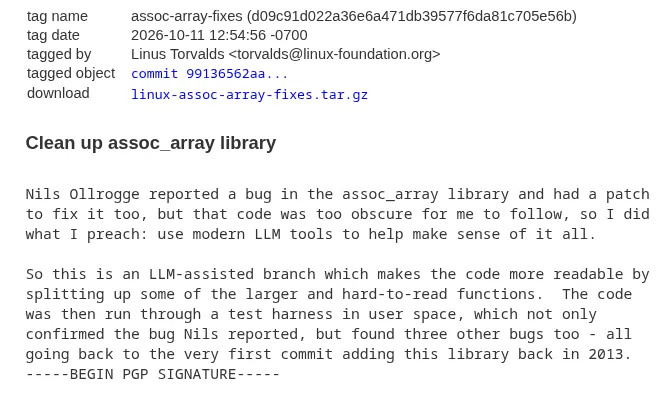
According to a report released by Phoronix on October 12, Torvalds recently added a Git tag called "assoc-array-fixes" to his Linux kernel code repository to organize and mark a series of repairs to the associative array code. This work is independent from his previous project of using Claude Code to optimize file reading performance, but both reflect his attempts to introduce AI tools into the complex kernel development process.
The cause of this work was that developer Nils Ollrogge reported a bug in the associative array library and submitted a corresponding fix patch. However, when Torvalds reviewed the patch, he found that the implementation of the relevant code was too obscure to directly understand its specific logic, so it was impossible to easily judge whether the patch correctly solved the problem.
Faced with this situation, Torvalds chose to use modern large-scale language models to assist analysis. He wrote in the Git tag description that this time he took the approach he had been advocating before, which is to use modern LLM tools to help understand complex code.
Torvalds then organized a set of patches with AI-assisted modifications to split some large and difficult-to-read functions into a clearer structure, making the code logic easier to understand and review. It is worth noting that the goal of this work is not to simply let AI rewrite the entire associative array implementation, but to first improve the readability of the existing code and then verify through testing whether its behavior is as expected.
After completing the modification, the relevant code was also put into the user space test framework to run. Testing not only confirmed that the bug originally reported by Olrog was indeed present, but also discovered three additional issues.
Even more concerning is that these flaws are not new problems introduced recently. According to Torvalds, the three additional discovered vulnerabilities date back to 2013, when the associative array library was first introduced into the Linux kernel. In other words, they have been lurking in the code for more than a decade, without being fully detected by relevant tests.
The associative array in the Linux kernel is a data structure used to organize and retrieve data by key value. Unlike ordinary arrays that access elements through integer subscripts, associative arrays can find corresponding data based on specific keys, so they are suitable for scenarios that require flexible indexing and management of objects.
The associative array implementation in the Linux kernel serves the data management needs within the kernel. Because kernel code must run under strict performance, memory safety, and concurrent access requirements, the implementation of such basic components is often more complex than similar code in ordinary applications. Even if a function ostensibly only performs data insertion, deletion, or lookup, it may involve tree structure adjustment, node life cycle management, and various boundary conditions.
Lack of clear structure in this type of code makes it more difficult for maintainers to understand its behavior. Developers not only need to confirm the operating logic under normal circumstances, but also must analyze abnormal inputs, special data structure states, and problems that may occur when multiple operations are performed continuously.
As code continues to evolve, defects that are not easily triggered in early implementations may remain for a long time. Especially in complex data structures, some errors will only be exposed in specific operation sequences or special structural states, and ordinary tests may not necessarily cover all situations.
The idea adopted in this AI-assisted work is to first split large functions that are difficult to understand into parts that are easier to analyze, and then verify the relevant logic through an independent testing program. A clearer code structure helps developers identify the relationship between different operations, and also makes it easier for testing tools to build verification conditions for specific behaviors.
However, the three vulnerabilities discovered this time cannot simply be attributed to AI's ability to understand programs beyond humans. More precisely, AI-assisted code refactoring, developer reviews, and testing frameworks all work together. Large language models can help organize code logic and identify potential problems, but ultimately it is still necessary to confirm whether the defects are real through actual execution and repeatable testing.
What’s special about this case is that AI not only participated in code analysis, but also helped Torvalds resolve understanding barriers during the patch review process. For developers who maintain large open source projects, this may be a working method of practical value: when the code is too complex and it is difficult for maintainers to quickly judge whether the repair plan is correct, AI can be used to assist in sorting out the code structure, and then the conclusions can be verified through testing and manual review.
Currently, this set of fixes for associative arrays has not yet been merged into the Linux kernel mainline. According to Phoronix reports, related work is expected to be further advanced during the upcoming Linux 7.4 merge window, but whether the final merge will still depend on the results of subsequent code reviews and testing.
It is worth noting that this is not the first time Torvalds has recently publicly demonstrated the use of AI in Linux kernel development.
Previously, he used Claude Code to carry out another kernel optimization work. The goal was to solve the competition problem caused by the memory page reference counting operation when multiple threads read the same file at the same time. The relevant patch attempts to reduce unnecessary reference counting operations by adjusting the file read path, thereby improving read performance under specific workloads.
In that work, AI participated in initial code writing, test program development, code review, and drafting of patch notes documents. Torvalds is responsible for determining optimization directions, overseeing the development process, and conducting performance measurements on his own computer.
The technical goals of the two tasks are different, but they embody a similar development model: engineers familiar with the kernel determine the problem, then use AI to help understand complex implementations, write or adjust code, and finally verify the results through testing.
This model may be particularly valuable for open source projects with large scale and long maintenance cycles like Linux. The kernel code has continued to evolve over decades and contains extensive implementation history and complex compatibility requirements. Even experienced maintainers cannot always be familiar with all the details of each subsystem.
Traditional code review mainly relies on developers to read code, analyze logic and design tests. AI tools have the opportunity to help maintainers sort out unfamiliar code faster, explain the relationship between functions, propose possible boundary conditions, and assist in generating test cases. They do not replace professional review, but are expected to reduce the time cost of understanding complex code.
At the same time, AI-generated code also has limitations. Large language models can misunderstand complex control flows, ignore rare boundary conditions, or propose modifications that appear reasonable but do not actually guarantee correctness. For operating system kernels, these issues are particularly important because code errors may affect system stability, memory safety, and even the reliable operation of the entire system.
Therefore, AI's participation in kernel development does not mean that review requirements can be relaxed. Instead, code refactoring, automated testing, patch review, and actual verification remain key to ensuring the quality of modifications. The associative array project was able to discover long-standing problems, which just shows that AI tools need to be combined with strict engineering verification processes to be effective.
Torvalds has always had a pragmatic attitude towards AI programming tools. He recognized the value of AI to help in the development process, but did not advocate that developers should accept machine-generated code without review. This time he publicly stated that he uses LLM to analyze the code, which further showed that AI is becoming an auxiliary option in the kernel development toolbox.
More broadly, the incident also sheds light on a long-standing difficulty in maintaining large software projects: the code not only needs to run correctly, but also must be understandable to future developers. For basic software that has been maintained for more than ten years or even decades, readability itself is an important factor affecting reliability.
This modification improves the code structure by splitting complex functions, and uses testing to discover previously missed problems, demonstrating the close connection between code readability and defect troubleshooting. When program logic is clearer, it is easier for developers to identify potential error paths and to build tests that cover relevant behaviors.
If this set of patches eventually enters the Linux mainline, its significance will not only fix the four identified problems, but also provide a clearer code basis for subsequent maintenance.
As AI programming tools continue to develop, there may be more similar cases in large open source projects in the future. However, for key basic software such as the Linux kernel, what really determines whether AI-assisted development can gain long-term recognition is whether the patch can pass strict review, whether the test can reproduce the problem, and whether the final code is reliable enough.
This time, AI did not replace the Linux founder in making the final judgment, but helped him understand the code that was originally difficult to review and further unearth defects that had been hidden for many years. For mature software engineering, this may be one of the most practical application directions of artificial intelligence.
Comments