
Abstract:
Microsoft recently officially released LiteBox 0.1, which is the first official version of its open source security project LiteBox. The project was jointly developed by Microsoft engineers and other participants. The goal is to use the Rust language and Linux virtualization security technology to build a Library OS specifically for application sandbox isolation.
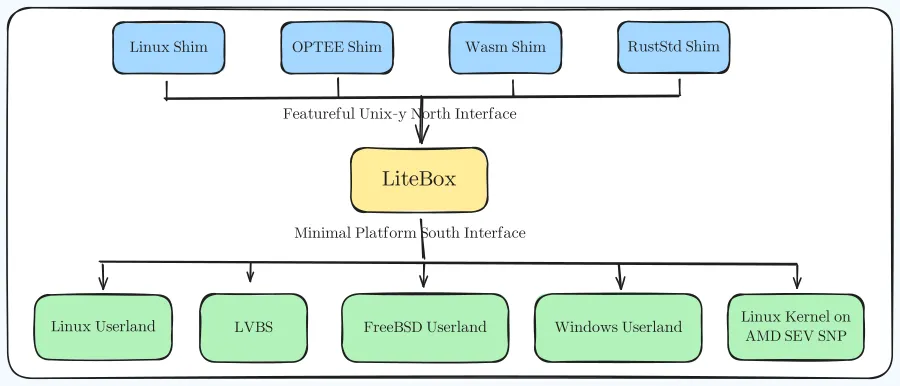
LiteBox will be publicly unveiled as early as February 2026. At that time, Microsoft described it as a security-focused Library OS. Its design goal was not to replace the traditional operating system, but to serve as a security isolation layer between applications and the ordinary operating system kernel, providing additional protection for environments that need to run untrusted code or high-risk applications.
Compared with traditional virtual machines, LiteBox pays more attention to sandbox application scenarios. It can use the security mechanisms related to Linux virtualization to establish an isolation environment with the support of hardware virtualization, allowing applications to run in a more restricted execution space.
Another core feature of LiteBox is the use of Rust for development. Rust is able to reduce buffer overflows, use-after-free, and other common memory safety vulnerabilities through compile-time memory safety mechanisms, which is especially important for a low-level security component responsible for isolating and protecting other programs.
In the design previously shown by Microsoft, LiteBox can make use of Linux Virtualization Based Security, which is a security mechanism based on Linux virtualization, allowing LiteBox to act as a secure kernel and protect the normal running Guest Kernel through virtualization hardware.
An important advantage brought by this architecture is that LiteBox is not limited to a single operating system environment. Microsoft envisions that it can be used to run Linux applications in isolation on Linux, and can also be used to safely run Linux programs in a Windows environment. It can also serve other scenarios that require higher program isolation and security.
From an architectural perspective, LiteBox is closer to a "library operating system" than a traditional operating system in the full sense. Library OS usually does not provide a large operating system environment containing a large number of general functions, but provides as streamlined system components as possible according to the needs of specific applications. This reduces the attack surface of the operating environment while reducing the size of the code that needs to be maintained and protected.
This is especially important for sandboxes. A traditional application often needs to rely on a large number of operating system services and system components when running, but LiteBox hopes to provide only some of the capabilities that the application really needs and isolate the remaining system resources outside the sandbox.
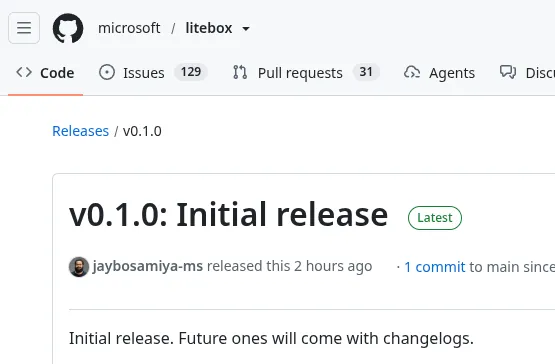
LiteBox 0.1 is still a very early version. The first version released by Microsoft did not provide a large number of detailed update instructions. The company said that future versions will provide a more complete change log. This means that the more important significance of version 0.1 is to confirm that the project has entered the official version release stage, rather than that LiteBox has become a mature production-level security platform.
When Microsoft previously disclosed LiteBox, the project code had been developed using open source methods. The launch of the first official version also shows that Microsoft is still continuing to promote this project, rather than stopping updates after the initial public release like some experimental open source projects.
The potential applications of LiteBox are very wide. As software supply chain attacks, malicious code, third-party plug-ins, and artificial intelligence-generated code become more and more common, putting incompletely trusted programs into independent sandboxes for execution has become an important security strategy.
Especially in the AI era, applications may need to automatically execute code generated by models or from the Internet. If these programs can be executed in a streamlined operating environment protected by virtualization technology, even if the program itself has vulnerabilities or contains malicious behavior, its ability to access the host system can be restricted as much as possible.
From this perspective, LiteBox is not just another open source project launched by Microsoft for the Linux community, but may become an underlying component of Microsoft's future secure computing system. The design of Rust, virtualization and Library OS it adopts is also consistent with the current overall trend in the field of operating system security to reduce attack surfaces, strengthen isolation and improve memory security.
However, LiteBox cannot yet be regarded as a product that can replace Docker, virtual machines or other mature sandbox technologies. It is still in the early stages of development, and actual performance, compatibility, security boundaries, and reliability in production environments need to be further verified with subsequent versions and actual applications.
The greatest significance of Microsoft's release of LiteBox 0.1 this time is to prove that the project has remained actively developed after it was first made public and has officially taken the step of versioned release. As subsequent functions continue to improve, whether LiteBox can develop into a truly secure isolation infrastructure with widespread application value will become a direction worthy of continued attention.
Learn more:
https://github.com/microsoft/litebox/releases/tag/v0.1.0
Comments