
Abstract:
The Fudan University research team has developed an ultra-thin polymer film attached to the robot's feet, which can directly generate electricity when it touches a specific ground and determine the material and surface roughness under the feet from the electrical signals. The study was published in the National Science Review. It targets the power supply problem that micro-robots have long faced: researchers pointed out that a micro-robot weighing about 1.7 grams can only crawl for about two minutes using a commercial battery; if the battery life is to be extended to two hours, the battery weight will account for about 94% of the total weight of the robot, far exceeding the energy density capabilities of existing lithium batteries.

This layer of "skin" is made of cross-linked potassium polyacrylate and forms a film directly on the robot's foot. The thickness is about 135 microns and the area can be reduced to about 1 square millimeter. It does not use walking friction or pressure to generate electricity, but an open electrochemical power source: after the sole of the foot contacts active surfaces such as aluminum and zinc, the ground material releases electrons; the platinum/carbon reaction layer on the membrane uses oxygen and water in the air to receive electrons to form an electric current, and the reaction stops immediately after lifting the foot. In other words, the robot consumes the chemical energy of the contact material, and the metal surface will gradually be oxidized, instead of obtaining "free electricity" that can be sustained indefinitely.
The research team reports that the film can achieve a power density of 133 milliwatts per square centimeter on the zinc surface and 103 milliwatts on the aluminum surface, about an order of magnitude more than typical microbatteries; available materials also include silicon, tin and lead. The size of the experimental robot is approximately 6.7 x 5.7 centimeters. The research report mentioned that it has accumulated more than 10,000 steps, with continuous testing spanning about 150 days, and has walked more than one million steps after consuming about 2 grams of aluminum. The team also demonstrated the robot climbing a tilted metal plate, lighting up an LED and driving a Bluetooth transmitter; the membrane can work in environments as low as minus 20 degrees Celsius and as high as 80 degrees Celsius, and can still discharge after being left at 20% relative humidity for 48 hours.
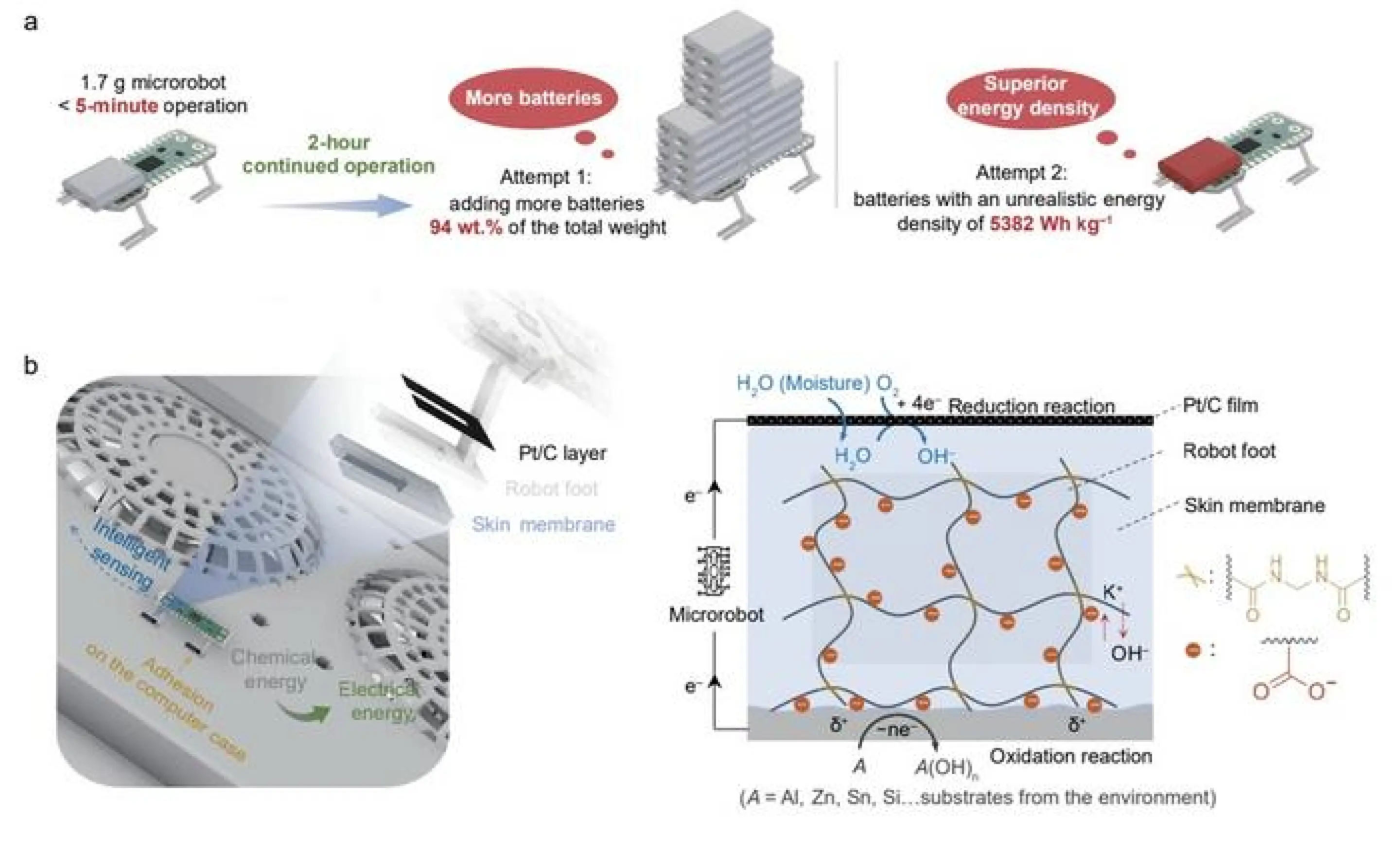
This film also has a sensing function. Different ground surfaces cause different electrochemical reaction speeds and ion migration, which will produce distinguishable electrical signals; changes in surface roughness will also change the signal, so the robot is expected to identify the environment and actively find a more suitable path for energy extraction. However, chemically inert surfaces such as plastic, glass, soil and organic tissue cannot be directly powered, so the researchers added small supercapacitors as buffers across such areas. Long-term operation will also be affected by electrolyte changes, and potassium hydroxide needs to be supplemented during experiments to maintain performance.
At present, this is still a power supply and sensing prototype in the laboratory stage. The research shows a crawling test on the surface of a specific material, and is not a product that can already be used for search and rescue in disaster areas, inspection of nuclear facilities, or commercial deployment. Its potential value lies in making microrobots less dependent on bulky batteries or external power sources, but whether the actual mission can continue to operate will also depend on the available surface materials, electrolyte maintenance and energy buffer design in the environment.
Comments