
Abstract:
According to The Information, Oregon battery startup ZincFive is using nickel-zinc battery technology with more than a century of history in AI data centers and plans to develop new products to replace some supercapacitors. The company predicts that sales of nickel-zinc batteries for AI data centers will reach US$105 million this year, a year-on-year increase of 60%.
ZincFive also plans to go public through a merger with a special purpose acquisition company (SPAC). The company submitted relevant documents to the U.S. Securities and Exchange Commission in June this year. CEO Tod Higinbotham said the merger process is expected to be completed by mid-December.
Nickel-zinc batteries are not a new technology. As early as the early 20th century, Thomas Edison bet on battery-powered long-range electric vehicles and applied for a patent for battery technology that combined nickel with iron and zinc. However, with the rapid popularity of gasoline internal combustion engines, these batteries were eventually mainly used in limited scenarios such as mining and railways.
Today, the demand for short-term high-power power supply in AI data centers has led to new uses for improved nickel-zinc batteries.
Higginbotham said that ZincFive's battery uses a zinc negative electrode and a pure nickel positive electrode, which can release all stored energy within 4 minutes, and the discharge speed can be up to 5 times that of traditional batteries. According to the report, this type of battery will face limitations in size, cost and battery life when used in electric vehicles, but it is suitable for providing short-term backup power for data centers.
When the external power supply is suddenly interrupted, the nickel-zinc battery can respond within milliseconds and continue to power equipment such as graphics processing units (GPUs) in the data center for up to 5 minutes, after which a diesel or natural gas generator takes over. For AI data centers with high computing costs, even a very brief power outage can cause significant losses.
“This is Edison-era technology, but we’ve made some new improvements to the chemistry that allow it to cycle charge and discharge at very high rates,” Higginbotham said.
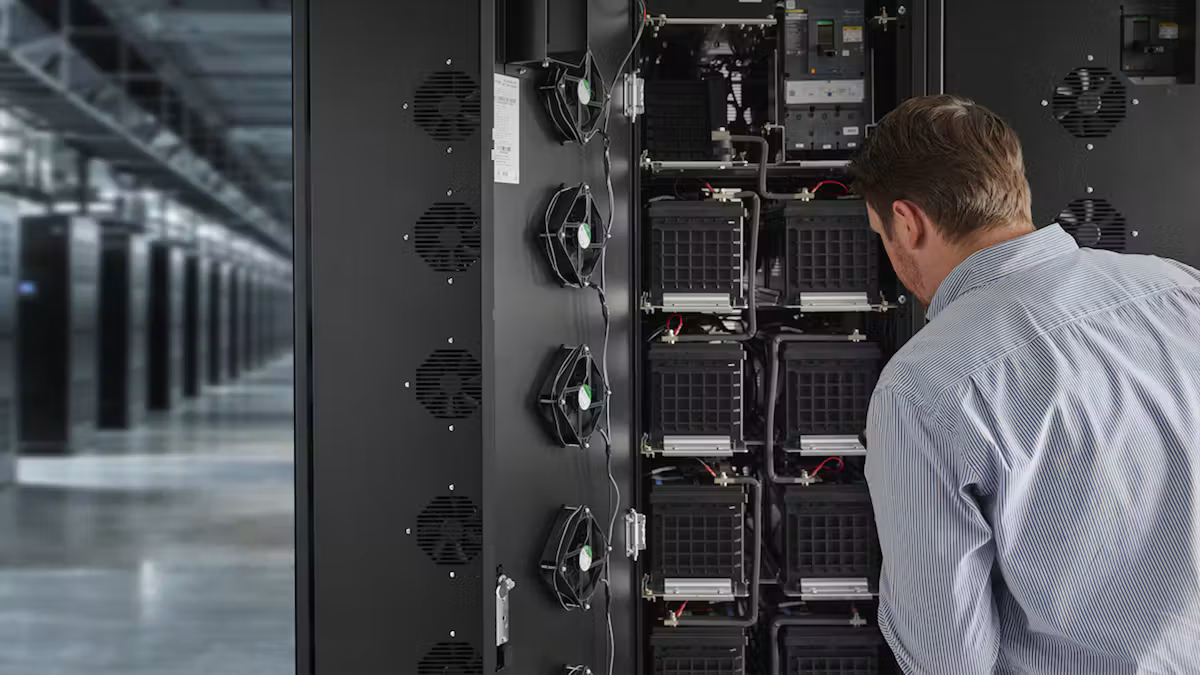
According to him, ZincFive has delivered nickel-zinc batteries to customers with a total power of 1.3 GW. The shape of these batteries is similar to the lead-acid batteries used in fuel vehicles. The company installs up to 39 batteries into cabinets about 2.1 meters high, places them on sliding pallets, and then deploys multiple cabinets side by side in the data center.
In addition to responding to power outages, ZincFive also targets the frequent instantaneous power consumption peaks in AI servers.
Higginbotham said GPUs often require high-power pulses lasting only about 50 milliseconds, at which point the server's power needs can be 70% higher than normal. Over the course of several months, a data center may have to deal with millions of such pulses.
The report pointed out that data centers usually rely on supercapacitors to quickly provide small amounts of power to cope with such needs. ZincFive is developing nickel-zinc batteries that discharge faster, with the goal of releasing full power in 2 minutes and recharging just as fast.
According to Higginbotham, the company hopes the new battery will be able to deliver twice the number of power pulses at about half the cost of a supercapacitor. These are still development targets, and the new products are not expected to be commercially available until 2028.
The growth in demand for AI data centers also improved ZincFive’s financial performance. In the first half of this year, the company's gross profit margin reached 9.5%, compared with negative 14% in the same period last year. The report believes that the growth in demand for AI and drones is bringing new business opportunities to the new generation battery industry, which has previously struggled to develop.
Comments