
Abstract:
Affected by the huge increase in memory prices, this year's PC computers are going into reverse. Microsoft and many PC manufacturers will launch notebooks with 8GB memory. Amway also said that they will optimize 8GB memory to be smooth enough. The question is, does everyone believe that Microsoft can optimize Windows 11 to a good level with 8GB of memory? Most people probably don’t believe it, but this also needs actual testing to verify.
Japanese media conducted a test on a Dell XPS13 laptop with 8GB of memory, comparing Windows 11 and Fedora, a well-known Linux distribution.
Tested items include boot, restart, Office, OCR, browser, file decompression, VS Code, GIMP graphics, Davinci video editing, Blender rendering, 2077 game, etc.
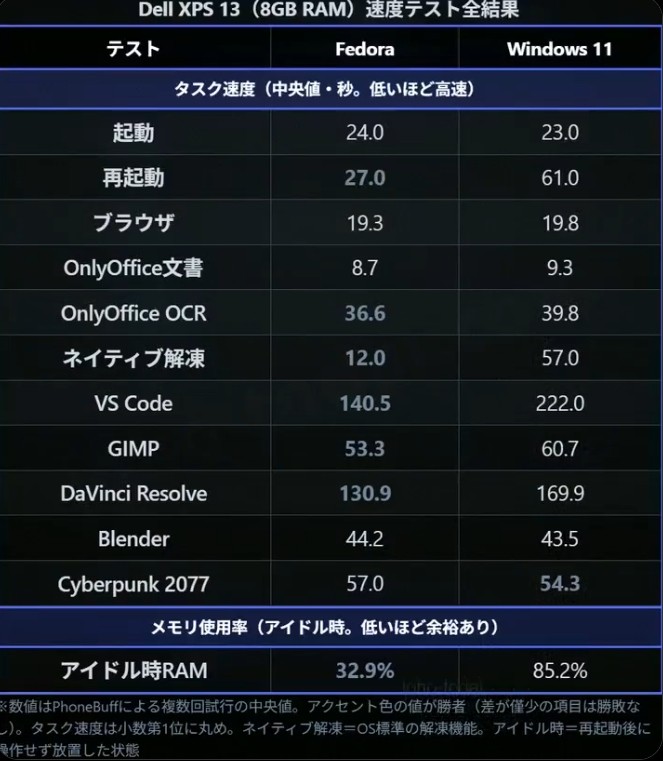
Among these projects, Windows 11 has many projects that have the same performance as Linux.
However, it loses to the Linux system in projects such as restart time, file decompression, image processing, video editing, etc., and there is a big gap in some projects.
The hardware platform is the same, the difference is the operating system itself. With 8GB of memory, Fedora only occupies 32.9% of the memory in idle state, and the memory left for the workload is still 2/3.
Windows 11 takes up 85% of the memory when idle, leaving very little memory for the workload.
In the end, it comes back to the issue that has been reported many times before. Whether a PC with 8GB of memory can run smoothly. The biggest problem is Microsoft itself. There are too many components that occupy resources on Windows 11. If Microsoft does not act harshly on itself, Windows 11 with 8GB of memory is unlikely to be able to beat Apple's MacBook Neo notebook.
Comments