
Abstract:
Four boxes of beer were taken out from the supermarket and stuffed into the trunk. With a bang, the cover collapsed. The incident occurred in an entry-price pure electric SUV. The video went viral and the manufacturer responded. The manufacturer says this is common industry practice, with a nominal load capacity of 40 kilograms. Only the latter item was included in the written instructions.
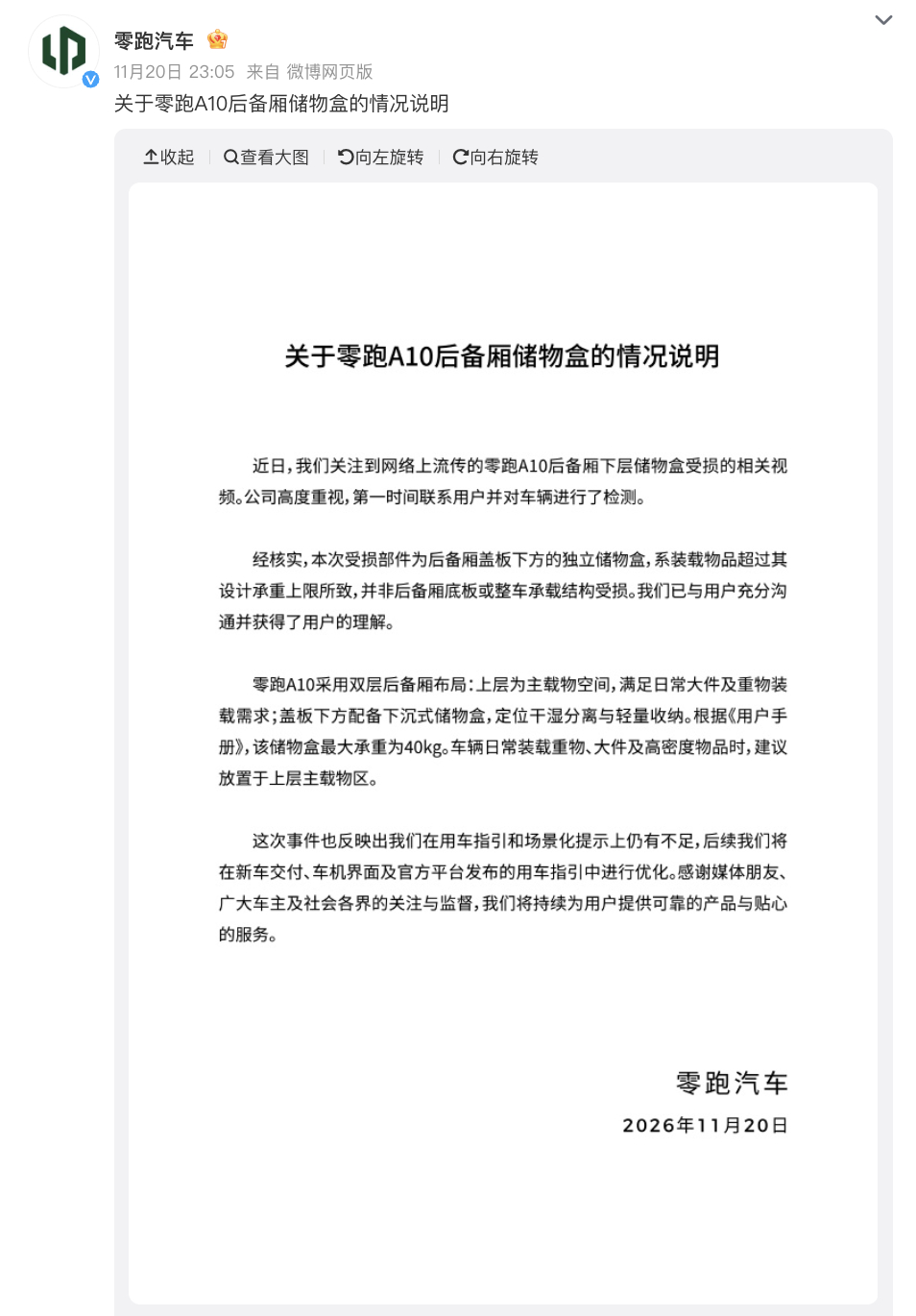
The manufacturer’s written statement is signed to Leapmotor and dated November 20 (Source: @乐盈车 Weibo)
The broken part is the independent storage box under the cover. The trunk is not damaged as a whole.
More people then turned over their cars: the cover became soft when pressed, the spare tire pit accumulated water in rainy days, and old accounts of discounted battery life were also uncovered.
How much does four boxes weigh? There are 12 bottles in one box, each bottle is 600ml, 13.7kg per box, four boxes of more than 50kg.
More than fifty kilograms, weighing above the 40 kilogram line.
Overweight is established and technically makes sense. But that's not what we're fighting for. What is at issue is whether the line itself is drawn appropriately.
This article does not use an accident to characterize a car. The issue is not about one company, but I want to explore whether the car-building logic of this new group of forces has gone astray.
What’s the difference between 40kg and 90kg
Plastic storage boxes are stale. Tesla was the first to use it on a large scale in electric vehicles, aiming to reduce weight, reduce costs, and organize space.
Tesla's manual shows that the lower box of the Model Y trunk does not exceed 40 kilograms, and the layer above the cover does not exceed 90 kilograms.
The same cover plate, the upper head is 90 and the lower head is 40. The difference lies in whether there is something to support it under the board: the lower box is empty, just a thin board with a few ribs.
First distinguish three numbers: 40 kilograms is the nominal name of the storage box, 90 kilograms is the load capacity of the layer on the cover, and 125 kilograms is the trunk body welded to the car body. They are compared together because in the eyes of buyers, they are all one space, called the trunk.
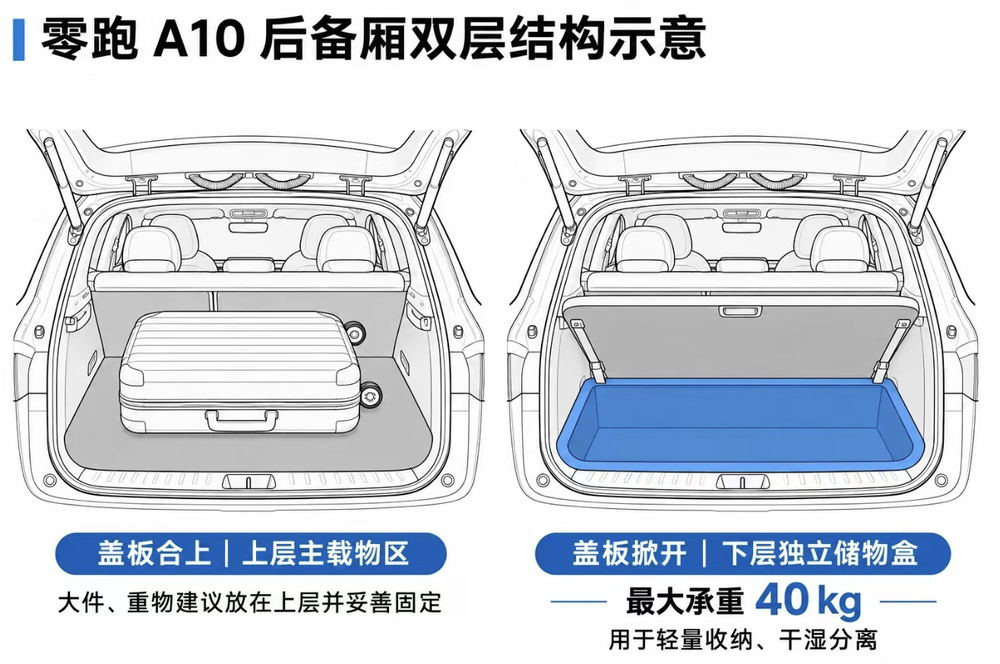
Double-layer structure diagram given by the manufacturer, the box under the cover is nominally 40 kg (Source: @乐动车)
40kg does not mean cutting corners. The location was different, and the labeling could have been twice as bad.
Manufacturers know that being unable to hold up and being able to hold up are two different things, so they mark the positions with two numbers.
According to this logic, there is nothing wrong with marking two numbers. But it bypasses an older rule, which is a tacit understanding between the industry and users. This tacit understanding comes from a hundred years of car use habits: in the trunk of a civilian car, there are not only four boxes of beer, but also two bags of cement and a golden retriever. Leave a margin to guard against this.
There is also a common rule in the auto repair industry: the trunk must be able to withstand 125 kilograms, which is the weight of an adult standing on it for construction work. Huxiu verified with the manufacturers that the trunks of some new energy models of BAIC Jihu and GAC Aion are made of metal welding parts; the figure given by Jihu engineers is also 125 kilograms.
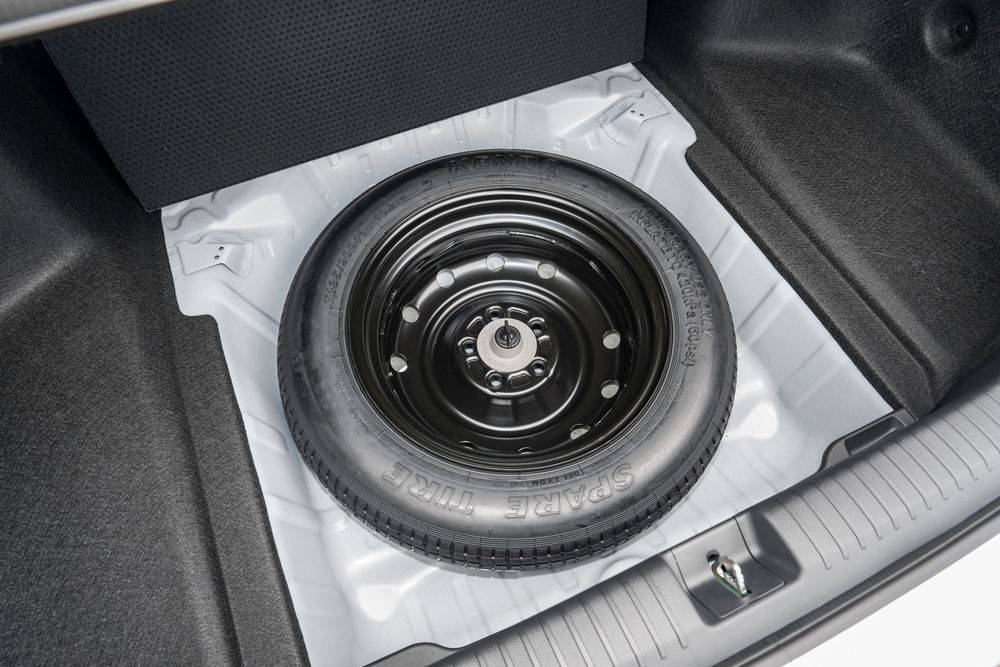
Another approach in the same position, the spare tire pit of Honda Yingshipa is a metal piece with a steel rim spare tire lying inside
One is welded to the body, and the other is a storage piece added later. The structural parts were replaced with plastic boxes as a selling point, and the load-bearing capacity dropped from "can stand a person" to 40 kilograms.
So there are two lines. One is 40 kilograms in the manual, which means don’t exceed it. One is the quantity that users can really use: four boxes of beer, stocked at one time. The trouble is, there is no standard between these two lines. There is no mandatory national standard for the load-bearing capacity of sunken storage boxes. Each manufacturer sets its own standards. GB 15083: Just try to keep the luggage from flying out when it collides, and don't push it down every day.
The risk lies between the two lines.
Type certification tests the lower limit. The regulations only say how much you can pass, but don't say how people will use it. When designing according to regulations, it is easy to stop at the passing line. This is not a design error caused by Leappa, but it is not enough for most people.
On the other end, for brands that have transferred from traditional car companies, the trunk is still a welded part and is still made at 125 kg. Put together, they are two logics of building a car.
The same BOM, two flowering methods
Two cars with the same BOM can have completely different money spent. This is a risk model, not that everyone has done this.
The mechanism is at both ends. On the development side, it takes traditional car companies 36 months to go from project establishment to mass production for a car, while it takes 18 to 24 months for new forces, and the number of verification rounds is reduced accordingly. On the procurement side, annual cost reduction of 5% to 10% is a common assessment. The same drawing can be replaced by a cheaper supplier, but the parameters are the same but the lifespan is different.
There are prerequisites for the establishment of this chain: the same price band, the same development cycle, and the same set of procurement assessments. If one thing is missing, the cost can still be recovered from the scale.
One way is to follow the old rules of durable goods. The material is one grade higher, and the structure leaves two more ribs to prove that it can run in high temperatures and cold for many more rounds.
The cost is straightforward. For the same money, the screen is smaller, there are two fewer radars, and the seats are made of fabric, so it suffers at the press conference.
One way is to follow the rules of FMCG. On the configuration table, all numbers that can be written are listed upward: large screen, ambient lighting, zero-gravity seats, and number of radars.
If it doesn’t fit into the configuration table, the structural strength, material grade, endurance mileage, and assembly tolerances are just passable. Also listed in compliance with regulations.
In recent years, China's auto market has followed the path of mobile phones: model changes are fast, car replacement cycles are shortened by financial plans, and buyers are accustomed to price comparisons based on parameters.
Don’t feel bad if you drop your phone. The car doesn't work.
Tesla best illustrates this matter. The interiors of Model 3 and Model Y are called rough rooms: no ambient lights, no big sofa, a screen in the center console, and plastic door panels.
In the public dismantling, most of its brakes, power components, and glass come from mature suppliers. The purchase list is not as shabby as the configuration list.
It’s clear where the money goes. Save where you can see and spend where you can’t. What is omitted is the score on the configuration table, and what is left is the chassis, three electric machines, and brakes.
Li Bin said: Don’t equate high configuration with technical content. Model Y’s configuration is not high, but its technical content is not low.
There is another way to do it. For the same money, put more where you can see it. Screens, light strips, seats, and radars are all included, and it’s really intimidating to sit in them.
Let’s get back to it. Domestic parts have made rapid progress in recent years, and those parts may not be unduly durable. It’s just that the configuration can be piled up overnight, and the verification takes season after season.
The result is that the parameters are astonishing and the consistency is as low as dust.
These are not empty words. A testing agency once dismantled ten 100,000-class cars. The energy absorption of the front anti-collision beam is 2.31 kilojoules for Buick Verano GS and 30.29 kilojoules for Chery Arrizo 8, a difference of 13 times.
In the same batch of cars, the Elantra's A-pillar's main driver's side is three times stronger than the passenger side; Qin PLUS DM-i's main driver's side has two layers of steel plates and the passenger's side has one layer.
Wei Brand Blue Mountain’s roof strength is 5.49 times higher than that of China Insurance Research Institute, and the occupants are all G-proof. In the old Wenjie M7, the A-pillar was bent 25% offset, and the structure was only A; the new M7 cost 500 million to re-open the mold to make up for it.
Another source of material is the cost account. UBS has dismantled Seal and Model 3: Seal’s overall cost is 15% lower, and 75% of its parts are produced in-house.
The disassembly of Xiaomi SU7 is also there: the materials are 257,000, the battery box is 111,500, accounting for 43%, the body chassis is 43,900, accounting for 17%, and the interior and exterior decoration is 40,300, accounting for 16%. Cutting off 20 configurations from the rough version only saves 4,000 to 6,500 BOM.
The visible configuration costs are not expensive, but the battery, body, and smart hardware are expensive.
Battery is the most intuitive. Wholesale battery cells cost US$53 to US$56 per unit, and the whole package costs US$75 to US$90. A package of 52.9 kilowatt-hours of electricity costs NT$28,000 to NT$34,000.
The seal's electronic control is made into an eight-in-one device. UBS estimates that integration can save about 20% of costs.
More configurations do not equal poor structure. Some cars offer both, relying on scale and self-development to keep costs down, not on saving materials.
BYD is on this path, and the cost advantage is not derived from the chassis.
The band between 100,000 and 200,000 is the tightest. The battery accounts for about 40%, and the rest is divided between the body, interior and exterior decoration, and smart driving. If you add money to one item, you have to give in to another item.
This picture looks at two things: how to divide the 25.7 materials, and how much the energy absorption difference of the front anti-collision beam of ten 100,000-class cars is.
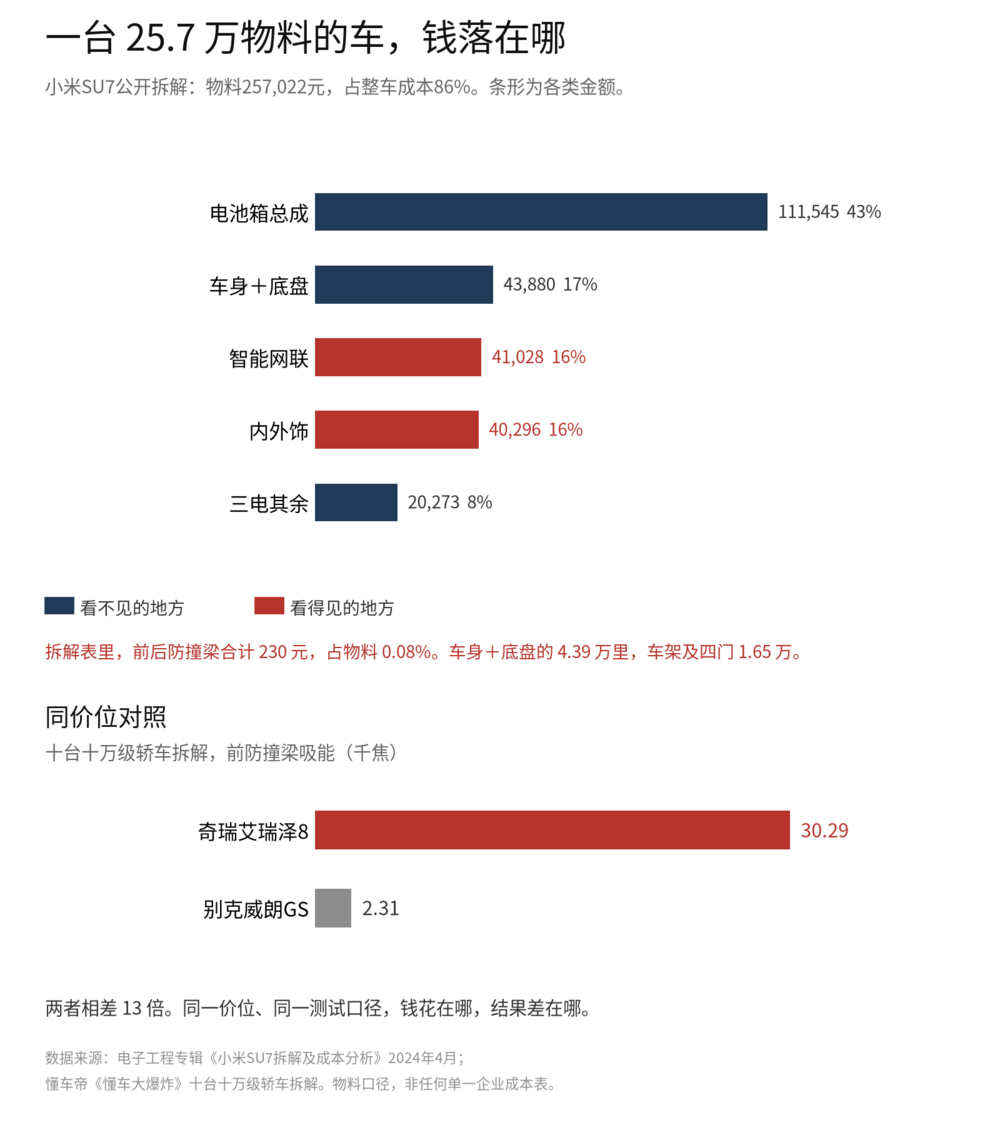
For the same material, where is the money and where is the difference (data source: Electronic Engineering Special Disassembly of SU7 in April 2024)
This is not a family problem
The entire industry is engaged in an arms race on the configuration table. Ideal makes refrigerator color TVs, Wenjie makes cockpit smart driving, and Xiaomi makes performance ecology.
Independent strategy researcher Chen Jia has calculated this: The cost of the entire vehicle has to be suppressed, money can only come from invisible places, and the materials used in the supply chain will follow.
Wei Jianjun said: Some companies cut corners, sacrifice safety standards to engage in price wars, and spend money on research and development into configuration stacking.
On the other front, Tesla puts money on structure, braking, and power devices. Both play styles are legal, the only difference lies in who the budget is given to.
The trunk incident should not be read as an accident of a certain family. It is a different solution to the same cost question.
The problem is that a car has to run 120km/h on the highway, carrying a whole family, for eight years.
In the past eight years, the manufacturer cannot guess what people will add to it. A box of beer, two bags of cement, a golden retriever, a move, and a trip back home filled with souvenirs.
Redundancy may seem like waste, but it is actually insurance for this uncertainty.
The higher the material level, the higher the cost; the additional beam in the structure, which adds a few kilograms of weight; the extra endurance, which increases the cost by running one more round.None of these can be written into the configuration table, and none of them can be mentioned in the press conference.
So there is a twisting phenomenon:
The easier it is to explain the indicators, the easier it is to optimize, and the more difficult it is to explain, the easier it is to omit.
What buyers see is an increasingly long configuration table. Invisible redundancy may be more difficult to budget for.
Cheap cars shouldn't be bad. A car that costs 100,000 yuan can be made solid, but you have to save money elsewhere: leather, audio, and zero hundred dollars.
Most of the hidden dangers are hidden and cannot be seen on the day of delivery. It takes several years before they are exposed.
The replacement cycle is five to eight years, and the parameter advantage is equalized in three years. If you lead by half a second today, your opponent will catch up tomorrow with an additional two thousand yuan.
Durability problems appear at this time: aging rubber strips, abnormal noise in decorative panels, structural fatigue, and failure of electronic components.
Talk skills are also costs.
To talk about the common practice in the industry is to say: we do not intend to be better than our peers, we only intend to do the same.
Standards are the bottom line of the industry. Using it as a disclaimer is another matter.
Everyone uses the lowest consensus as a shield, and the ceiling is blocked by themselves.
This has little to do with origin. Traditional car companies will also save money in invisible places, especially cars whose old platforms are converted to electric power and the cost is pushed to the limit.
Thinking of this, I believe consumers will know how to choose a durable car.
1. See how it answers the worst case scenario. Those who are willing to write down clear limits usually treat themselves as durable goods. If you only give a nominal number and don't say what will happen if it exceeds the limit, the responsibility will be limited to the national standard, so you have to be suspicious.
2. See how it explains the problem. Those who admit shortcomings deserve another chance; those who only push standards and user operations and still use caliber instead of explanation need to be more careful.
Finally, I want to say that what determines how far a car brand can go is whether the car owner dares to fill up the trunk and drive a thousand kilometers back to his hometown three years later.
Because cars are the only durable goods that cannot be just "useful".
Comments