
Abstract:
“The worst thing is that the peak season is not booming.” As soon as October ended, car companies began to release the rankings. Before talking about specific numbers, let’s look at the market first. In October, the retail sales of narrowly defined passenger cars was approximately 1.6 million units, down 1.1% month-on-month. In September, it was 1.618 million units, down 28% year-on-year. For two consecutive months, the year-on-year decline has been around 28%. The China Passenger Car Association estimates that retail sales of passenger cars will be 18.5 million units in 2026, a year-on-year decrease of 22%.
This is the first time that China's auto market has experienced a double-digit annual decline.
As for the sales targets of car companies, they were originally designed to be based on a wave of gold, nine and silver, and then another wave at the end of the year. If the previous wave did not grow, the base for the latter wave would be gone.
With the above figures in mind, when we look at the efficiency completion rate of car companies in the first ten months, it looks more like an arithmetic verdict.
Geely has 2.5457 million units, corresponding to the target of 3.45 million units, with a completion rate of 73.8%, and Chery Group has a completion rate of 78.2%. It is already the most respectable among traditional car companies, but its exports in October accounted for more than two-thirds of total sales.
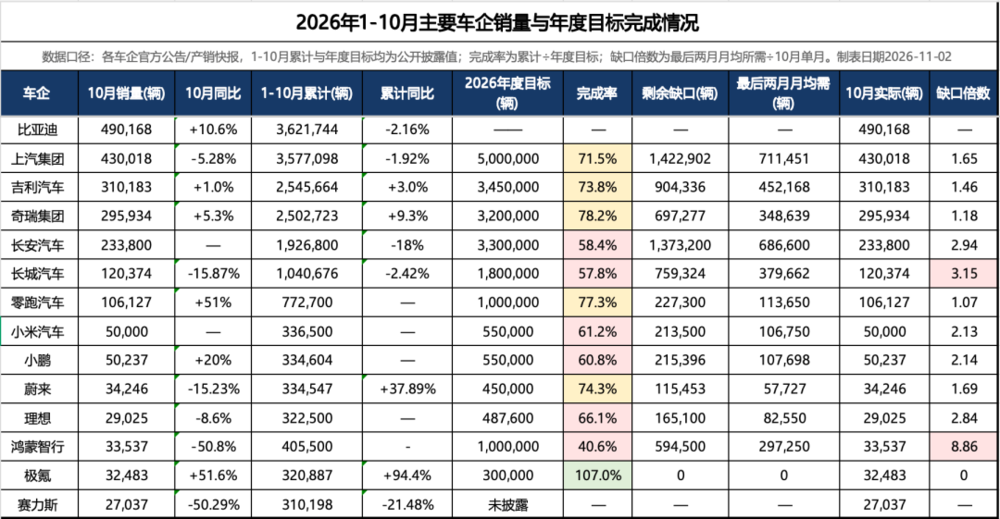
Tabulation: Chaodian Laboratory
As for new forces, Ji Krypton is the only car company that can close its books in advance this year. It delivered 320,887 vehicles from January to October, with an annual target of 300,000 vehicles, and a completion rate of 107%. The zero-run completion rate is 77.27%, ranking second, but it is still 227,300 units short of 1 million units. The average monthly delivery in November and December was 113,700 units, which is higher than the 106,127 units it just set in October.
Retail sales in October dropped by nearly 30% year-on-year. It was the first time that the Golden Nine and Silver Ten disappeared in this way. There are only two months left. For most companies, completing KPIs is an unattainable dream.
01
No shame if you fail to meet KPI
According to industry common sense, more than 80% of the full-year target should be achieved in the first 10 months, and there will be room for maneuver in the last two months.
In 2026, only Jikrypton will cross this line.
For new forces, Xpeng delivered 50,237 vehicles, a record high in a single month, and delivered 13,326 vehicles overseas, a year-on-year increase of 166%. Xiaomi has more than 50,000 units, from 30,000 in August to 40,000 in September, three steps in three months. On the other side, Weilai had 34,246 vehicles, Lideal had 29,025 vehicles, and Hongmeng Zhixing had 33,537 vehicles, a year-on-year decrease of 50.8%.
Leipao is the most powerful among the new forces, firmly standing in the TOP 1 position. Among the six companies that were still competing in the same echelon last year, this month the first place is already 3.7 times that of the last place.
BYD sold 490,200 vehicles in a single month in October, which is already a historical high, an increase of 11% year-on-year, and its exports more than doubled to 170,000 vehicles. But if calculated according to the target of 5 million vehicles, it means that the remaining 1.3783 million vehicles will have to be squeezed into two months, with an average of 689,000 vehicles per month.
Geely sold 2.5457 million vehicles from January to October, with a target of 3.45 million vehicles. The remaining 904,300 vehicles were divided by two months, with a monthly average of 452,000 vehicles. Geely has just exceeded 310,000 units in a single month for the first time in October, and it will jump to nearly 46% again.
SAIC sold 3.5771 million units from January to October, with a target of 5 million units, leaving a shortfall of 1.4229 million units, with an average of 711,000 units per month. Great Wall sold 1.0407 million units from January to October, with a target of 1.8 million units, a shortfall of 759,300 units, and an average monthly sales volume of 379,700 units. It sold 120,400 units in October.
A simple calculation of these divisions will give you the result. The target line is completely out of range.
At the beginning of 2026, the goal of mainstream car companies is generally set at "a growth of 20% to 50% based on 2025." This has been a standard move in the past ten years. The market is growing, and the goal is to set a little faster than the market, forcing yourself to grab share.
But the market in 2026 is going downwards. On one side, the target is set at "20% growth", while on the other side the market is set at "22% decline", with a difference of 40 to 70 percentage points.
Assume that a car company sells 1 million vehicles in 2025 and targets 1.2 million vehicles in 2026. The market drops from approximately 23.7 million vehicles to 18.5 million vehicles. To achieve its goal, its market share must increase from 4.2% to 6.5%—an increase of 55%.
This cannot be solved by "selling more points", which means grabbing the extra 55% share from others.
There are only two months left in the fourth quarter, and even if the target is changed, the gap cannot be filled. Therefore, there is only one conclusion: it is not that car companies are not working hard, but that the denominator of the target and the numerator of the market are developing in opposite directions. This is the simplest mathematical problem.
02
Why is this happening
That list of goals at the beginning of the year looks back like an optimistic memo.
SAIC has 5 million vehicles, BYD has 5 million vehicles, Changan has 3.3 million vehicles, Leapmotor has 1 million vehicles, and Hongmeng Zhixing has 1 million to 1.3 million vehicles. In a year when full-year retail sales are expected to experience double-digit negative growth, the growth expectations implied by these figures are generally double-digit or even above 30%.
It’s not that people who set goals don’t know that the market is going down. Some industry analysts have judged that car companies are aware of the difficulties, but their goals are not anchored on terminal demand and they cannot fall behind others. In a market with more than half of the penetration rate and incremental growth turning into stock, the goal has changed from a navigator to a posture written for the capital market and supply chain.
What’s more important is that in 2026, even the tools for momentum will be taken away.
On January 1, 2026, the new energy purchase tax will be reduced from full exemption to half, and the upper limit of bicycle tax reduction will be reduced from 30,000 to 15,000. The rush buying at the end of 2025 digested the demand at the beginning of 2026 in advance, and the tail-off market that was supposed to appear at the end of the year did not appear.
In February, the "Compliance Guidelines for Price Behavior in the Automotive Industry" was implemented. Sales below cost were clearly defined as a major compliance risk. The toolbox for price wars was narrowed at the legal level. In the past, there was a last resort for failing to meet KPIs - price reduction, inventory reduction, and momentum. In 2026, the price of this move has become so high that most players cannot afford it.
Dealers gave the answer first. The average gross profit margin of new cars was -21.4%. Nearly 80% of dealers had prices upside down. The inventory coefficient was 1.58, far exceeding the warning line. In the first half of 2026, more than 1,800 authorized dealer stores have closed or withdrawn from the network, with an average of 10 stores closed every day, and the withdrawal rate has reached the peak in the past five years.
In this channel state, using inventory to increase the wholesale figures for the last two months will destroy the dealer's cash flow and brand residual value.
The income statement does not support sprinting either. From January to September 2026, the sales profit margin of the automobile industry was 3.3%, and in September it was only 1.4%, the lowest level in the past four years. The profit of Changan bicycles ranges from 619 to 811 yuan, and the profit of zero-running bicycles is 589 yuan. The money earned from selling one bicycle is not enough to pay for a decent meal.
03
Scale is no longer the most important thing
So we found that "setting KPIs" failed for the first time in 2026.
In this process, what failed was not a certain set of numbers, but systemic adjustments. Some companies made a U-turn early and converted sales targets into revenue targets that better represented the quality of their operations.
For example, Dongfeng lowered its annual target from 3.25 million vehicles to 2.6 million vehicles, and Great Wall lowered its sales assessment target from 2.49 million vehicles to 1.8 million vehicles, while keeping its assessment target of net profit of no less than 10 billion yuan unchanged.
These actions are often read as admitting defeat, but a more accurate reading is that when scale no longer automatically translates into profits and cash flow, continuing to provide sales KPIs at the center of business logic is a dereliction of duty in itself. Great Wall's choice is particularly clear-sacrifice part of sales volume to maintain profitability indicators.
Looking at the good completion rate figures from January to October, moisture and color are separate.
Leapao 77.27% relies on extreme cost control and product rhythm. The profit of a bicycle is only 589 yuan, but it is exchanging real products for real orders, not the wholesale numbers squeezed out of the warehouse. In October, Xiaopeng's sales exceeded 50,000 for the first time in a single month, with overseas deliveries of 13,000 vehicles, a year-on-year increase of 166%. The growth came from the new space opened up by exports, rather than grabbing share from the broader market. Xiaomi's first 50,000 monthly sales depended on the first complete delivery month of the Pengcheng series, not year-end momentum.
Chery Group’s completion rate of 78.2% seems to be high, but its structure speaks for itself. In October, it exported 201,000 vehicles. It was the third time this year that its exports exceeded 200,000 vehicles in a single month. Exports accounted for the majority of total sales. BYD exported 170,000 vehicles in October, a year-on-year increase of 103%; Geely exported 107,000 vehicles, a year-on-year increase of 158%.
These increases are not the product of completing KPIs, but are caused by the second curve of exports that is covering up the inflow of domestic storage.
On the other hand, Hongmeng Zhixing's sales in October were cut in half year-on-year, marking the fifth consecutive month of year-on-year declines. Dongfeng Honda's sales continued to fall, and GAC Toyota's sales dropped nearly 25% year-on-year. The share of Japanese brands in China has already fallen below 11%. The differentiation in completion rates from January to October is essentially the differentiation between "who is still trading real products for real demand" and "who is still relying on inertia to support numbers."
The real signal given in 2026 is not to set the target lower. But when the vast majority of players in an industry are unable to achieve the goals they wrote at the beginning of the year, the problem is not the level of the goals, but the fact that setting the goals itself has been decoupled from the business reality.
With industry profit margins of only 3.3%, cash flow determines life and death more than rankings. So it’s time to take sales off the altar of KPI and put profits, cash flow, bike value and real demand back.
This is not a step back, but a way for the industry to loosen its grip on the cult of scale and start a belated correction.
Comments