
Abstract:
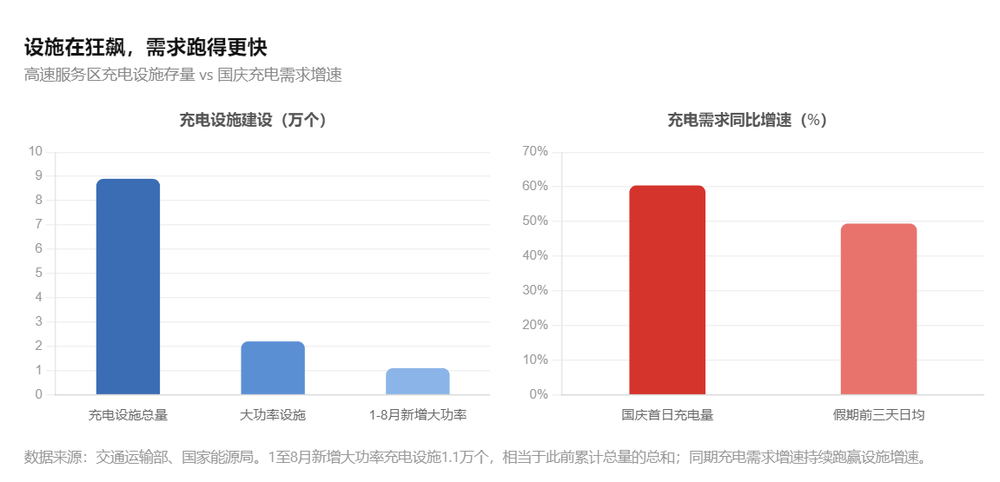
Trillions have been poured into high-speed energy replenishment infrastructure, and the problem of queuing for charging during the National Day holiday has not been solved at all. So far, a total of about 89,000 charging facilities have been built in highway service areas across the country. From January to August 2026 alone, the Ministry of Transport added 11,000 high-power charging facilities, which is equivalent to the previous cumulative total. Charging facilities have basically covered all service areas.
But numbers are vulnerable to peak demand. Taking the first day of National Day as an example, the country's high-speed charging capacity reached 28.0469 million kilowatt hours, a year-on-year increase of 60.40%, setting a record high for a single day during a historical holiday. In the three days before the holiday, a total of 2.9686 million charging times were performed, and the average daily charging capacity was 23.8731 million kilowatt hours, a year-on-year increase of nearly 50%.
Against this macro-background, this year’s situation is even more ironic: in addition to frequently picking up an account and waiting for more than a hundred accounts to charge, there are also new contradictions: flash charging has been reduced to power reduction, and some brand-specific charging piles have introduced differentiated charging limits.
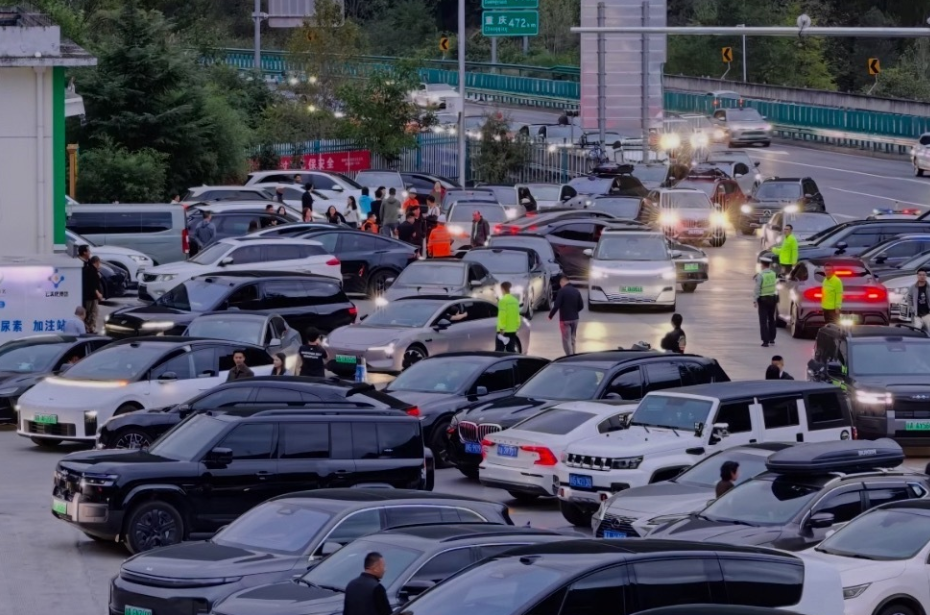
Photo provided by interviewee
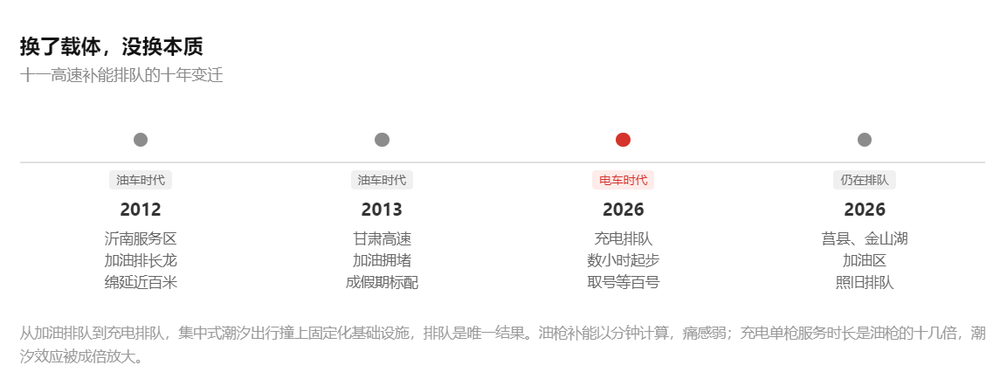
In fact, similar contradictions not only appear in the new energy era. During the Golden Week of the oil truck era more than ten years ago, long queues for refueling at popular service areas blocked the ramps, and some service areas were even faced with the dilemma of running out of fuel.
However, compared to recharging, refueling takes less time and is less painful, so it is unlikely to stir up public opinion.
When electricity replenishment became the absolute mainstay of travel during the Golden Week, the length of single-station stations increased several times, and the contradiction between tidal travel that had been hidden for decades was directly brought to the surface.
Tiger Sniff Cartography
From refueling queues to charging queues, the underlying logic has never changed:
Centralized tidal travel hits fixed infrastructure, and waiting is the only result. Similar topics include long queues for toilets in scenic spots, crowded tourist attractions, and crowded restaurants.
Although high-speed charging facilities have cost trillions of real money, car owners still cannot escape the exclusive fate of queuing. What’s special about this year is that the emergence of the following four new variables has made this queuing conflict more complex and acute.
Range-extended vehicles grab piles
The most concentrated flash point of charging conflicts during the long holiday is in the north service area of Zaoyang, Hubei.
The local government directly issued hard rules: all vehicles must leave the venue when their charge is 80%, and numbers are allocated to enter the venue in rounds. Only 48 places are allowed in a single round. During peak hours, nearly 200 vehicles were blocked on site. The queue was thrown directly onto the main road in the service area, and even entering the station had to be crowded.
Tiger Sniff Cartography
A car owner who drove back to his hometown from Wuhan told Huxiu that he picked up No. 112 at the entrance of the service area at 2 p.m. that day and waited until 7 p.m. to be called. He queued for more than five hours. During this period, I didn’t dare to go far in search of food, for fear of being re-arranged, so I could only sit in the car and consume it.
In fact, the 80% charging limit rule essentially captures the physical characteristics of lithium batteries: 0 to 80% is the efficient fast charging section with stable power; after 80%, it enters trickle slow charging, and the remaining 20% takes about the same time as the previous 80%.
Against this background, when similar rules were implemented one after another in major service areas, pure electric and extended-range car owners directly quarreled.
Tiger Sniff Cartography
An owner of a pure electric SUV complained: "My car has no gas to fill, so it is left on the highway without charging. The extended-range vehicle can obviously burn gas, but it has to join in the fun and compete with us for public resources." A more extreme statement on the social platform is: eight out of ten piles are occupied by hybrid vehicles, and pure electric vehicles cannot be ranked.
The owners of extended-range cars also feel aggrieved. An ideal L-series owner told Huxiu: "With traffic jams and cooling on the highway, the battery drains much faster than usual, and I feel unsure when I only charge 80%. Besides, I only use electricity for commuting, and the fuel tank is just a decoration. Why can't I charge it on holidays?"
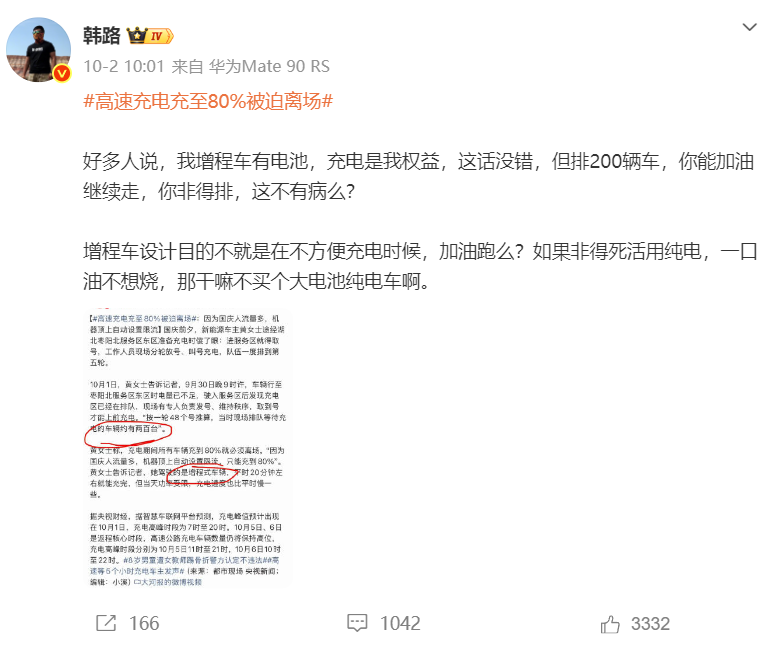
Screenshots from social platforms
In this regard, car blogger Han Lu directly criticized on Weibo, pushing the controversy to the climax: "There are 200 cars in line, and you can refuel and continue walking, but you have to wait in line. Isn't this unhealthy? Isn't the purpose of extended-range vehicles designed to refuel and run when it is inconvenient to charge?" He even made a calculation: 100 kilometers of electricity saves 18 yuan compared with oil. For this, queuing for four or five hours is completely unworthy of the time cost.
In Huxiu’s view, this war of words has never been about quality. The essence is a systematic misalignment of product positioning and public resource allocation.
The original design intention of extended-range vehicles is to "use both fuel and electricity, eliminating anxiety", but in daily use, the vast majority of car owners have developed the habit of "prioritizing the use of electricity and trying not to burn fuel".
Under such inertia, when it comes to high-speed scenes on holidays, "you can use gas or electric power" has directly turned into "you can recharge, but never refuel."
Because the fuel tank is your own private reserve and the charging pile is a public resource, the result is that public resources are being depleted at an accelerated pace.
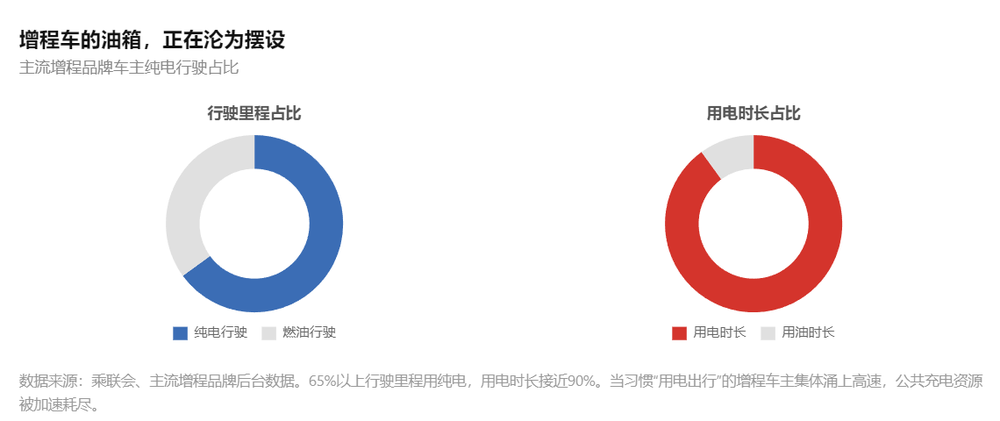
Data from the Passenger Car Association shows that the wholesale sales of range-extended vehicles exceeded 500,000 in the first half of 2026; backend data from mainstream range-extended brands shows that vehicle owners use pure electricity for more than 65% of their driving distances, and nearly 90% of the time they use electricity. When this wave of car owners who are accustomed to "traveling with electricity" collectively flock to the highway, they will not take the initiative to give up because "they can refuel". Instead, they will feel "Why can't I recharge?"
The use of two powered vehicles for the same set of piles is a misalignment of product popularization and public resource allocation. This mistake will not be solved in the short term.
The dispute between 800V and the brand’s self-operated piles over double standards
2026 was supposed to be the year when 800V high-voltage platforms and branded flash charging stations were launched on a large scale, which should have alleviated the pain points of energy replenishment. However, the National Day revealed a double embarrassment.
On the one hand, a large number of 800V new cars are on the highway, and the corresponding high-power piles cannot be found. Among the public charging piles across the country, 800V exclusive supercharging piles with more than 350kW account for less than 5%. Most of them are in urban business districts, and there are only a few high-speed service areas.
In this regard, Huxiu noticed that most car owners who charge in the service area can only plug in ordinary 120kW and 180kW piles.
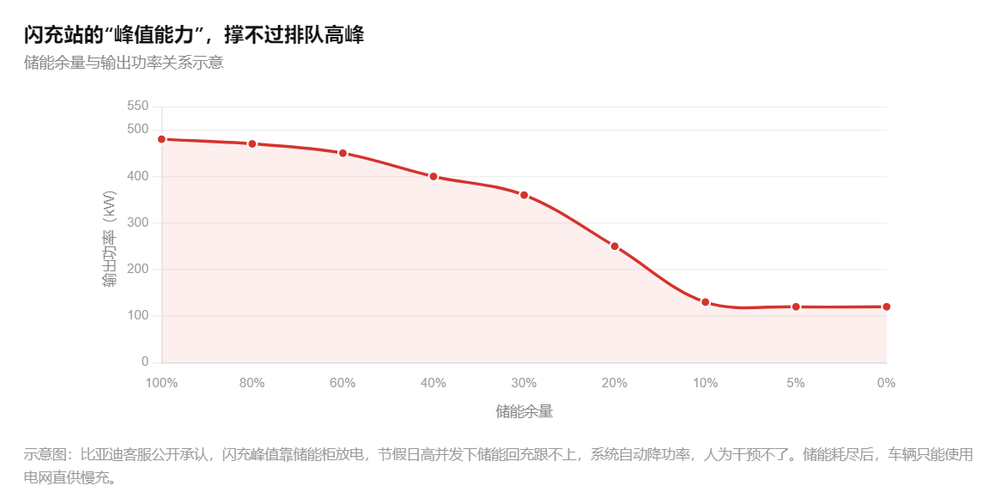
Although the car can "feed" 500kW, the piles can only "feed" less than a quarter. The advertised 10-minute fast charge is directly invalid at high speeds.
Tiger Sniff Cartography
A car owner who drives a Krypton car mentioned: "Theoretically, my car can recharge more than half of it in ten minutes, but it turns out that there are slow cars occupying the piles in front of it. It takes two hours to queue and half an hour to charge. The advantage of fast charging is all wasted on the road."
The other side is more controversial: the brand’s self-operated flash charging stations collectively “slow down” during holidays.
Many BYD car owners reported to Huxiu that the flash charging station in the high-speed service area was waiting until they realized that the power was not enough. "It all depends on how much power is left in the energy storage cabinet. The first few cars have exhausted the energy storage, and the rest is slow charging directly supplied by the grid, which is no different from ordinary piles."
In this regard, BYD customer service also publicly admitted that the peak flash charging depends on the discharge of the energy storage cabinet. During high concurrency during holidays, the energy storage recharge cannot keep up. The system automatically reduces power and human intervention is not possible.
Car companies spend money to build high-speed supercharging networks, relying on flash charging generated by energy storage, and the experience is amazing during peak periods. At peak times, queues are constantly spinning, and there is no time for energy storage to recover, and the peak capacity is directly ineffective.
Why can the construction speed of high-speed supercharging piles never catch up with the iteration of vehicle terminals? The answer lies in three rigid cost constraints, each of which cannot be circumvented:
The first is the cost of the pile itself: high-power charging piles require high-power IGBT devices, high-voltage DC modules and efficient liquid cooling systems. The cost of a single device is several times that of ordinary fast charging piles. Industry estimates show that the equipment and construction cost alone for a charging station with six 480kW supercharging piles exceeds 2 million yuan.
The second is the cost of supporting the power grid: building 10 500kW supercharging guns in a high-speed service area has a peak power consumption of 5,000kW, which is equivalent to the power consumption of a factory with a scale of 1,000 people. It requires special wires from the high-voltage power grid, and supporting upgrades of transformers and cables. The cost of urban power grid reconstruction is 500,000-800,000 yuan per kilometer, and the average cycle from application to power supply is 18-24 months; the power grid expansion cycle in high-speed service areas is longer, involving multiple administrative and investment cycles. Comprehensive calculations show that the total cost of a high-quality high-speed supercharging station is between 5 million and 8 million yuan.
The third is risk cost: the higher the charging power and the greater the current, the greater the heat generated by the power battery. The damage to battery life of high-frequency and high-voltage fast charging is about 30% higher than that of slow charging. Once a fire accident occurs at a charging station, technical identification and responsibility division alone will take a long time, and the operator's compliance risk and brand risk will be extremely high.
What's more, the construction model of charging stations is linear and gradual, while the technology of car companies is iterative. More charging stations have just been completed, and the technology of car companies has been officially announced to the next generation.
Currently, for fast charging to be successful, high-voltage vehicles, high-power piles, energy storage and unified regulations must be in place. Now the car is running at the front, and the rest are still chasing.
Battery replacement is still only for a few people
The biggest variable during this year’s long holiday is battery replacement.
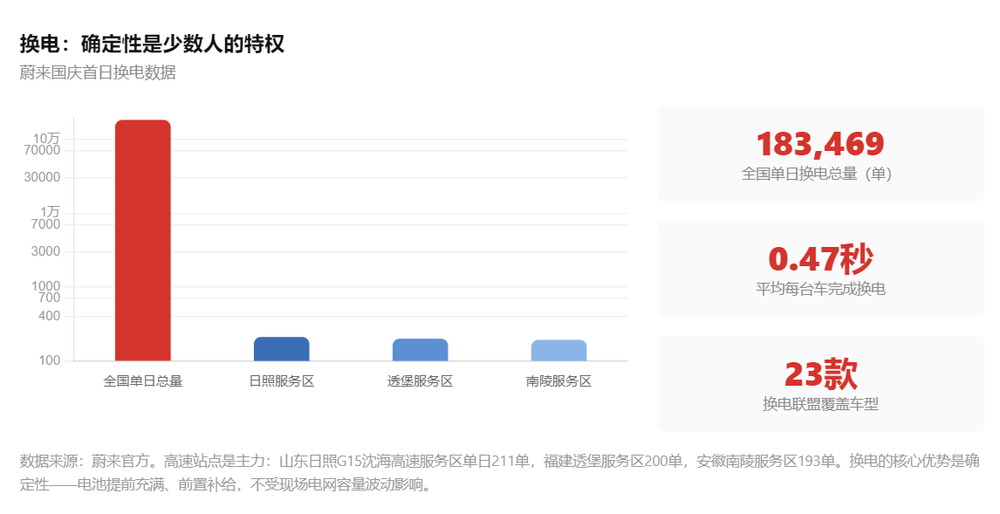
Official data from NIO shows that there were 183,469 battery swaps nationwide on October 1, a record high, with an average of 0.47 seconds for one vehicle to complete the battery swap. In this regard, Huxiu noticed that high-speed stations are the main output: Shandong Rizhao G15 Shenhai service area has 211 orders in a single day, Fujian Toubao service area has 200 orders, and Anhui Nanling service area has 193 orders.
Tiger Sniff Cartography
In fact, the core advantage of battery swapping has never been "fast", but certainty.
Charging piles will encounter power shunting and transformer overloading at peak times, and the nominal 10 minutes may become an hour; the batteries at the power swap station are fully charged in advance and are not directly affected by fluctuations in the on-site power grid. Staff at the Rizhao service area told Huxiu that the site has a fully charged battery at the front and adjacent sites to provide backup, and it can handle more than 200 orders every day during the National Day.
Bigger changes are at the industry level: Geely just announced its strategic investment in NIO Energy in September, and Changan, Chery, GAC and FAW have already joined the power swap alliance; CATL is taking BAIC and Aian on another power swap route, and the "Chocolate Power Swap" plan will build 1,000 high-speed power swap stations in 2027, with supercharging piles as standard.
It can be seen that battery swapping has an iterative trend from being an exclusive asset of a company to an industry-level energy supplement infrastructure.
But this certainty is currently only the privilege of a few people.
The current products in the auto market that support battery swapping are only a fraction of the 48.97 million new energy vehicles in the country. The vast majority of high-speed tram owners still have to rely on charging piles, and battery replacement cannot solve the public's queuing problem.
Moreover, power swapping cannot escape the tidal effect. On weekdays, the utilization rate of high-speed power swapping stations is not saturated, and the payback period for heavy assets is long. During holidays, there are still queues at popular stations, but the time is much shorter than at charging piles.
Trillions of investments cannot solve the tidal dilemma
In the face of peak pressure, various places have indeed adopted more coping methods this year than in previous years.
State Grid has deployed mobile charging piles in Bengbu, and emergency charging cabins have been set up in hot service areas in Beijing-Shanghai, Qingyin and Beijing-Taiwan; Fujian has deployed 18 mobile charging vehicles and moved them wherever there are traffic jams; Jiangsu has deployed more than 60 mobile terminals in 30 key service areas; 80% of Zaoyang North has left the site, Jiaxing has guided car owners to use high-speed charging, and the Ministry of Transport has launched the "e-road unblocked" applet to check piles.
Tiger Sniff Cartography
But these are all symptom relief, not treatment of the cause.
Few people face the truth:
The high-speed charging pile business is inherently unprofitable.
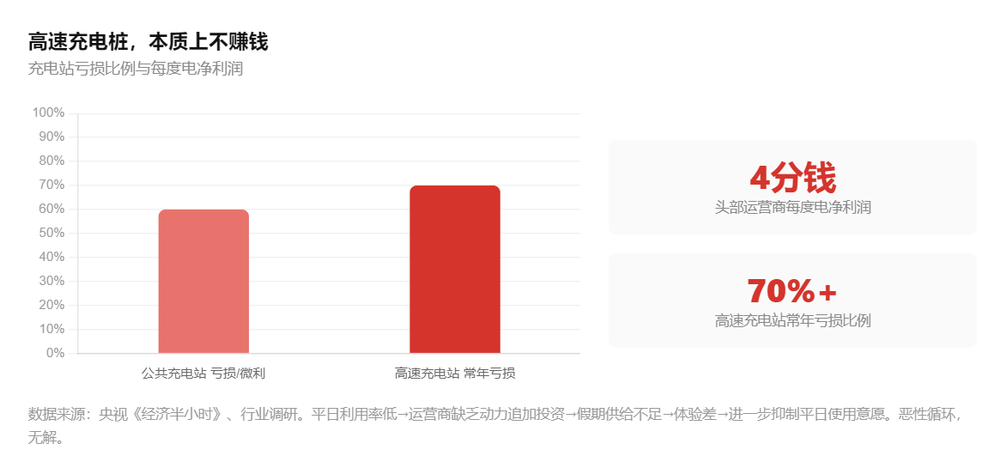
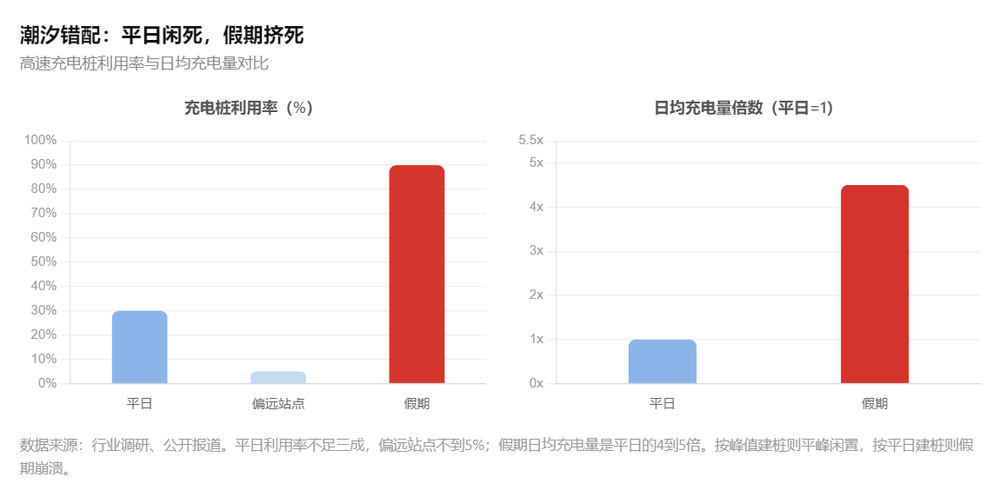
Industry data shows that the net profit of head charging operators is only 4 cents per kilowatt hour, and more than 60% of public charging stations are losing money or making a small profit. The piles in the high-speed service area are typical tidal assets: the utilization rate is less than 30% on weekdays, and less than 5% at remote sites. Rent, depreciation, and operation and maintenance cost money every day; during holiday peaks, equipment capacity is required to be far higher than usual.
A vicious cycle is formed like this:
Usage is low on weekdays, and operators have no incentive to invest more; supply during holidays is insufficient, and user experience is poor; this further reduces willingness to use on weekdays.
Some people say that it is enough to build piles according to the peak value?
This is simply impossible. The average daily charging capacity during holidays is 4 to 5 times that on weekdays. No asset-heavy infrastructure can withstand this level of fluctuation.
Tiger Sniff Cartography
If it is built according to the peak value, it will be idle for more than 300 days a year, and the investment cannot be recovered; if it is built according to the weekdays, it will be blocked during holidays.
Even for flash charging stations with energy storage, the energy storage capacity has a limited cost and cannot be infinitely stacked.
This is the same logic as the gas stations in the era of oil trucks, but the intensity is completely different:
Oil can be stored in storage tanks at low cost, tank trucks can be dispatched flexibly, and refueling guns can be turned around quickly;
The charging pile is tightly tied to the power grid, and the time for a single recharge is more than ten times that of refueling, and the tidal effect is multiplied;
Coupled with the interest game after the brand's self-operated piles are opened to the outside world, the problem is even more complicated.
The National Day Expressway energy replenishment in 2026 is a typical pain of progress on the road to the popularization of new energy.
Trillions are being poured in, the number of stakes is increasing, supercharging is being implemented, battery swapping is expanding, and operating methods are also being refined. However, the penetration rate of new energy vehicles for long-distance travel is rising faster, and demand growth always outpaces supply.
Of course, the fact that queuing has not disappeared does not mean that there is no progress:
The 80% rule has improved the turnover rate, mobile piles have saved the emergency, power grid replacement is spreading, and every improvement is shortening the queuing time.
However, new issues such as double standards for self-operated piles and slowdown in flash charging also remind the industry: when commercial facilities assume public functions, the question of fairness has already been handed to them.
We can never wait for the day when "high-speed charging will eliminate queues at all", and we should not set this goal.
The significance of trillions of investment has never been to eliminate queues, but to compress the collapse-level waiting to an acceptable range.The queues will get shorter, but they won’t disappear completely. As long as the pattern of concentrated long-holiday travel remains unchanged, this scene will happen every year.
Comments