
Abstract:
Starting from September 1, 2026, the State Administration of Taxation and other departments jointly announced that the lithium battery consumption tax will begin to be levied at 2%, and will rise to 4% from September 1, 2027. At the same time, sodium-ion batteries, solid-state batteries, and fuel cells will continue to be tax-free until December 31, 2028.
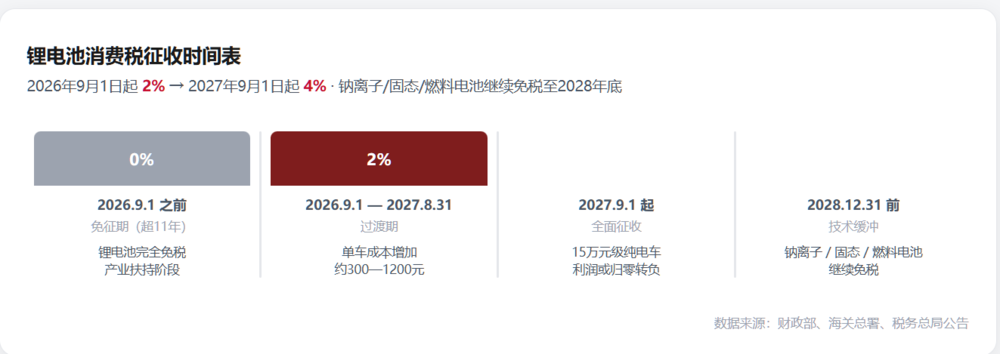
Battery consumption tax schedule
This is not an isolated tax adjustment.
Huang Yana, associate researcher at the Institute of Industrial Economics, Chinese Academy of Social Sciences, pointed out: "When the tax exemption was implemented in 2015, the industry was still in its infancy; now China's photovoltaic and lithium battery industry chains dominate the world. The inclusive tax exemption policy has completed its historical mission of 'getting started'."
The lithium battery industry, which has been protected for 11 years, is entering a period of change.
Battery factory: Some people rush to run, some people wait and see, the leader remains unchanged
On the eve of the implementation of the policy, the tension in the industrial chain has already spilled out of the paper.
According to Huxiu, some energy storage battery manufacturers began to ship goods intensively at the end of August, hoping to have the goods shipped out of the factory and issue invoices simultaneously before the policy takes effect on September 1.
The reason is simple: orders completed for shipment and invoicing before September 1 will not incur the 2% consumption tax. Taking a 500 million yuan contract as an example, the company can save about 10 million yuan in costs.
Everbright Securities pointed out in a report: Before the start of the tax collection period on September 1, battery cell factories may have a "rush to install" effect of concentrated shipments and early stockpiling, and August production schedule data may rise in the short term.
However, the responses were not unanimous.
According to Xinhua Finance, CATL did not adopt a "one size fits all" general increase model, but a layered and flexible negotiation strategy. At the 2026 semi-annual results conference call, CATL stated that "relevant policy adjustments will not have a big impact on the company's operations", and customers generally expressed their willingness to share the burden.
Many battery manufacturers have expressed support for the policy in their respective announcements and media interviews, and their shipment plans have not yet been affected.
Guoxuan Hi-Tech said the pace of shipments in August was "at normal levels." Sunwanda said that "the specific price increase plan has not yet been finalized, but the direction of cost transmission is clear." Yiwei Lithium Energy explained that the company's battery production capacity and market demand have been in a tight balance for a long time, the delivery rhythm itself has been at a high level, and there has been no additional disturbance during the policy window period.
But Yiwei Lithium Energy is also the first to "do it".
According to "China Business News", Yiwei Lithium Energy took the lead in issuing the "Letter on Price Adjustment on Transmitting Consumption Tax Costs", clarifying that starting from September 1, domestic sales of products will be subject to an additional 2% consumption tax on the original excluding tax price. Hunan Yuneng, an upstream lithium battery core material company, took action earlier. Starting from August 1, the price of the entire series of lithium iron phosphate products was increased by 2,000 yuan per ton, which launched the "first shot" of the new policy of industrial chain cost adaptation.
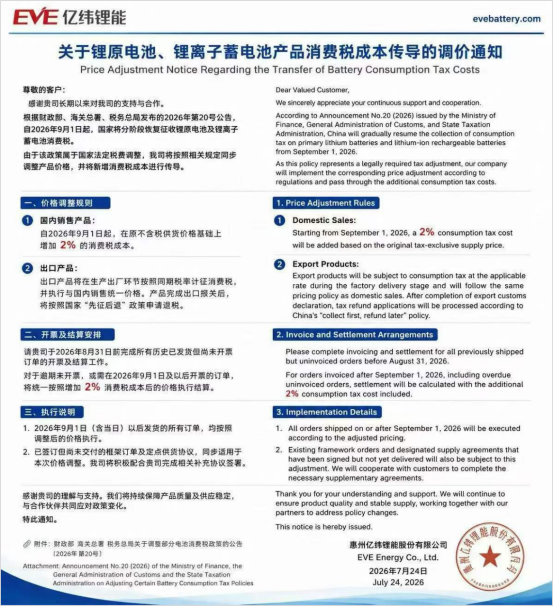
It is circulated on the Internet and has not been confirmed by the manufacturer
The judgment of Hu Song, a senior expert at China Automotive Data Co., Ltd.: In the short term, battery companies will mainly bear the new tax burden, because the supply of battery companies and car companies generally has long-term stable prices and will not be adjusted immediately with the market; however, it will be gradually passed on in the subsequent negotiations, and may eventually be partially transmitted to consumers, but the perception will not be obvious.
In other words, the first wave of pain will be borne by the battery manufacturers themselves, but the pain will not disappear and will only be passed backward along the industrial chain.
The differentiation between battery manufacturers is doomed from this moment on. Leaders rely on scale to dilute the tax burden and rely on bargaining power to share the tax burden with customers; second-tier companies seize the window period, issue price adjustment letters, and transmit pressure to upstream material suppliers; the most uncomfortable ones are those third- and fourth-tier battery cell factories that have no scale and are bound to low-price long-term agreements - their gross profits are only single digits, and a 2% tax is enough to eat up half of their profits.
Car companies: With a profit margin of 1.5%, can it afford hundreds of dollars?
The price increase letter from the battery factory has been sent out, and the OEM has taken over.
The problem is that the automakers themselves can hardly survive. Data shows that from January to May 2026, the profit margin of automobile manufacturing is only 1.5%. Many car companies only earn a few dozen yuan in profit from their bicycles, and some are still losing money.
How much does battery consumption tax cost?
According to Gaogong Lithium Battery data, the average price of domestic 314Ah lithium iron phosphate energy storage cells in August 2026 is about 0.365 yuan/Wh. Taking a new energy vehicle equipped with a 60kWh battery as an example, the battery cost of a single vehicle increases by about 438 yuan under a 2% tax rate; the increase reaches 876 yuan after a 4% tax rate.
Based on the mainstream 150,000-yuan household pure electric model equipped with an 80kWh ternary lithium battery, the new tax burden will be about 1,200 yuan in the 2% stage and 2,400 yuan in the 4% stage. If calculated according to the mainstream market, the cost of pure electric bicycles will increase by RMB 300 to RMB 1,000. (Huxiu’s note: The industry profit margin is not the net profit margin of a certain car, and the retail price of 150,000 yuan also involves differences in value-added tax, channels, sales expenses, after-sales and model structure. For reference only)
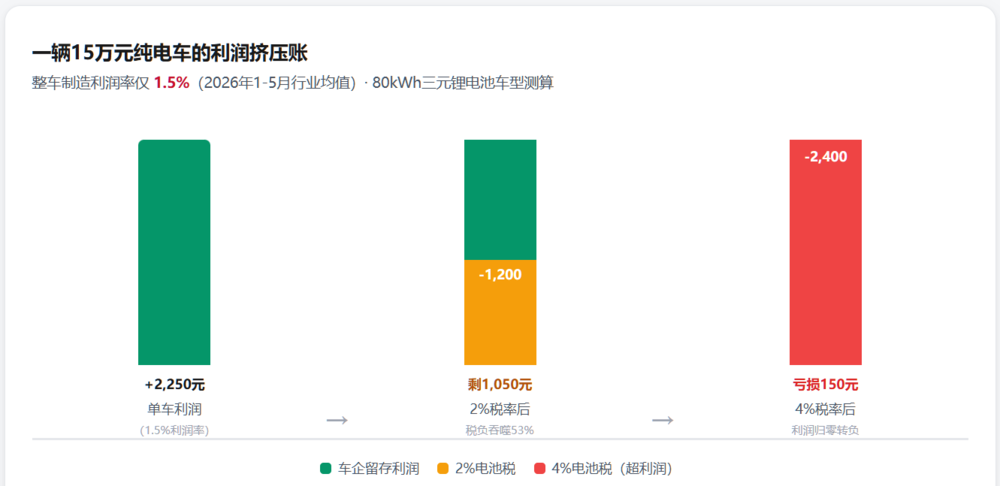
Huxiu Cartography Estimated loss of battery consumption tax on bicycles
We can do a simple arithmetic question: for a pure electric vehicle worth 150,000 yuan, based on a vehicle manufacturing profit rate of 1.5%, the profit per vehicle is about 2,250 yuan. If it is equipped with an 80kWh ternary lithium battery, the new cost brought by the 2% battery consumption tax will be about 1,200 yuan, which is equivalent to eating up more than half of the profit. By 2027, the tax rate will rise to 4%, the new cost will be 2,400 yuan, and the theoretical profit will directly return to zero or even turn negative.
In other words, car companies are not struggling to "make less money", but are struggling on the critical line of "whether they can make money or not."
Li Yanwei, a member of the expert committee of the China Automobile Dealers Association, believes that in the face of fierce market competition, car companies will most likely absorb the cost of the increased battery consumption tax themselves and will not be able to transfer it to consumers. "Unless everyone increases prices together, it is difficult to increase prices."
The person in charge of the marketing department of a self-owned brand car company admitted to the China Consumer News that the current price competition in the new energy vehicle industry continues to be fierce. If the battery factory transmits tax pressure to the OEM, the OEM will be unable to further pass on the pressure of price increases to consumers, and will ultimately be able to squeeze its own profit margins.
Duan Chao, chief macro analyst of Industrial Securities, regards this policy adjustment as one of the mild measures to "anti-involution." Lu Jinbiao, a consulting expert from the China Photovoltaic Industry Association, also pointed out that this adjustment “is mainly to guide the new energy manufacturing industry not to compete at low prices, but to provide high quality and low prices.” The implication: When the entire industry is selling cars at a loss, adding a little tax and forcing everyone to recalculate their accounts may not necessarily be a bad thing.
Under consumption tax, car companies have different pressure-bearing capabilities
Article 6 of the announcement clarifies: Taxpayers who produce taxable battery products for their own use and use them for the continuous production of taxable battery products will not pay consumption tax. Some media commentators believe that BYD, Great Wall (Hive Energy), Geely and other car companies that have achieved self-production of batteries can legally avoid taxes.
This is not true.
Huxiu reviewed the documents of the State Administration of Taxation and clearly stated in the official interpretation that self-produced batteries are used to assemble automobile products and are ‘used for the continuous production of products other than taxable batteries’, and consumption tax should be declared and paid when transferred for use. This means that car companies that produce their own batteries, such as BYD, Great Wall (Hive Energy), Geely, etc., cannot "legally avoid" this tax, but will incur tax obligations during the battery transfer and final assembly process. Its real advantages lie in internal settlement, supply chain efficiency and flexibility in profit adjustment, rather than tax exemption.
However, from a side perspective, self-produced batteries do have a comparative advantage in battery pricing power.
BYD's vertical integration has opened up the entire chain from lithium mines, cathode materials to batteries and packs. Batteries are produced for self-use without going through the sales process, and industrial risks can be reduced through internal collaboration. Great Wall has also achieved a closed-loop battery internal supply through hive energy. Geely's Quzhou Jidian and Yaoning batteries are also rapidly increasing their volumes. Although Tesla does not produce its own battery cells in China, it has sufficient flexibility in price negotiations through its deep integration with CATL and its scale effect.
What is really under pressure are those "naked" car companies: they have no battery production capacity, bicycle profits are meager, and the annual sales volume is not enough to dilute costs in procurement negotiations. They face two transmission chains at the same time - battery factories push the tax burden downwards, and market competition does not allow them to raise prices. The profit margin caught in the middle has been further compressed.
Of course, the tax burden will not fall equally on every link, nor will it be automatically transmitted backwards. Where it stops depends, first of all, on the contract structure.
Category 1: Annual long-term agreements between battery manufacturers and car companies.
Hu Song, a senior expert at China Automotive Data Co., Ltd., judged that the supply of battery companies and car companies generally maintains long-term stable prices and will not adjust immediately with the market. This means that for long-term agreement orders that continue to be executed after September 1, the 2% tax will probably be absorbed by the battery manufacturers themselves until the next negotiation cycle.The second category: spot goods and short orders from small and medium-sized battery factories.
The negotiation cycle for this type of order is short, and the battery factory can directly add taxes in the new quotation. But the problem is that whether you dare to increase it and how much you want to increase depends on market supply and demand. In the context of overall excess battery production capacity, small and medium-sized manufacturers without customer stickiness often have to swallow their own.Category 3: Fixed-price contract for energy storage projects.
The energy storage EPC and system integrator lock in the total price when bidding for the project. If the tax burden changes cannot be adjusted through the contract terms, the integrator himself will be the first bearer. A staff member of an energy storage battery division told Blue Whale News that "rushing to complete outbound invoicing before September 1st" is essentially trying to secure the final tax-free window for this type of contract.Category 4: Fixed-point price negotiation for new models.
This is the entrance where the tax burden really begins to be transmitted to car companies. New projects have no historical price baggage, and battery manufacturers can directly include taxes into costs when quoting. The problem is that at a time when car companies' profits are as thin as razors, adding two points to the quotation may directly lose the qualification for fixed-point.In other words, the 2% tax will not "flow", but will only "park" at the end of the contract with the most rigidity and the weakest bargaining power. Who holds the long-term contract, who holds the spot, who signed the fixed total price, and who is grabbing the new fixed point will determine who will be hurt first.
In business history, when any industrial policy is withdrawn, it will almost always be accompanied by a round of brutal reshuffle. After the photovoltaic "531 New Deal", companies without cost advantages were eliminated in batches, and the surviving leaders became stronger. There is a high probability that the lithium battery industry will repeat this scene.
Specifically for car companies, the path of differentiation is clear: the first tier is companies like BYD with a high proportion of self-produced batteries, and the tax burden is minimal; the second tier is CATL's core customers, relying on procurement scale and strategic cooperation to strive for shared burdens; the third tier is tail-end new energy brands that have neither battery factories nor scale advantages. They will be the first to feel the chill of 2% and face a test of survival before the 4% tax rate is implemented in 2027.
Small battery models gain marginal advantage
It is worth noting that the real structural role of the policy may not be between fuel vehicles and pure electric vehicles, but between the technical routes within new energy.
In the first half of 2026, the sales growth rate of extended-range models has slowed down significantly, and some models have declined. The high fuel consumption and power attenuation under high-speed conditions in the feed state make the technical transition attributes of range extension increasingly clear. More efficient plug-in hybrid technology is filling this gap.
The battery tax puts the same cost pressure on pure electric vehicles and extended-range vehicles, but has a relatively smaller impact on plug-in hybrids. The battery capacity of small battery models such as plug-in hybrids and gasoline hybrids is usually only one-fifth to one-third that of pure electric vehicles. If a 150,000-yuan plug-in hybrid vehicle is equipped with a 20 to 30kWh battery, the new tax burden under the 2% tax rate will only be 150 to 350 yuan, which is far lower than the thousand-yuan level pressure on pure electric vehicles at the same price. When the "tax-free dividends" of pure electric vehicles and extended range are weakened, the relative economic competitiveness of plug-in hybrids becomes highlighted.
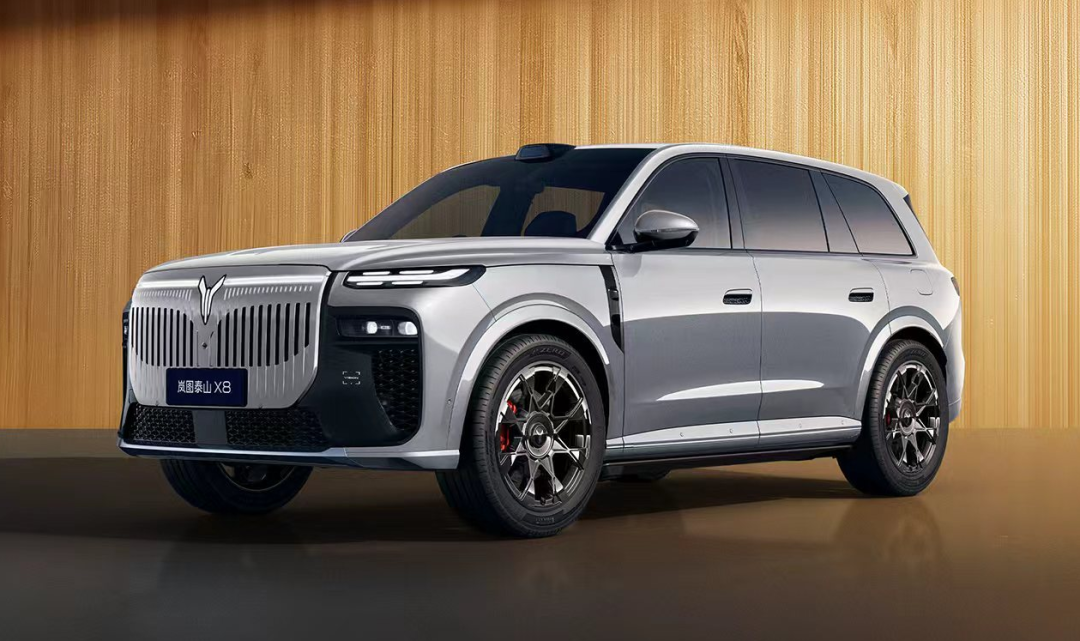
Lantu Taishan insert mixed version
Tax leverage has inadvertently accelerated the return to rationality on the technical route. Shen Yinghua, partner in charge of tax policy at Ernst & Young Greater China, pointed out that the differentiated arrangement of “one tax, one exemption” in the policy—taxation on lithium batteries and tax exemption on solid-state sodium batteries—not only helps standardize the tax order of mature industries, but also provides a policy buffer period for the research and development iteration of cutting-edge battery technology. Sodium-ion batteries, solid-state batteries, and fuel cells will continue to be tax-free until the end of 2028, which means that the policy is using real money to leave a window for the next generation of technology.
This is also beneficial to BYD. The battery capacity of the DM-i plug-in hybrid system is much smaller than that of pure electric models, so the battery tax pressure is naturally diluted.
To summarize, after the reform of the tax-sharing system in 1994, automobiles and refined oil products were included in the scope of consumption tax collection. Since then, fuel vehicles have long been responsible for multiple tax burdens such as purchase tax, vehicle and vessel tax, and fuel consumption tax. In 2009, road maintenance fees were reformed into fuel taxes, further solidifying the logic of “those who use the road more, pay more”. New energy vehicles have been exempted from vehicle purchase tax since 2014, and lithium batteries have been exempted from consumption tax since 2015, forming a de facto "tax depression."
This depression is not unreasonable. In the initial stage of the industry, tax incentives are the most direct support tool. But any support comes in cycles. When China's lithium battery production capacity accounts for more than 80% of the world, and when the annual sales of electric vehicles exceed 10 million units, continuing to provide tax exemptions for lithium batteries is no longer "support", but "subsidising mature industries."
Finally, we must be alert. Even if the battery cost increases by a thousand yuan, the economic advantages of pure electric vehicles throughout their life cycle will still exist. The consumption tax will slightly expand the cost difference between large-battery pure electric vehicles and small-battery hybrid models, but it will not be enough to change the outcome of the technical route alone. Pure electric vehicle manufacturers should not stop eating because of choking, but should actively embrace policies and seek innovation and change.
It took China's automobile industry forty years to go from "market-for-technology" to "changing lanes to overtake". For four decades, tax policy has played a key role behind the scenes. Today's resumption of battery taxation does not negate the new energy route, but declares a phased end: the growth based on tax exemptions, subsidies, and policy preferences has come to an end.
Comments