
Abstract:
A Tesla with no steering wheel or brake pedal started carrying passengers in Austin.
On September 3, Cybercab connected to the Tesla Robotaxi network and provided ride-hailing services in some areas. On the same day, the National Highway Traffic Safety Administration responded that it was contacting Tesla and assessing the situation.
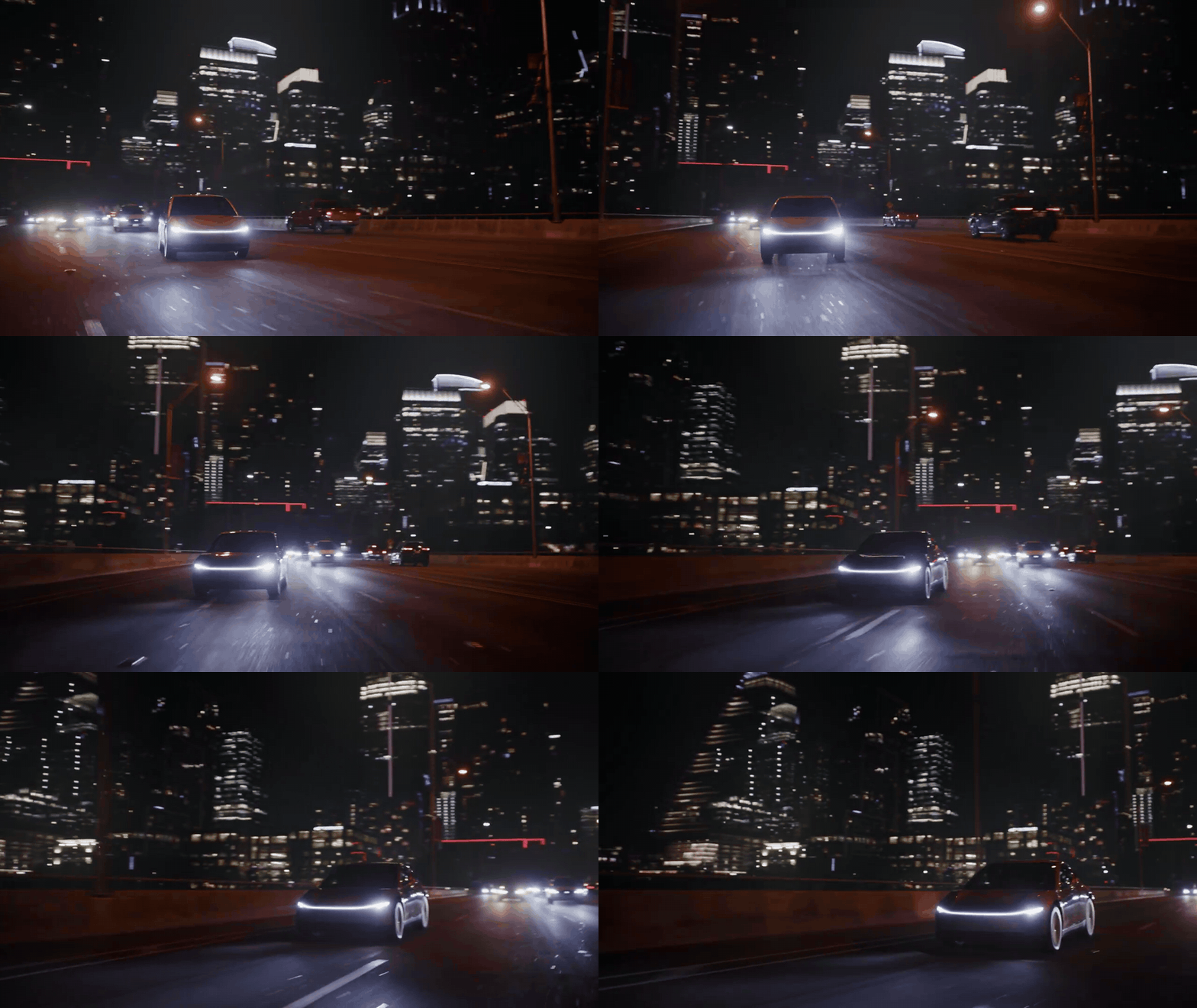
Unmanned taxis are no longer new, and Tesla has also used Model Y to operate Robotaxi.
What Cybercab has crossed this time is another threshold: a car that has canceled the manual driving device from the beginning of its design has begun to undertake the actual task of carrying passengers.
If this model holds true, the changes will be more than just one less driver in the taxi.
For ordinary people, the bigger question is whether they will need to buy a car in the future: when driverless taxis are cheap enough and readily available, the car may change from a durable good that needs to be purchased and maintained to an on-demand travel service.
But in Austin, Tesla currently has only 45 Cybercabs. The charges and full opening scope have not yet been announced, and supervision has not yet given a clear conclusion.
Cars are already on the road, but to truly replace buying a car, it depends on whether it can be cheap, stable, and readily available.
1. Cars without steering wheels began to carry passengers
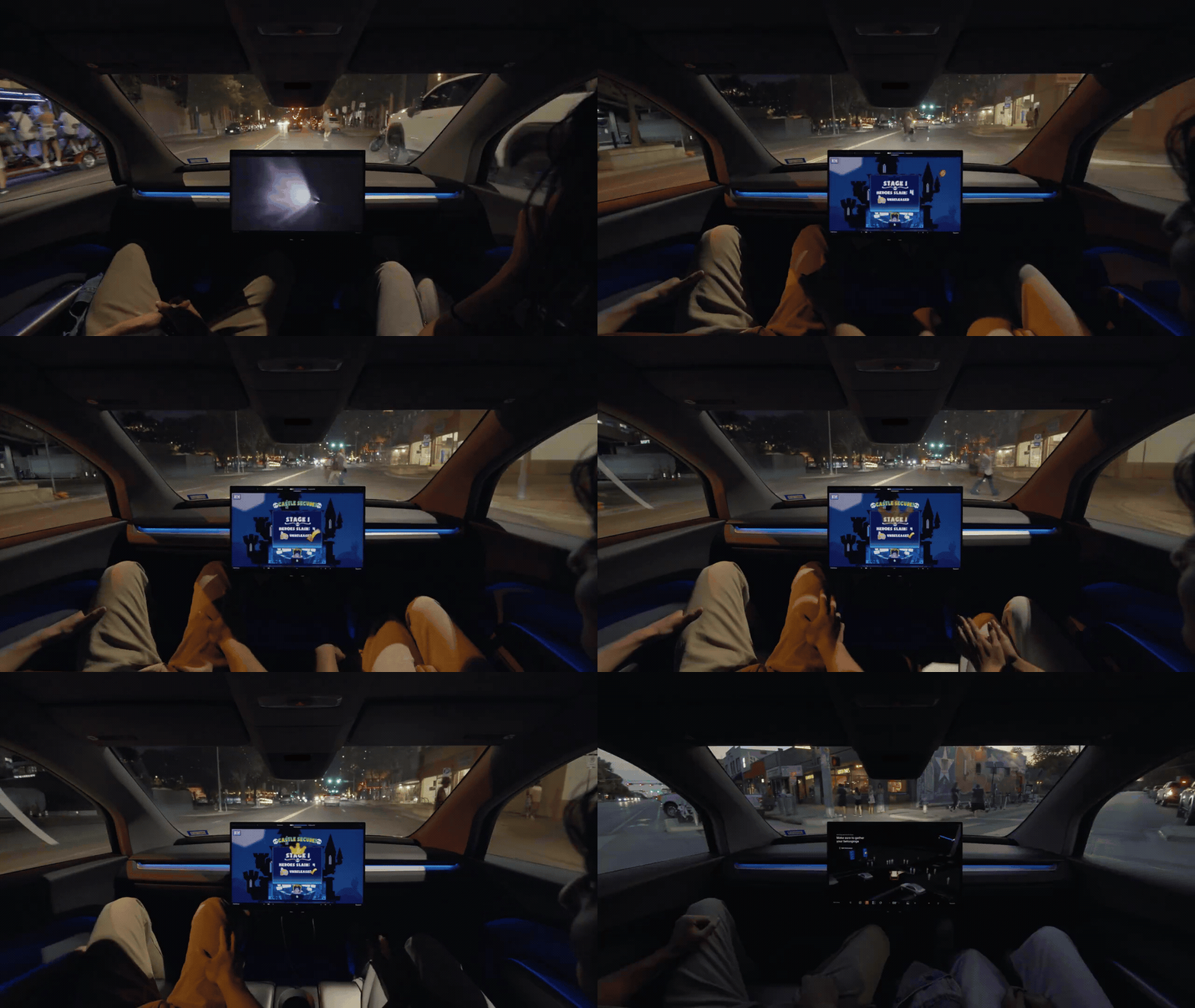
Cybercab is a two-seater model designed from scratch for driverless driving. It uses butterfly doors, has no steering wheel and pedals, and relies entirely on Tesla's autonomous driving system. A large screen is retained in the car, and Musk also said that Starlink allows passengers to watch 4K videos when there is no signal on their mobile phones.
This car has been put into production at the Texas Gigafactory this year. In June, it began engineering testing on the streets of Austin, and some vehicles still had safety monitoring personnel sitting in the passenger seats; by the end of August, the outside world began to photograph Cybercab without safety personnel. Musk has previously warned that initial production "will be slow."
On the day of the release, Tesla did not arrange a public live broadcast, nor did it announce the price of Cybercab rides. Musk did not go on stage to deliver a speech, but only wrote one sentence on the X: "The Cybercab storm is coming."

This "storm" is currently limited in scale. Records from the Texas Department of Motor Vehicles show that as of the evening of September 3, Tesla had registered 45 Cybercabs there. Including other models, mainly Model Y, Tesla has a total of 420 self-driving vehicles registered in Texas.
For comparison, Waymo has registered 988 vehicles in Texas; across the United States, its driverless fleet has reached about 4,000 vehicles.
Cybercab has entered actual operation, but it is currently only a small part of Tesla's Robotaxi network.
2. The car is already on the road, but supervision is still evaluating
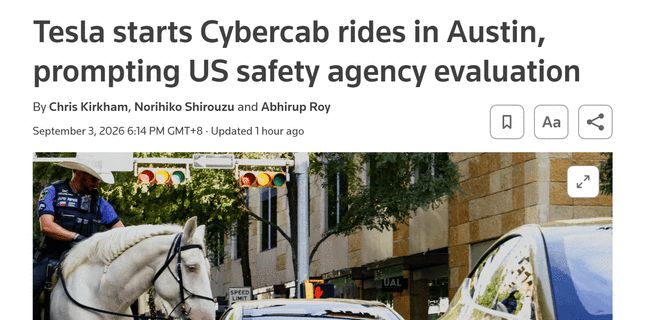
On the day Cybercab started carrying passengers, the U.S. National Highway Traffic Safety Administration gave only a brief response: "NHTSA is in contact with Tesla and is evaluating the situation."
The trouble lies in the most eye-catching aspect of Cybercab: it has no steering wheel and no pedals.
The current federal safety standards in the United States have long been based on manual driving devices such as steering wheels and pedals, but Cybercab has canceled them from the beginning of its design. Tesla has not publicly stated whether it meets existing requirements and whether expanded deployment requires exemptions.Federal rules limit the number of vehicles that automakers can sell without steering wheels and pedals; the number of vehicles used for testing is not subject to this limit, but this would also limit Tesla's ability to use these vehicles to operate for a fee. Tesla has not announced the price of Cybercab rides, nor has it said whether it will be available to all Austin Robotaxi users.
Cybercab is currently confirmed to be open in parts of Austin; Tesla’s Robotaxi service, mainly Model Y, has been expanded to other cities in Texas and Florida. The two cannot be mixed into the same batch of vehicles.
In the important market of California, Tesla has not yet obtained a license to operate Robotaxi services, nor can it test driverless vehicles without a front-seat safety officer.
In addition, parts of Tesla's Autopilot system are still under federal safety investigation.Tesla also updated its terms of service: Cybercab passengers must be at least 13 years old, while the previous minimum age limit for Model Y Robotaxi was 8 years old. The company did not further explain why the two models have different limits.
3. Feedback from the first batch of test rides is good, but the real test lies in daily operations
Most of the first test drive reviews came from supporters and technology bloggers invited by Tesla. They got the first batch of experience opportunities, and their feelings about the release were generally positive.
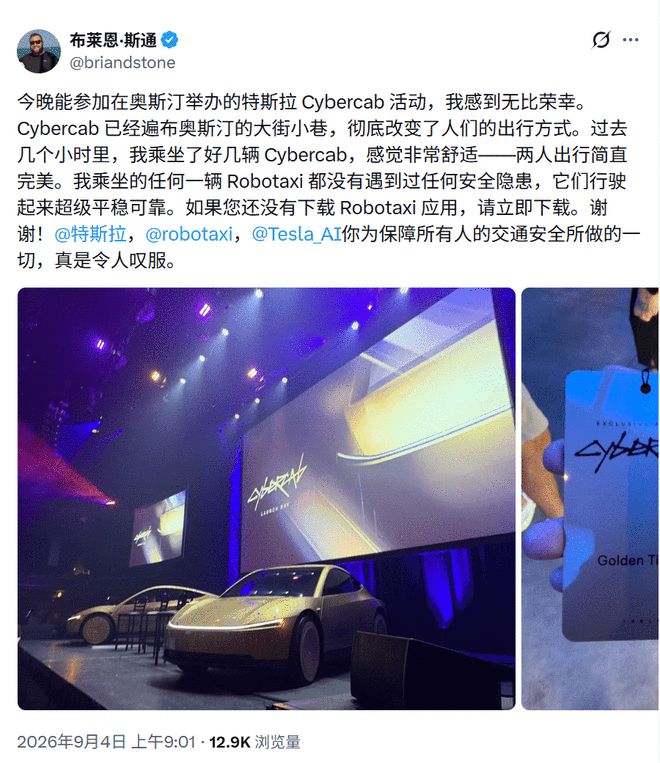
Tesla supporter Brian Stone said that he test-drove multiple Cybercabs in a few hours and found that they were comfortable and smooth, and did not encounter any situations that required safety intervention.
Another invitee took the ride three times in a row. The advantages listed include: it is smoother than Model Y, has lower road noise, has no obvious abnormal noise and vibration, and the in-car screen and audio experience are also good. Others mentioned that the butterfly doors will automatically open when passengers approach, and the large legroom and reclining seats were described by invitees as "more like a mobile lounge."
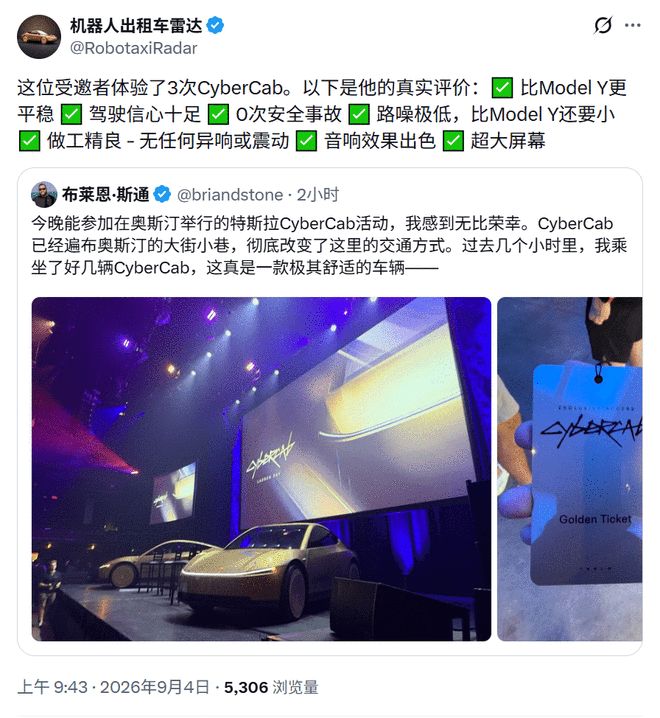
These feedbacks come from invitees selected by Tesla and also occur at scheduled events, and may not be equivalent to the daily taxi experience of ordinary users.
The invitees participated in the invitation-only event and signed a confidentiality agreement, and the content cannot be released until the event is over.The voices outside the court are more complicated. Some bloggers joked that Cybercab may not be able to stably handle night operations by arranging the press conference during the day.

Another user reported that a Cybercab was out of service due to trunk problems during the test ride, and accordingly questioned whether the product was fully prepared.
Tesla did not explain how to deal with such glitches in the daily operations of its autonomous fleet.

Other users continue to question Tesla's insistence on the purely visual route, believing that compared to Waymo equipped with lidar, it still needs more actual operating data to prove itself in complex environments such as rain, fog, and strong light.
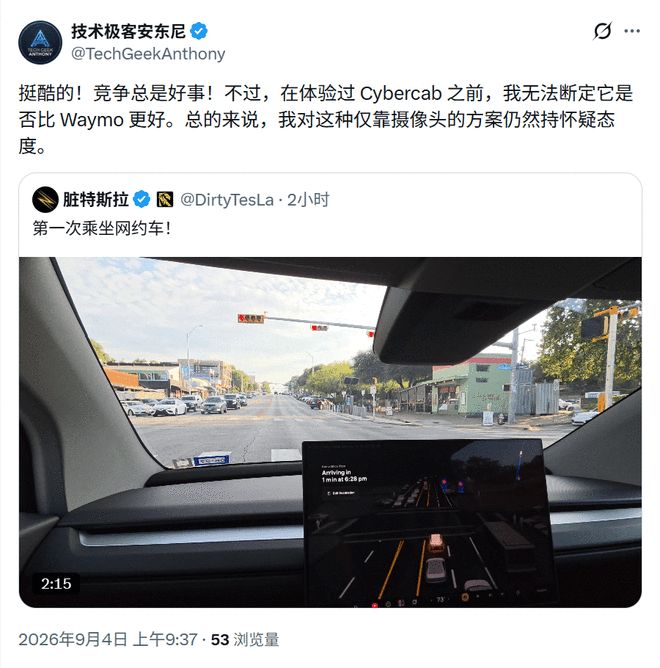
What is more worthy of reference are the operational tests that have already occurred. Earlier this year, when a Reuters reporter experienced Tesla Robotaxi (Model Y) in Dallas, he encountered long waiting times many times, and sometimes there was even no car available.
Three successful rides, the vehicle did not take the reporter to the city center destination within the service area, but stopped at a location where it still took about 15 minutes to walk.
4. From 45 vehicles to a network, Tesla does not want to rely solely on itself
Tesla did not announce the specific price of Cybercab’s passenger transportation.
The company's previous goal is to reduce operating costs to about 20 cents per mile and charge passengers 30 to 40 cents per mile.
But this is just the target number given by Tesla itself. It has not been stated whether it includes all costs such as vehicle depreciation, insurance, maintenance and infrastructure.If Cybercab can really lower the price to this range and provide a stable enough service, it will not only face Waymo and online ride-hailing.
For many city dwellers, the total cost of buying a car, insurance, parking and maintenance may need to be compared to hailing a driverless taxi at any time.But whether the low price can be established depends on whether the vehicle can continue to operate, whether the waiting time is short enough, whether the service area can be expanded, and how many orders each vehicle can complete per day.
What Cybercab has not released yet is precisely the data that determines whether ordinary people will give up buying cars.
On the day of the release, Tesla also launched an expression of interest form for enterprises, inviting potential partners to choose cooperation directions such as purchasing a Cybercab fleet, building travel hubs, and providing related infrastructure.
The form did not announce the terms of the cooperation, nor did it indicate whether Tesla would sell Cybercab directly to third parties.
But it revealed a possible way of expansion: Tesla is responsible for vehicles, autonomous driving systems and Robotaxi platforms, while third parties may participate in purchasing and operating fleets and building parking, charging and other facilities.
This will make Cybercab's business model no longer just "Tesla operates an autonomous fleet." If more companies are willing to invest in vehicles and infrastructure, Tesla may speed up its network rollout; if charges, supervision, and utilization cannot be calculated, partners will not pay solely based on Cybercab's technical vision.
Capital markets are still pricing in this possibility. On the day of the Cybercab event, Tesla’s stock price rose 5.4%, with a market value of approximately US$1.4 trillion. At the same time, the company's stock price has still fallen by approximately 21% this year.
As the traditional electric vehicle business faces competitive pressure, autonomous driving and Robotaxi have become one of the main basis for the market to price Tesla's future valuation.
Musk has repeatedly predicted for many years that the era of driverless cars is coming. In July 2025, he also said that the Tesla Robotaxi network would expand at a "super exponential" rate and cover half of the U.S. population by the end of that year.
This goal was not achieved.
Musk and company executives have become more cautious in their rhetoric in recent months, emphasizing avoiding injuries and accidents.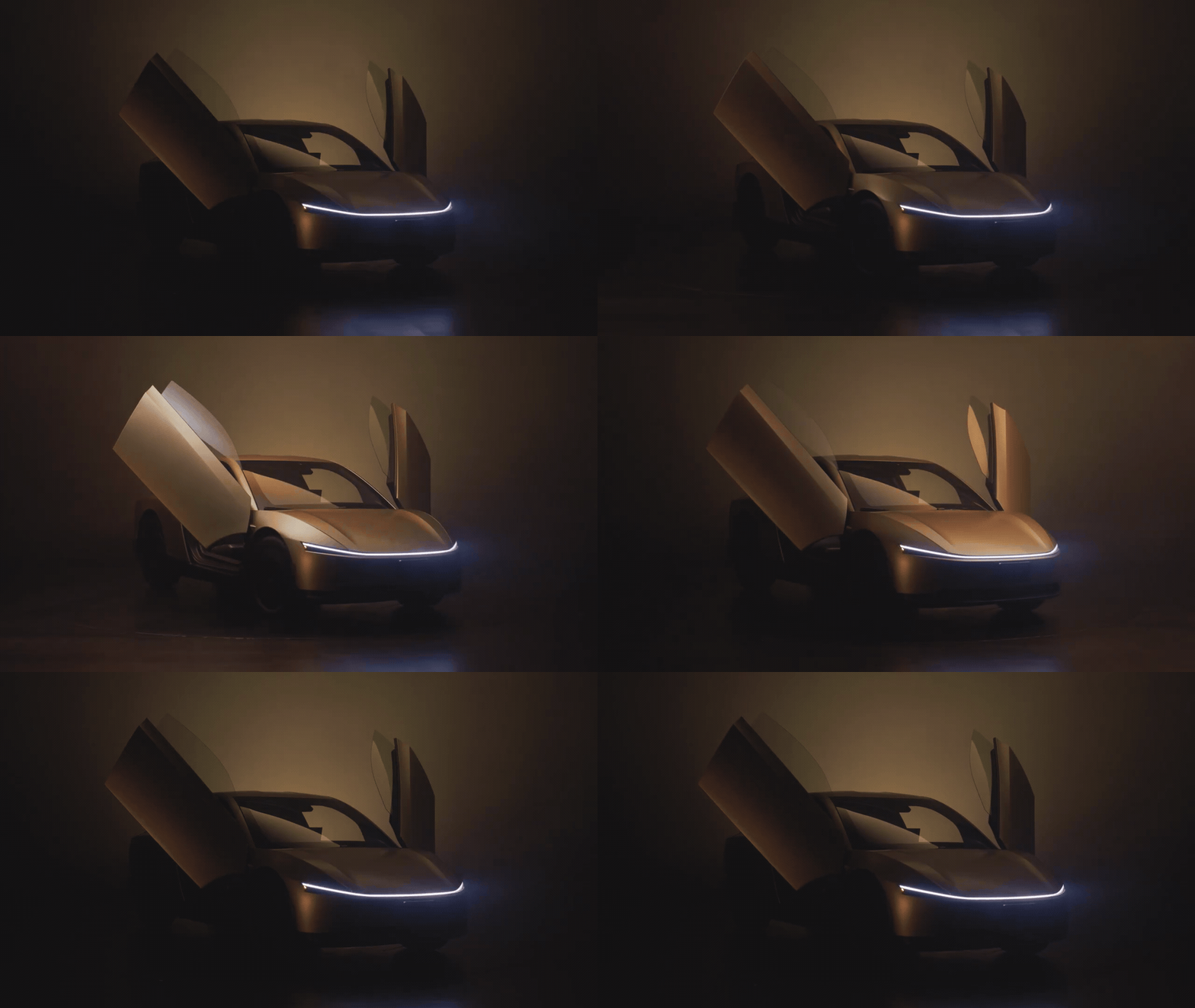
The copywriting Musk assigned to this event was "Cybercab Storm is Coming", and Tesla's promotional video read "The future has arrived in Austin".
The cars have indeed arrived, but there are currently only 45 of them. The price has not been announced and supervision is still evaluating. Will ordinary people give up buying cars because of this? They have to wait for these 45 cars to show off first.
Comments