
Abstract:
OpenAI is causing public outrage again! Just today, the global mathematics and AI communities were shocked by the news - without warning, without peer review, and even ignoring the long-standing etiquette of the academic community, OpenAI released a series of new mathematical results generated by internal cutting-edge models.
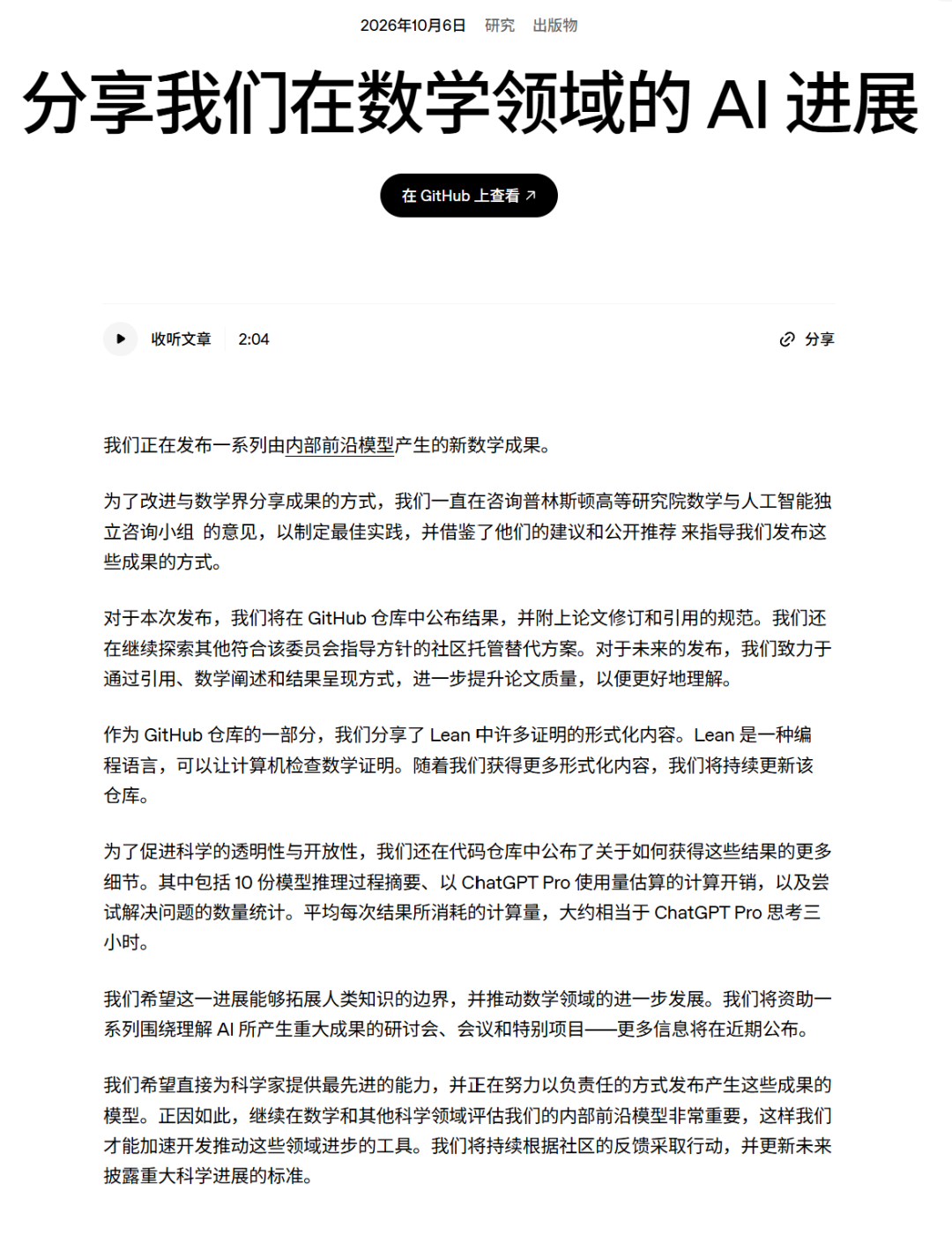
They released the GitHub project library math simply and crudely.
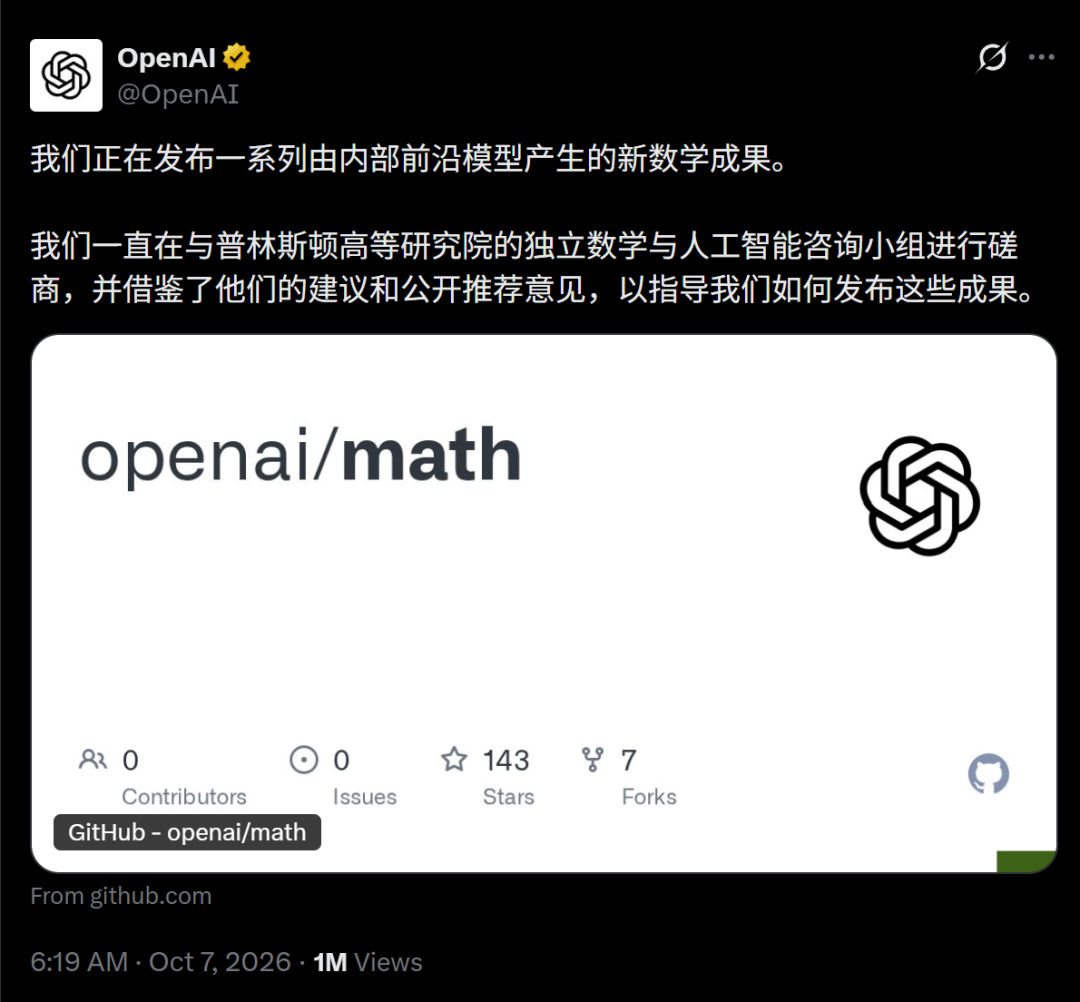
Link: https://github.com/openai/math/
Inside are 722 mathematical manuscripts, covering 372 families of previously unsolved top mathematical problems.
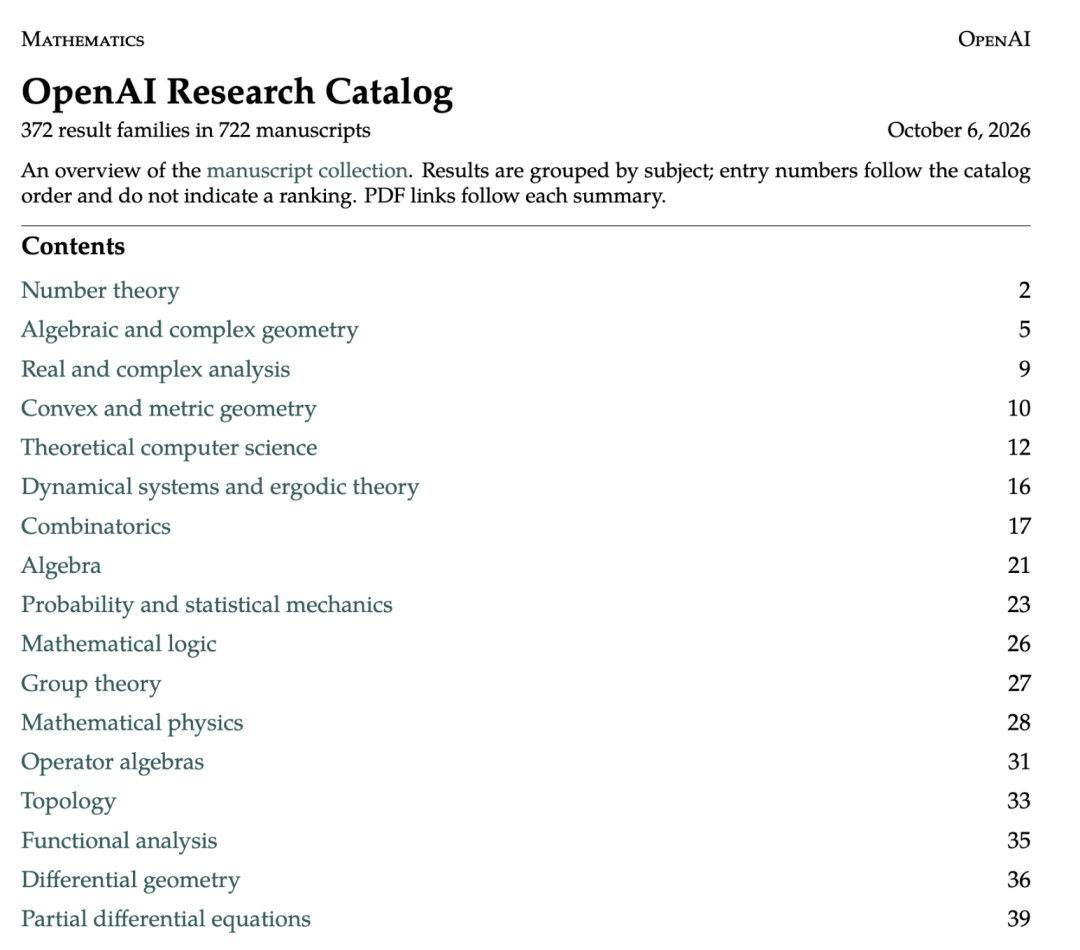
Link: https://github.com/openai/math/blob/main/overview.pdf
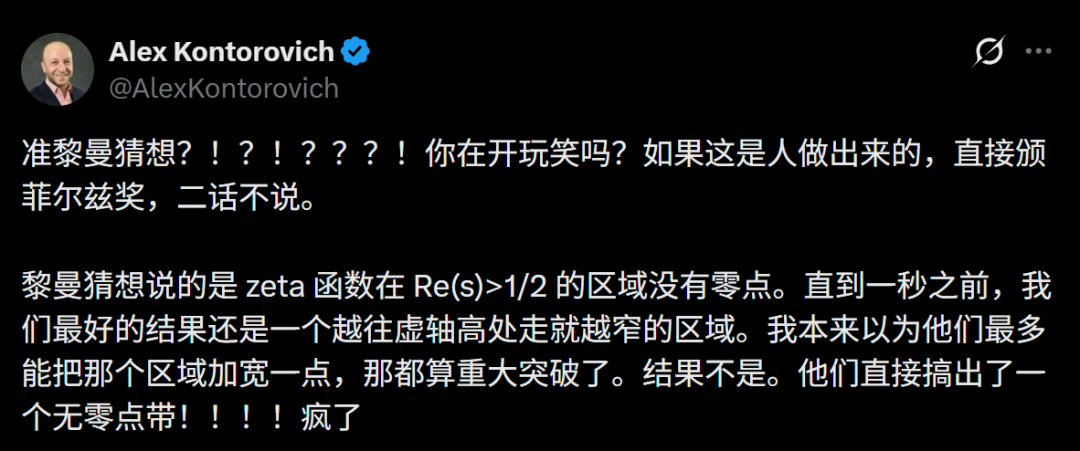
Among them, OpenAI’s unreleased AI model proved the quasi-Riemann hypothesis, and Lean formal verification was simultaneously released. If confirmed, this will be a historic breakthrough in the field of number theory and a milestone moment in the history of AI development!
According to OpenAI's disclosure, the proof of most difficult problems only took an average of 3 hours of ChatGPT Pro thinking power on an unreleased internal model!
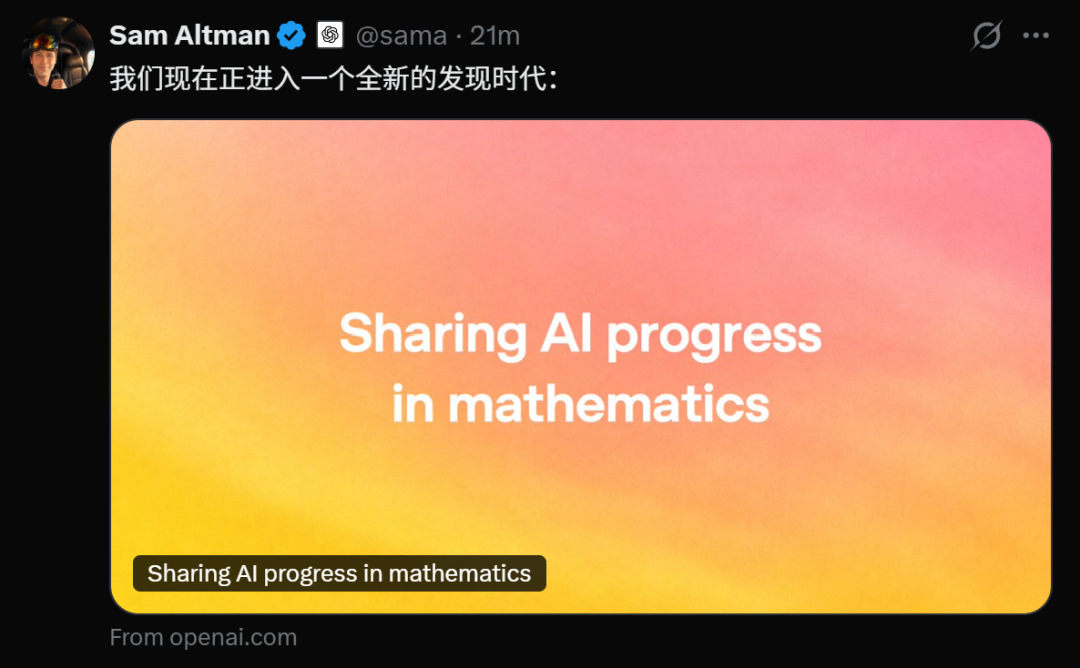
Ultraman X said: We are entering a new era of discovery
Mathematicians were furious.
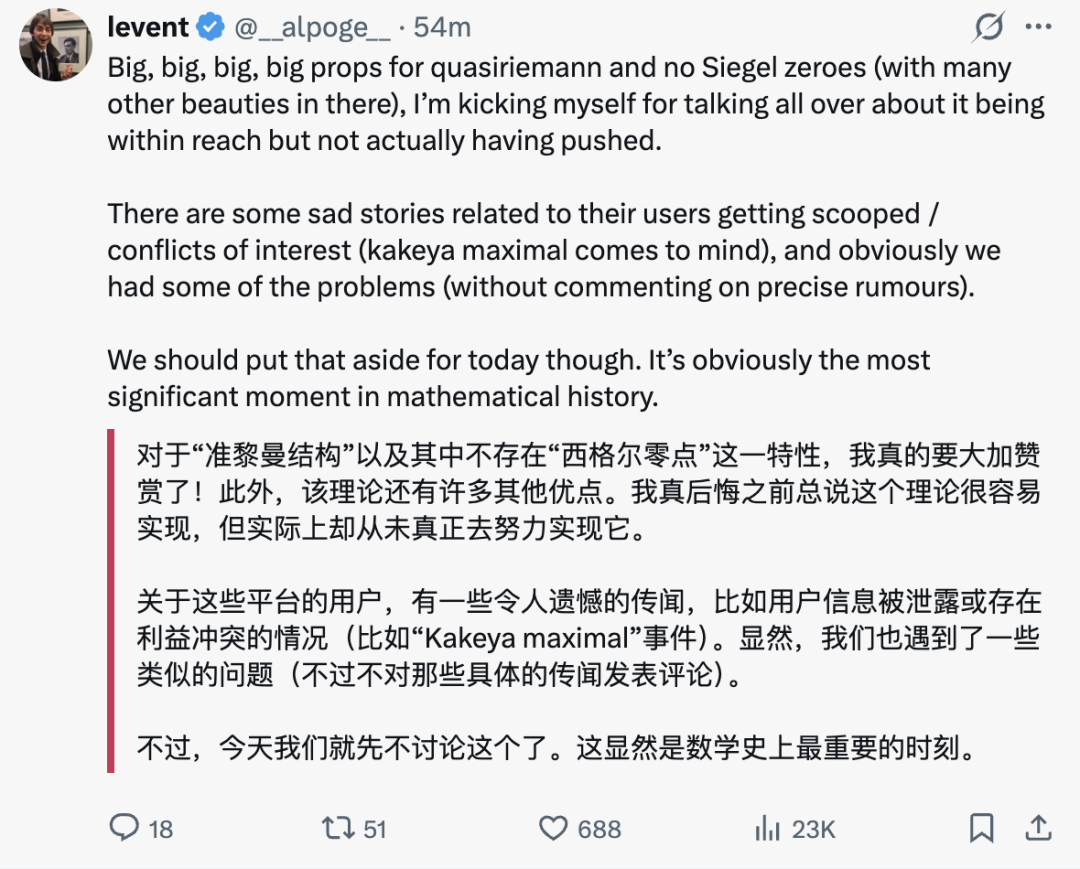
The list of puzzles to solve is breathtaking.
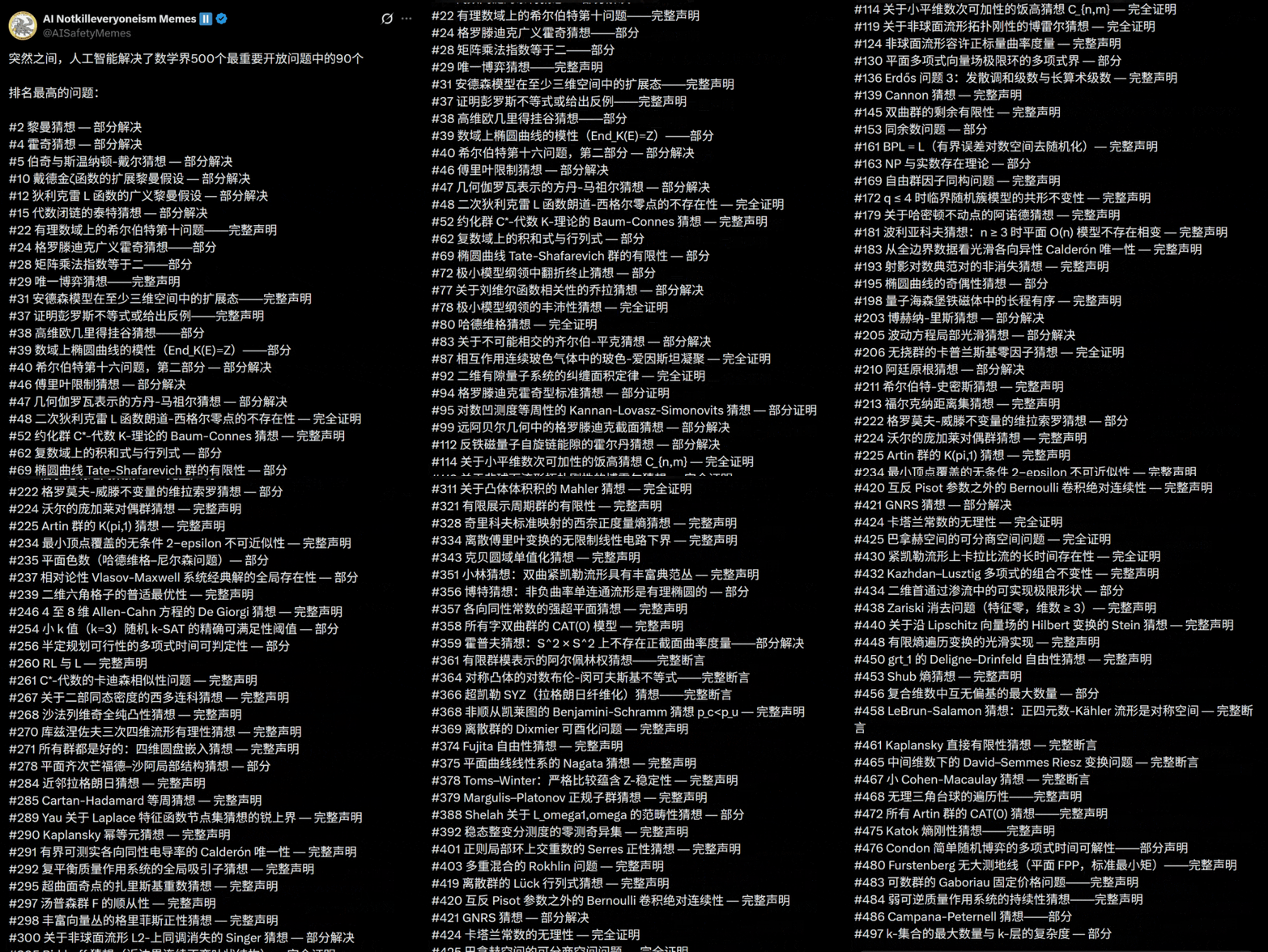
Mathematics explosion!
Behind this “academic massacre”, OpenAI and mathematicians have already been at war with each other.
According to "Wired", as early as August this year, OpenAI secretly convened 40 of the world's top mathematicians for a closed-door meeting. They raised a suffocating topic: "If AI surpasses humans in the field of pure mathematics, how should we respond?"
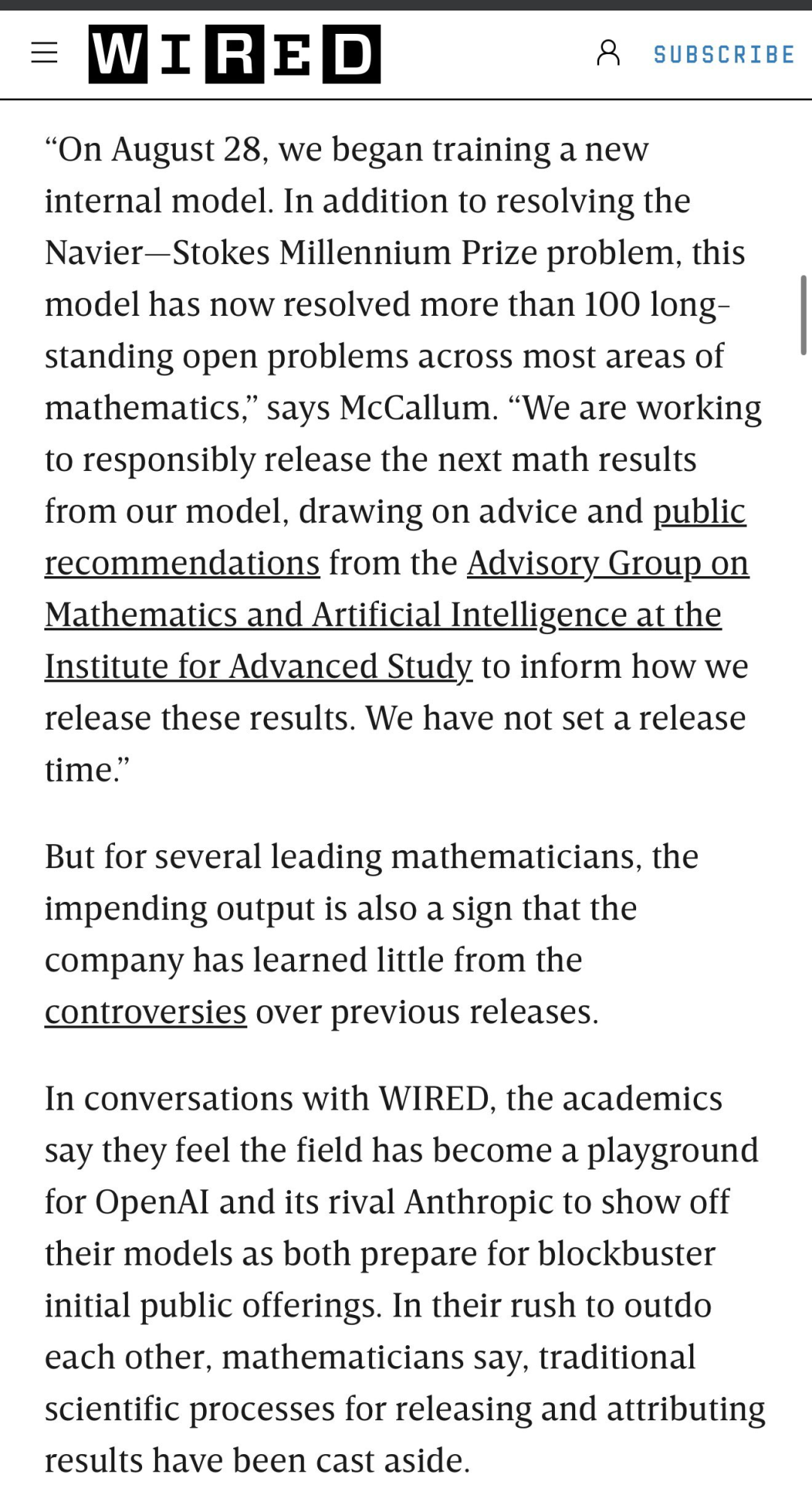
At that time, OpenAI revealed vaguely that its internal model had broken through hundreds of unsolved cases.
Bryna Kra, a well-known mathematician at Northwestern University, recalled that the atmosphere at the scene was "a coexistence of extreme excitement and extreme fear."
Scholars have tried hard to advise OpenAI: Don’t just post Twitter or short blogs like Internet celebrities. You must publish rigorous papers in accordance with academic standards, leaving time for human scholars to digest and verify.
However, OpenAI declared its sovereignty in the crudest way and even academically blocked the breakthrough of the Navier-Stokes equation in advance.
Nestor Guillen, a visiting professor at New York University, angrily complained——
In the eyes of mathematicians, these AI giants behave like gangsters! Everyone is feeling extremely panicked, not only because of AI itself, but also because the highest dimension of human intelligence power is being monopolized unscrupulously by a handful of technology oligarchs.
It was revealed that some OpenAI engineers have reached a private consensus: "Classical mathematics is dead today, and AI will have an unstoppable trend and end the careers of most professional mathematicians."
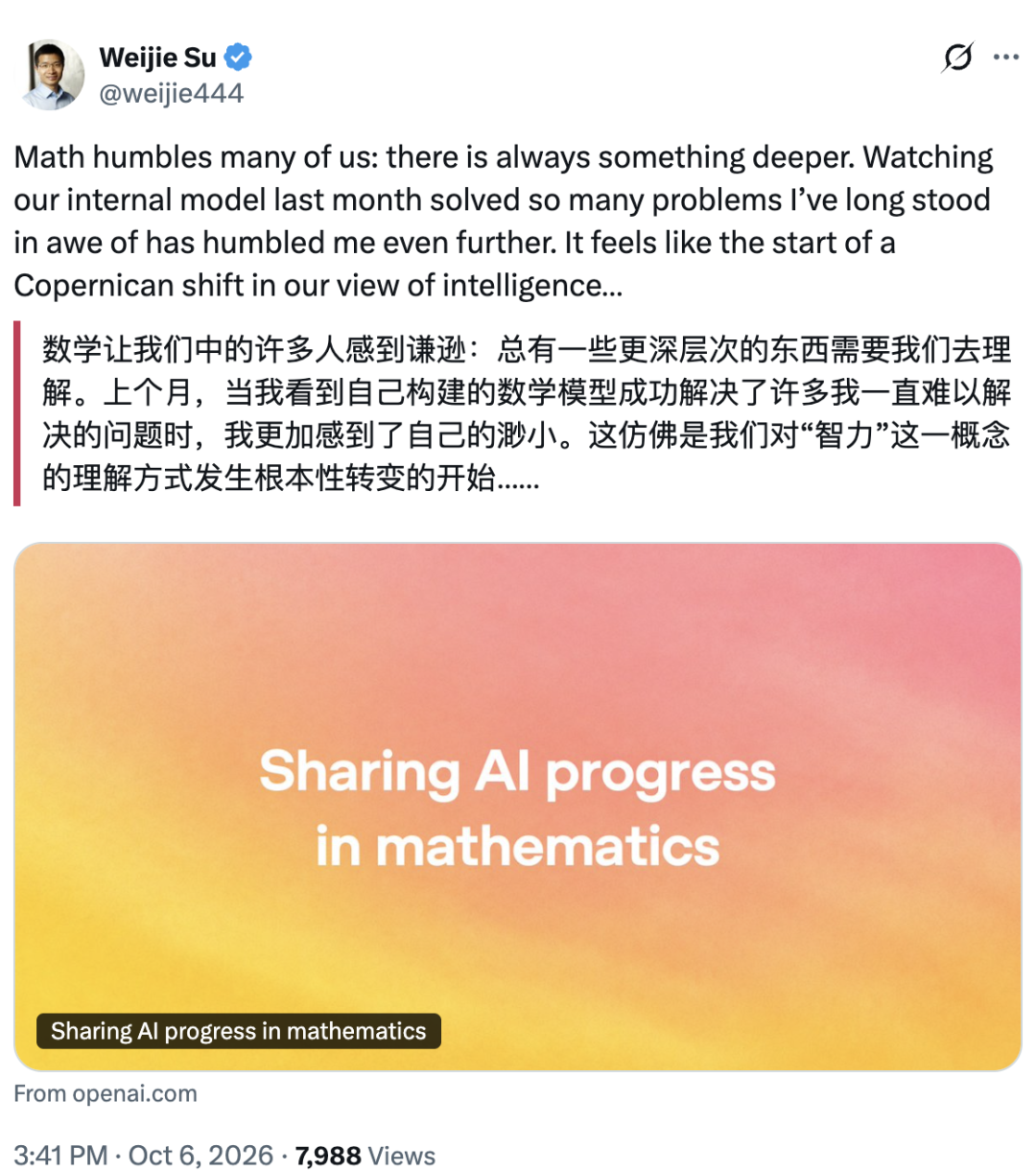
Su Weijie, a Peking University mathematics alumnus, winner of one of the highest awards in statistics, the "President Cowpus Award", and OpenAI researcher, said bluntly: This is like the beginning of a Copernican-like paradigm shift in the concept of intelligence.
AI nuclear explosion-level results: the quasi-Riemann hypothesis was overcome and the formal verification standard was passed
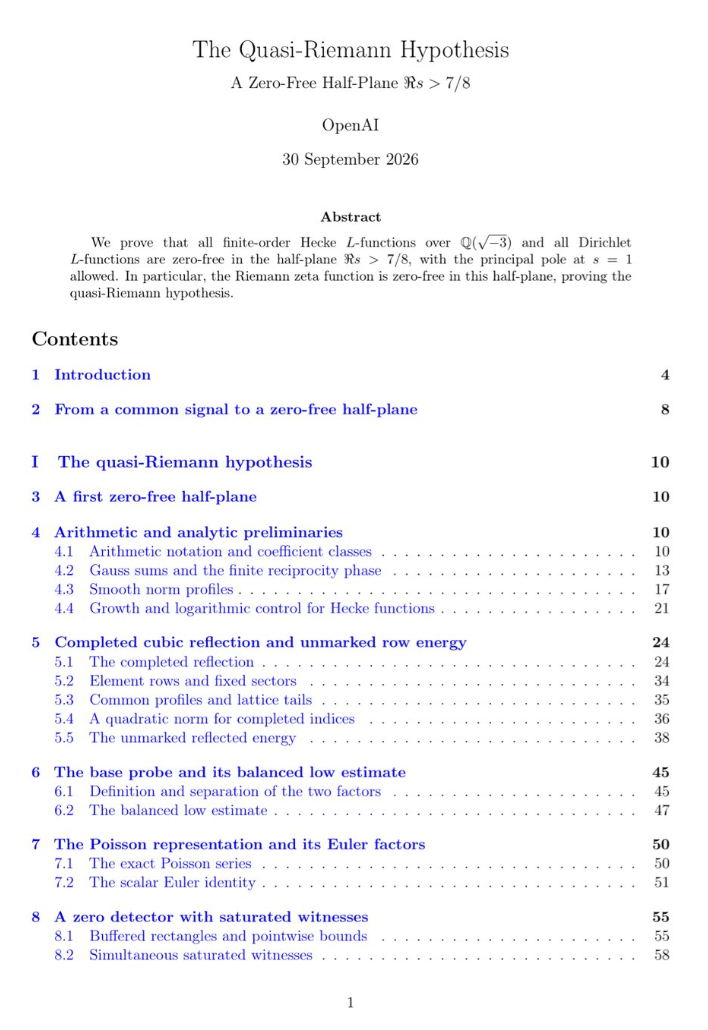
Among all the fortresses that were conquered, the one that first sent the entire number theory world into madness was the super result numbered Result 003 - which opened the door to the ultimate holy grail of mathematics, the Riemann Hypothesis.
The Riemann Hypothesis is recognized as the "crown jewel" in the world of mathematics. Hundreds of theorems in modern number theory are all based on the foundation of "the establishment of the Riemann Hypothesis". It asserts that all non-trivial zeros of ζ(s) lie on the line with real part ℜs=1/2. For more than 160 years, humans have even found it difficult to rule out that it is at the zero point far away from the 1/2 region.
Moreover, there lurks the specter of a "Landau-Siegel zero" - the possibility that some Dirichlet L-functions have anomalous zeros on the real axis very close to 1, hampering hope.
In this published manuscript, the OpenAI model comprehensively overcomes the "quasi-Riemann hypothesis": it is proved that all Dirichlet L-functions have absolutely no zero points in the half-plane of the entire real part ℜs>7/8!
Moreover, the Landau-Siegel Zero Point was completely eliminated.

OpenAI admitted in its GitHub description that most of the problems were automatically run by the model. Only in the work on the zero-point area of the Riemannian Zeta function, the research team conducted extremely rigorous manual review and readability polishing.
Although this has not yet completely reached the final ℜs=1/2, it has pushed the zero-point area to the fixed constant bound (7/8 and 11/12) in one go, and consistently eliminated the Siegel zero point. This is an unprecedented leap in analytic number theory in half a century!
Peak moment: Overcoming "normal NP-difficulty under basic semi-definite threshold"
In the field of computer science, if P vs NP is the ultimate crown, then "ordinary NP-difficulty under a basic semi-definite threshold" is the "uncrowned king" that determines the limit of human algorithms.
This is also the most disruptive research in this OpenAI results library (No. Result 102).
Link: https://github.com/openai/math/blob/main/reasoning_traces/basic-semidefinite-threshold-np-hardness.pdf
What is NP-Hard?
In the real world, a large number of large-scale optimization problems (such as chip wiring, logistics scheduling, route planning, graph coloring) are classified as NP-Hard problems.
Human beings cannot calculate the optimal solution in polynomial time, and can only resort to the next best thing to find approximate solutions. The semidefinite programming relaxation (Basic-SDP) is recognized as the most powerful approximation tool.
In 2008, computer scientist Prasad Raghavendra published a paper that has been handed down for generations. He proved an amazing conclusion: for any fixed finite constraint language (Max-CSP), the approximation ratio that Basic-SDP can achieve is the theoretical absolute limit of polynomial-time algorithms!
Link: https://dl.acm.org/doi/epdf/10.1145/1374376.1374414
However, this great theorem has a fatal premise - it must be based on the establishment of the "Unique Game Conjecture" (UGC).
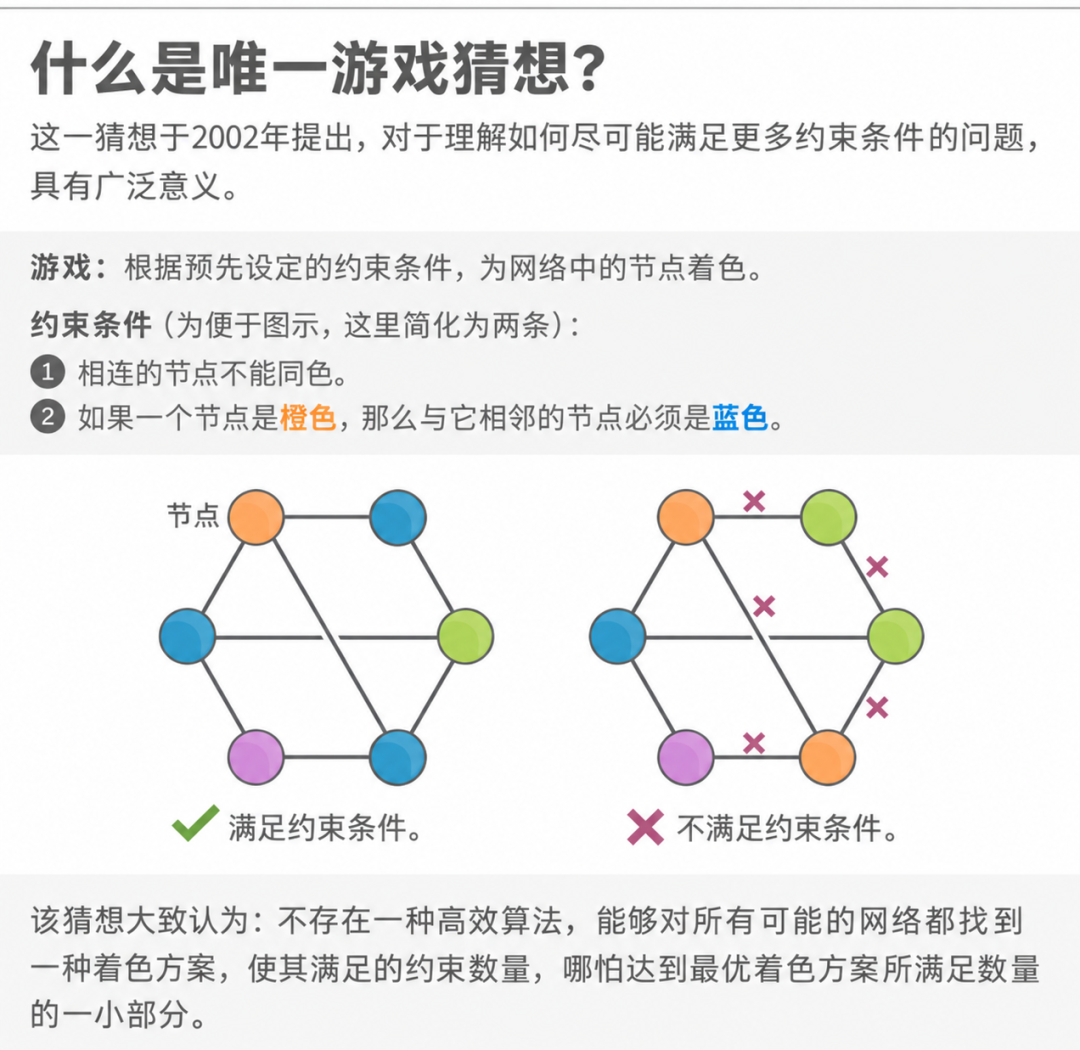
UGC is the problem of the century proposed by Subhash Khot in 2002.
If UGC is false, Raghavendra's theoretical building will collapse instantly, which is the "Achilles heel" of theoretical computers in the past 20 years.
In the past twenty years, the dream goal of countless theoretical computing scholars is: can we break away from the assumption of UGC and directly prove that the gap problem corresponding to the Basic-SDP threshold is itself ordinary NP-Hard under a pure, unconditional, classical framework based only on P≠NP?
If this conclusion is true, it means that under the pure assumption of P≠NP, any polynomial-time deterministic algorithm that attempts to surpass the performance of Basic-SDP is mathematically impossible!
How does AI tear down this barrier head-on? The following is the solution CoT.
In the first step, AI first reviewed Raghavendra's original framework and confirmed that repeated variables and local probability distributions cannot provide loopholes for constructing counterexamples.
AI realizes that if UGC is bypassed, the core obstacle is: in the classic PCP (Probabilistic Verifiable Proof) construction, the tensor representation will "leak" the projected coordinates, causing cheaters to easily pass the level.
In order to suppress information leakage without destroying completeness, AI gave up the smooth function route and introduced an algebraic core on the finite field with characteristic 2:

Then, AI designed a nonlinear decoder with shift equivariance

It is extremely insensitive to small noises but can be constantly captured by high-rank linear features, which resolves the information leakage dilemma.
Then, the AI adoption probability is only
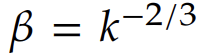
's extremely sparse projection, combined with the innovative "row fiber richness lemma", quickly returns the statistical error to zero while retaining sufficient decoding coordinates, completely blocking the possibility of fraud on local slices.
In the end, AI divided the entire grand proof into two sophisticated stages:
First step
: The difficulty of unconditionally constructing Unique Games with near-perfect completeness (1−ε) and arbitrarily small reliability (δ);Second step
: Connect to the dictator test system, use low-impact Gaussian variable replacement, and transfer the gap to the Basic-SDP threshold of any limited constraint losslessly.As a result, for the first time, AI is completely separated from UGC and is purely based on standards
P≠NP
The ordinary NP-difficulty that establishes the Basic-SDP threshold completely locks the theoretical physical boundaries of human effective approximation algorithms!A gap in the Millennium Puzzle: Hodge’s conjecture
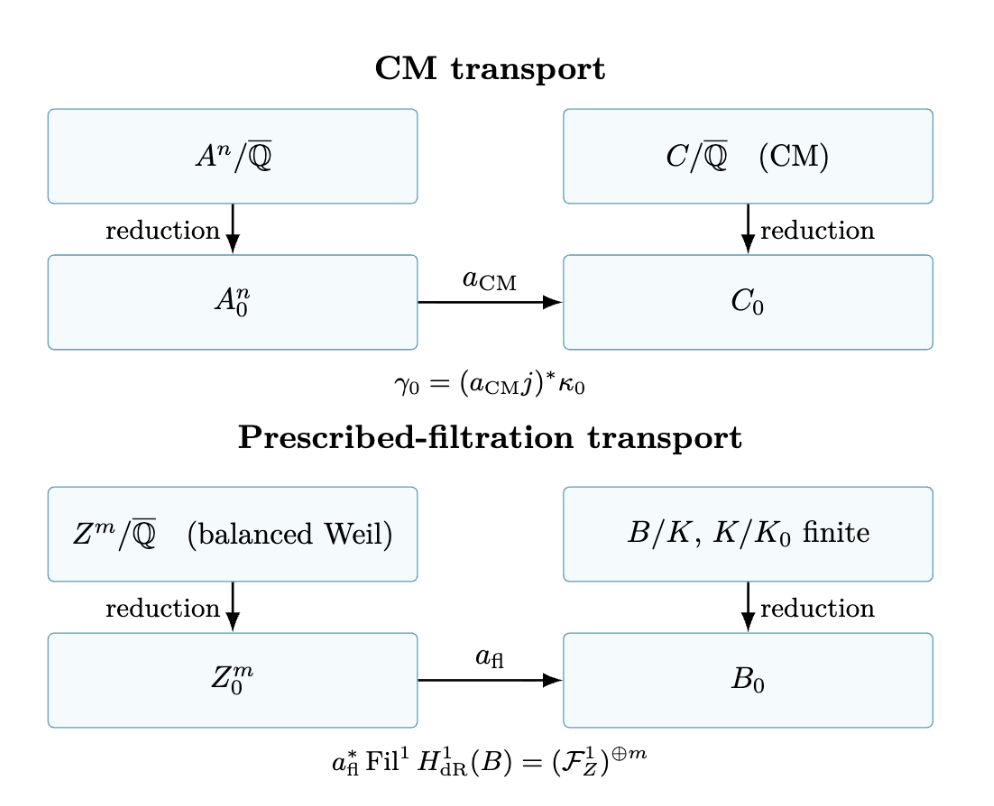
In the Result 01 manuscript, AI conquered a major fortress of the Hodge conjecture: it comprehensively proved the "rational Hodge conjecture" of Abelian varieties with complex multiplications (CM) in the complex number field in all dimensions and co-dimensions!
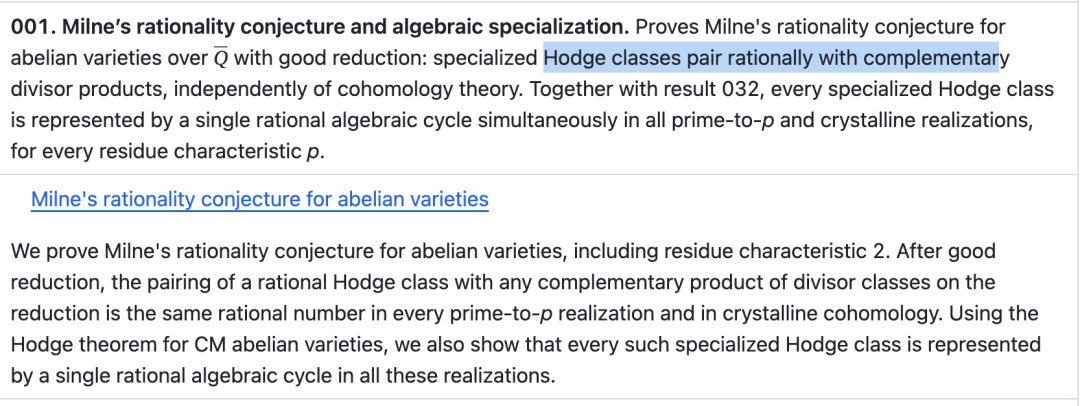
OpenAI official special instructions:
Most of the results are automatically generated by the standard model, but the proof of the complex multiplicative Abelian cluster Hodge conjecture is a special key breakthrough that breaks the conventional process.
Not only that, AI also extended this result to any finite product of projective complex K3 surfaces, and incidentally proved the Tait conjecture of all Abelian varieties on finite fields and the Hodge standard conjecture under arbitrary characteristics.
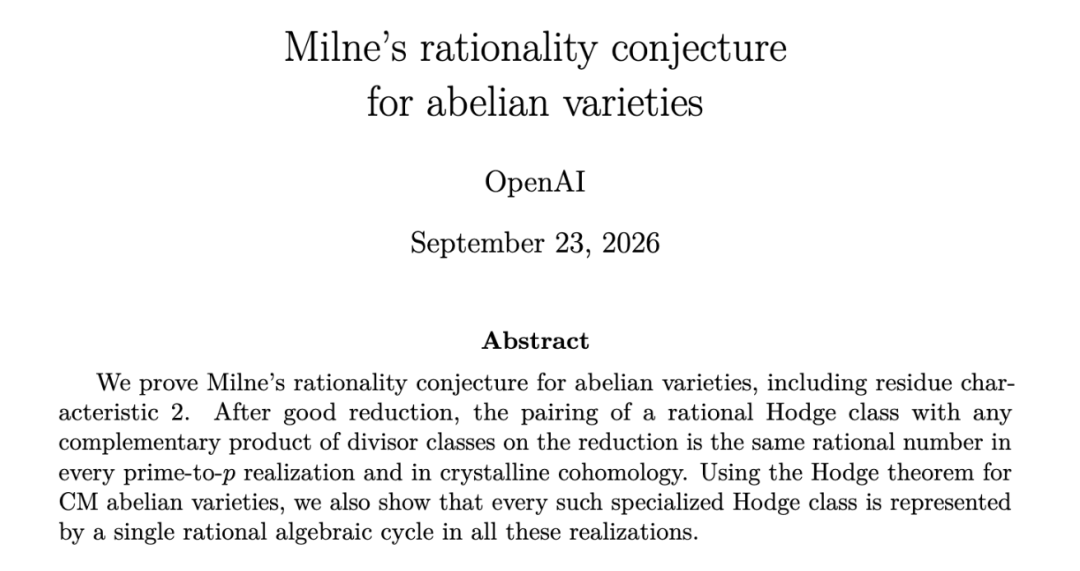
Link: https://github.com/openai/math/blob/main/preprints/Milnes-rationality-conjecture-for-abelian-varieties-September-23-2026/paper.pdf
AI’s problem-solving logic is as follows:
1. Transformation and projection
: The core difficulty in proving the Hodge conjecture is to prove that the abstract "Hodge class" is essentially "algebraic". AI did not try to attack all manifolds directly, but focused on highly symmetrical CM Abelian clusters and K3 surfaces.2.Kuga–Satake correspondence algebraization
: AI exploits the esoteric Kuga–Satake correspondence to embed the transcendental cohomology of the K3 surface into the second-order cohomology of the Abelian variety. It was successfully shown that the correspondence itself is induced by a rational algebraic ring.3. Degeneration and variational continuation
: Subsequently, AI used the Lie algebraic symmetry and the variational rigidity of Hodge general points to construct an algebraic path from the special curve coverage to the overall self-power variety, proving that these Hodge classes must be completely spanned by algebraic closed chains in the rational number field.This step is equivalent to opening a huge gap in the front of Hodge's conjecture!
Other mathematical problems of the century solved by AI
In addition, OpenAI's manuscript also contains many shocking breakthroughs in the fields of number theory, convex geometry and analytic geometry.
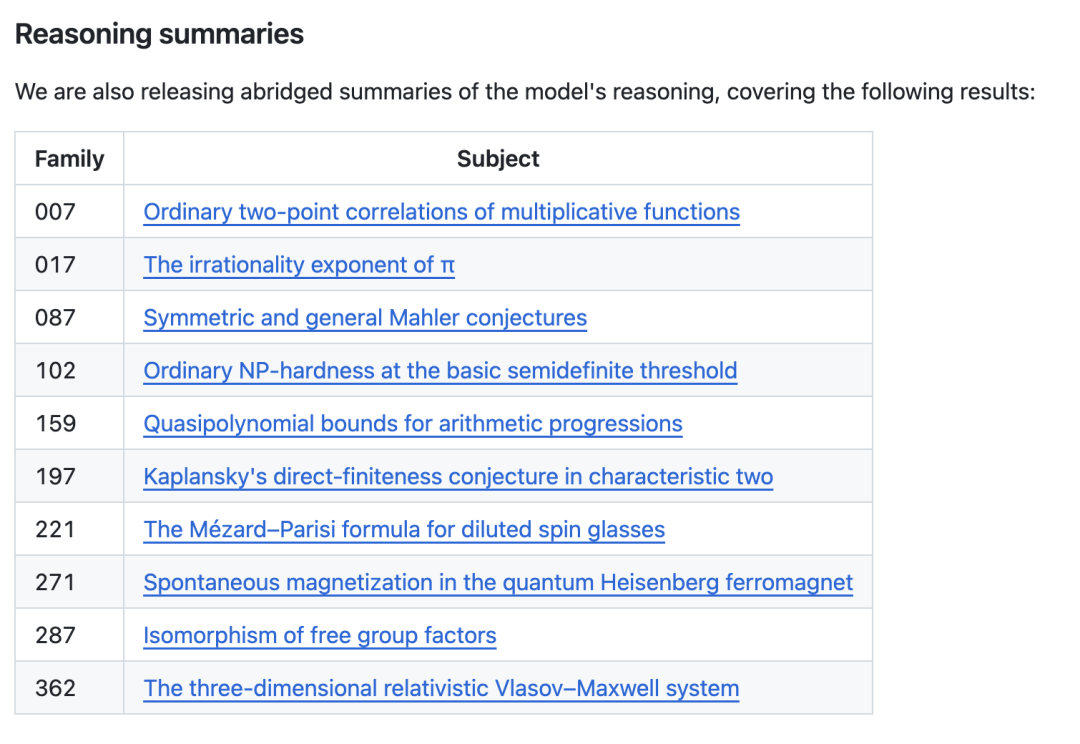
Ordinary two-point correlation of multiplicative functions (Result 007)
This is an extremely core issue in number theory, involving the famous Chowla conjecture and Elliott conjecture. The core is to prove whether the average of the products of a bounded multiplicative function under different translations tends to 0.
AI proves the ordinary two-point Chowla conjecture and achieves logarithmic power level error savings at every scale.
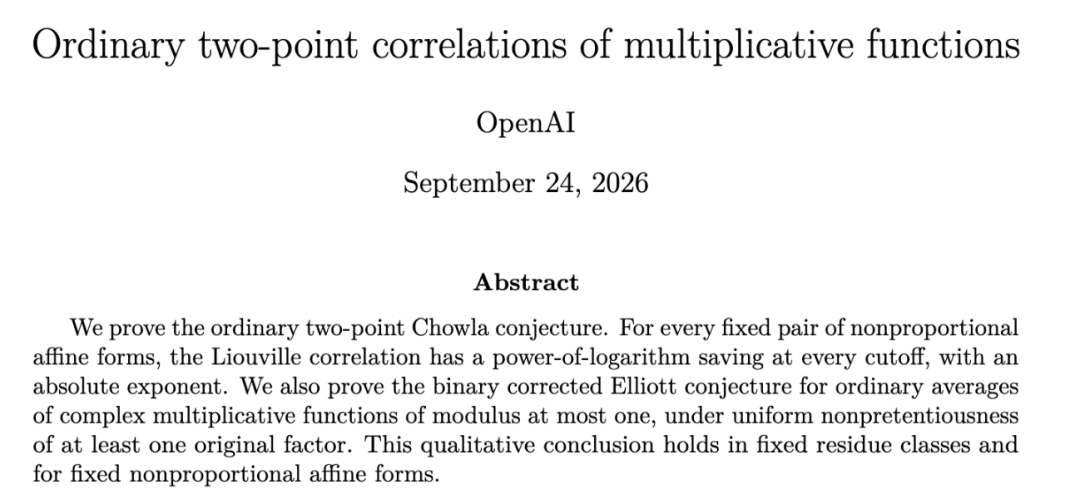
Link: https://github.com/openai/math/blob/main/reasoning_traces/ordinary-two-point-correlations.pdf
Symmetry and general Mahler conjecture (Result 087)
The decades-long unsolved Mahler conjecture in the field of convex geometry.
It asserts that in n-dimensional real space, the minimum value of the volume product of a convex body and its polar body is obtained at a simplex (for a general convex body) or a cube/crossed polytope (for a symmetric convex body).
AI solves both symmetric and asymmetric geometric Mahler conjectures in all dimensions, and provides a classification of all equal sign establishment conditions for Hanner polytopes and simplexes.
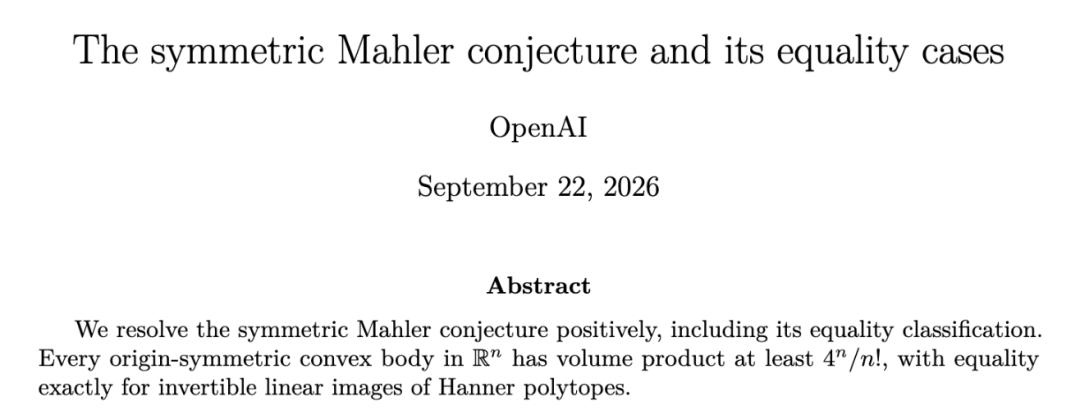
Link: https://github.com/openai/math/blob/main/preprints/The-symmetric-Mahler-conjecture-and-its-equality-cases-September-22-2026/paper.pdf
Is mathematics dead?
After reading this, the mathematics community felt a deep sense of powerlessness and shock.
In the past, we thought that AI proved mathematics and only performed pattern matching in massive corpus.
But the manuscripts released today are full of "intuition transfers", "structural counterexamples", "Laplace expansion" and "physical intuitions (such as heat flow simulations, Hamiltonian systems)" that only humans can understand.
It not only learned the human mathematical framework, it also created its own mathematical intuition.
Back to the heavy question at the beginning of the article: Faced with such a model that can produce top-level research results in just 3 hours on average, what should human mathematicians do?
Bryna Kra said: "We in this space have to adapt. It changes the way we operate, but it's also a moment where we can take a longer view... It's a scary time, but it's definitely an extremely exciting time."
When the answers to more than 100 unsolved century-old problems lie like cold data streams in the GitHub code repository, the era of classical mathematics may be over.
But mankind’s “silicon-based exploration” of truth has just begun. But in this new era powered by silicon-based intelligence, humankind’s exploration of truth has just sailed towards the sea of stars.
Tonight, no one in the mathematical world is destined to sleep.
Comments