
Abstract:
From 0:00 on October 1 to 24:00 on October 3, statistics on 62,700 highway charging facilities (guns) included in the national charging facility monitoring service platform show that,
Three days before the National Day holiday this year, the number of new energy vehicle charging times on highways across the country reached 2.9686 million times, with an average of 989,500 times per day, a year-on-year increase of 48.41%.
During the same period, the charging capacity reached 71.6193 million kilowatt hours, with a daily average of 23.8731 million kilowatt hours, a year-on-year increase of 49.39%.
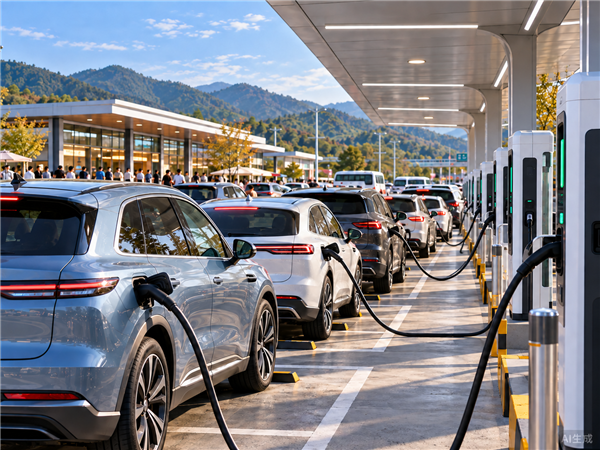
With the rapid growth of charging demand, new energy vehicles have been queuing up for charging in many high-speed service areas across the country. Some service areas have also adopted measures such as "leaving the site after charging to 80%" to improve the turnover efficiency of charging piles.
In this regard, experts said that this approach will not affect new energy vehicle batteries.
Qin Jian, director of the charging service center of State Grid Smart Internet of Vehicles Technology Co., Ltd., said that currently electric vehicles basically use lithium batteries, and lithium battery charging is divided into two stages.
Among them,
0 to 80% belongs to the high-efficiency fast charging stage, with fast charging speed and stable power. After the power exceeds 80%, it will enter the trickle slow charging mode.
The charging time for the remaining 20% of the battery is basically the same as the charging time for the first 80%, which consumes a lot of pile resources.
During peak charging hours, "eight-percent full" replenishment makes the battery safe and saves time; during off-peak hours, car owners can still fully charge the battery normally.
According to the forecast of the Ministry of Transport, the overall demand for highway charging during the National Day holiday is characterized by "dispersion on the outbound journey and concentration on the return journey".
From 10 o'clock every day, the number of charging vehicles in the expressway service area begins to increase significantly. After 21 o'clock, the traffic flow gradually drops, and the charging demand also decreases.
Among them,
October 5th and 6th are the core periods for return journeys. It is expected that the number of charging vehicles on the highway will increase significantly. The charging peaks are from 11:00 to 21:00 on October 5th and from 10:00 to 22:00 on October 6th.
Comments