
Abstract:
It is reported that a team led by James Quach, a quantum science researcher at Australia's Commonwealth Scientific and Industrial Research Organization,
successfully constructed a quantum battery prototype that can be charged at the femtosecond (10 minus 15 seconds) level and extract current from it for the first time.
The core principle of this quantum battery is a quantum effect called "superabsorption." In traditional batteries, the larger the battery, the longer it takes to charge. The superabsorption effect is just the opposite. The more molecules involved, the faster the system absorbs energy.
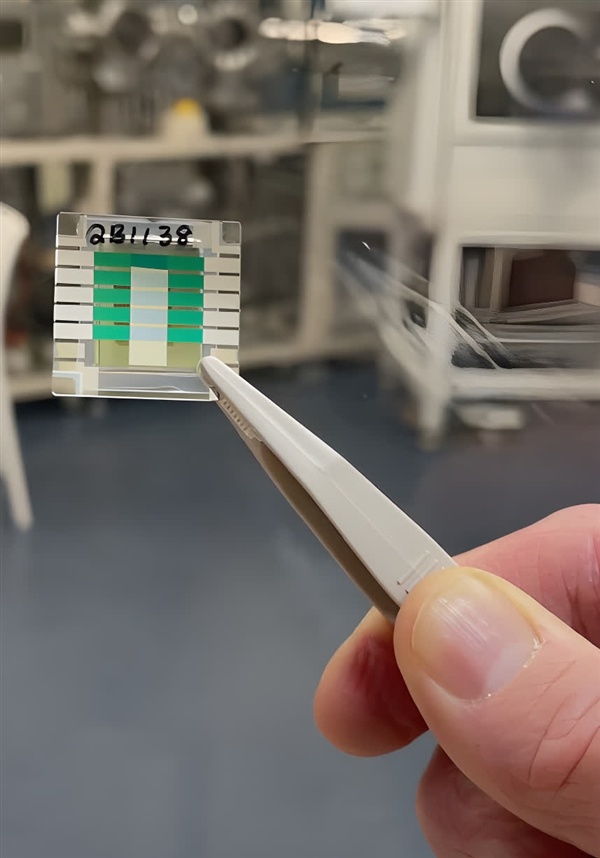
The prototype device uses an optical microcavity structure, consisting of two mirrors about 100 nanometers apart, with organic dye molecules filled between the mirror surfaces.
After the laser is injected into the microcavity, the light interacts strongly with the molecules, resulting in a mixed light material state. In this state, the molecules no longer absorb energy independently as in classical systems, but respond collectively to capture light energy in a single superabsorption event, enabling femtosecond charging.
The Quach team first demonstrated the superabsorption effect in a journal in 2022, and the paper was cited more than 345 times.
In March 2026, the team went a step further and successfully extracted current from the quantum battery prototype. The latest experiments further demonstrate the feasibility of quickly absorbing and extracting energy from quantum batteries.
However, there is still a huge gap between quantum batteries and practical applications.
The current prototype can only store a very small amount of energy, about a few billion electron volts, and the energy retention time is only nanoseconds (10 minus 9 seconds), which is about six orders of magnitude longer than the charging time.
For comparison, the energy stored in a mobile phone battery is about tens of thousands of joules, a difference of more than ten orders of magnitude.
Dario Ferraro, associate professor of physics at the University of Genoa, said in an interview,
The goal of quantum batteries is not to significantly increase the battery's energy storage, but to improve the speed and accuracy of energy transmission. The core appeal of quantum batteries is the possibility of extremely fast charging and precise energy delivery, rather than competing for capacity with lithium batteries.
Quach revealed that the team has built a hybrid design to break through current limitations. The design uses quantum components for fast charging and classical material layers for long-term energy storage, trying to take into account the speed advantage of quantum effects and the durability of traditional energy storage. Related papers are in preparation.
It is reported that quantum batteries will not appear in mobile phones, laptops or electric vehicles in the short term. But its rapid energy transfer capabilities may find future applications in quantum hardware and other specialized systems, such as providing precise energy delivery to the qubits of quantum computers.
Comments