
Abstract:
In table tennis or football, the high-speed rotating sphere "loop ball" will draw a curved trajectory due to differences in air flow. This classic physics phenomenon is called the Magnus effect. Recently, an international research team led by scientists from the Paul Scherrer Institute (PSI) in Switzerland published a paper in the academic journal Physical Review Letters, announcing that for the first time the corresponding "optical Magnus effect" was directly observed using lasers and single ions at an extremely microscopic scale.
This phenomenon reveals that there is a tiny lateral shift of hundreds of nanometers at the strong interaction point between the highly focused laser and the qubit. This discovery has important scientific value for improving the control accuracy of ion trap quantum computers.

Normally, it is intuitively believed that the light intensity is strongest at the center of the laser beam, and the interaction with atoms should also be the most intense at the center of the beam. However, when laser light is focused extremely tightly, its spatial electromagnetic field structure undergoes complex microscopic reshaping. Theoretical physicists at the University of Amsterdam predicted a few years ago that this change in the light wave field would cause the strongest interaction point between the laser and the atoms not to fall in the center of the light spot, but slightly to one side, which is manifested as the Magnus effect at the optical level.
In order to capture this extremely weak physical phenomenon in the experiment, the research team used electromagnetic fields to immobilize single calcium ions in an ion trap in an ultra-high vacuum chamber. In quantum computing, trapped ions are often used as qubits to perform calculations, and finely tuned laser pulses are the central tool for changing their quantum states. During the experiment, the researchers moved a highly focused laser beam relative to calcium ions and precisely measured the intensity of the interaction between the ions and the light field at different spatial coordinates. Using calcium ions as a microscopic probe, they successfully measured a tiny lateral displacement of only a few hundred nanometers.
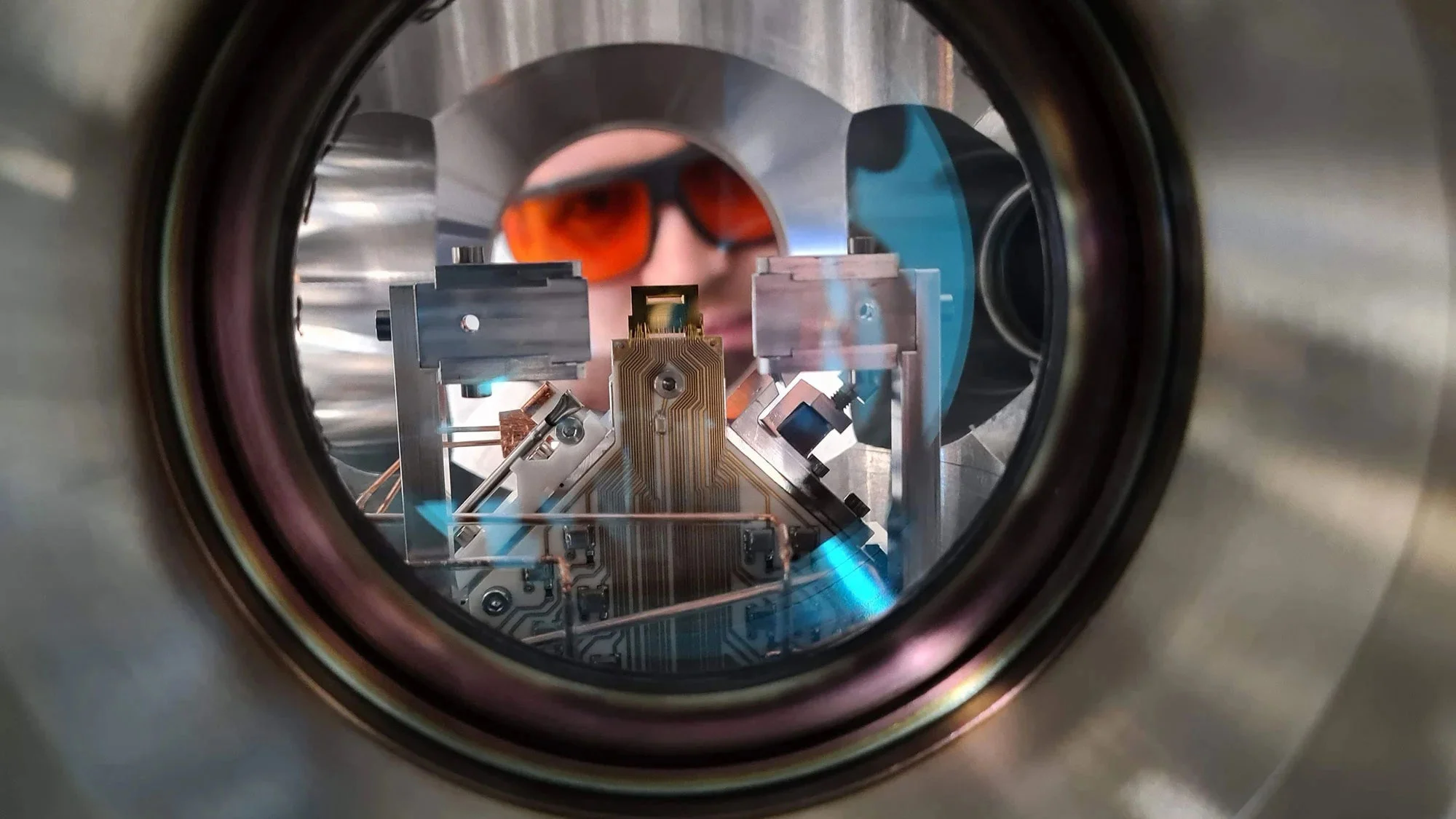
The experiment also revealed an unexpected physical property: the exact magnitude of this lateral shift depends only on the wavelength of the laser used, not how tightly the laser beam is focused. For ion trap quantum computers that rely on precise laser beams to address individual qubits and control quantum logic gates, if the "eccentric" displacement of hundreds of nanometers is ignored in the algorithm and optical alignment, the laser may not act accurately on the intended target, thus introducing systematic errors in continuous high-precision quantum operations.
Philip Leindecker, the first author of the study and a researcher at the Department of Physics and the Paul Scherr Institute at ETH Zurich, also pointed out that this effect is not only negative interference, but the microscopic electromagnetic force it generates is also expected to be used as a new physical mechanism to assist in achieving controlled coupling between adjacent qubits, thus providing new experimental ways to perform more complex quantum logic operations. This achievement not only verified long-standing theoretical hypotheses at the level of basic quantum optics, but also established an important parameter benchmark for the optical system calibration of next-generation highly fault-tolerant ion trap quantum hardware.
Comments