
Abstract:
A research team at Columbia University in the United States announced an important breakthrough in quantum physics. For the first time, researchers have directly observed the phenomenon of trapped electron waves in a metallic material. This discovery verifies the long-standing theoretical predictions of quantum mechanics and opens up new research directions for manipulating quantum states in metals in the future.
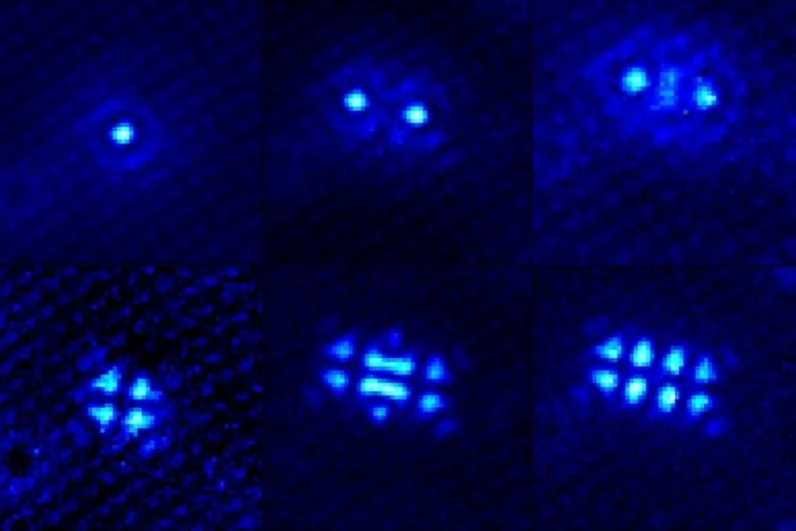
In traditional knowledge, metals can conduct electricity because electrons can move freely within the material. However, the research team found that under certain quantum conditions, the electron waves would not spread as expected, but would be restricted to a local area. Even if there were a large number of paths for them to propagate around, they still could not escape.
The researchers observed this phenomenon in a special metal called Pd₅AlI₂. The material, previously developed by a Columbia University research team, can be peeled off into thin, two-dimensional layers while still retaining metallic properties. During the research, scientists found that the electrons moved slower than theoretically expected, prompting them to conduct further investigations.
Analysis shows that the unique atomic structure of Pd₅AlI₂ provides multiple different movement paths for electrons. As electrons try to move between atoms, the quantum waves generated by these paths interfere with each other, with parts of the paths canceling each other out, inhibiting electron diffusion. This phenomenon is called a "frustration jump," and it is an important feature that the research team has previously identified.
The researchers then used scanning and spectroscopic measurement equipment with atomic-level resolution to conduct more detailed observations of the material. Surprisingly, they found unusual patterns near tiny atomic defects in the material's crystal lattice. Further study confirmed that these patterns were actually electron waves trapped in localized areas.

According to quantum mechanics theory, electrons essentially behave as waves that can travel along multiple possible paths simultaneously. When different waves meet, they may reinforce each other or they may cancel each other out. Under very few special conditions, destructive interference can prevent electron waves from spreading outward and make them permanently confined to a certain area, even if there are theoretically infinite escape paths.
This phenomenon is called "Bound State in the Continuum" (BIC for short). Scientists have observed similar effects in the optical field in the past, but direct experimental verification in electronic systems has always been lacking. Therefore, this discovery is considered a landmark achievement in this field.
The research team said that atomic-level defects played a key role here. These seemingly trivial structural defects actually become important nodes that trigger quantum interference effects, allowing electron waves to stay stably in specific locations rather than flowing freely as in traditional metals.
The researchers believe that this discovery not only deepens the scientific community's understanding of the quantum interference mechanism, but is also expected to provide new design ideas for the future development of quantum materials and quantum devices. By artificially regulating the atomic structure and defect distribution in metals, scientists may be able to precisely control electronic behavior in the future, thereby developing new electronic devices with special quantum functions.
Relevant research results have been published in the journal Science. The research team stated that follow-up work will further explore the universality of this phenomenon in different material systems and its potential application value in quantum computing, quantum information processing and new electronic technologies.
Comments