
Abstract:
Researchers from the University of Science and Technology of China, the Chinese Academy of Sciences, Shanghai Jiao Tong University, MIT and other institutions have made a new superconducting research progress. They used a specially designed terahertz "dark cavity" to artificially enhance the originally extremely weak quantum vacuum fluctuations, and for the first time observed experimentally that this vacuum fluctuation can enhance superconducting properties. Research results show that under certain conditions, the superconducting critical temperature of a six-layer-thick niobium diselenide (NbSe₂) device can be increased by up to 5.4%, while the critical current and critical magnetic field are also significantly enhanced.
This research was completed by the team of Zeng Changgan and Cheng Guanghui of the University of Science and Technology of China and the team of Jiang Qingdong of Shanghai Jiao Tong University. Researchers such as Frank Wilczek, a physicist at the Massachusetts Institute of Technology and winner of the Nobel Prize in Physics, also participated. The relevant paper has been published in the magazine "Nature".
In the concept of classical physics, vacuum is usually considered to be a space without matter, but quantum mechanics gives a completely different answer. According to quantum electrodynamics and the Heisenberg uncertainty principle, even in the lowest energy state, there are still quantum fluctuations in space that cannot be completely eliminated. Virtual particles will continue to be produced and annihilated, so that the so-called "nothing" is actually always in a state of microscopic activity.
Quantum vacuum fluctuation is not a purely theoretical concept. Its existence has been verified through experimental phenomena such as Lamb shift, spontaneous emission and Casimir effect. However, under ordinary conditions, the effect of vacuum fluctuations is usually very weak, and it is difficult to directly affect condensed matter on the macroscale.
The research team has previously been exploring how to control this quantum vacuum fluctuation. The team of Zeng Changgan and Cheng Guanghui had previously used magnetic fields to reversibly adjust the Casimir force, allowing it to switch between attractive and repulsive forces. This work further raises the question: If vacuum fluctuations can be actively manipulated, can this seemingly weak quantum effect also be used to control macroscopic quantum states?
At the same time, Jiang Qingdong's team studied how quantum vacuum affects the state of matter from a theoretical perspective, and proposed the concept of "vacuumronics", which is to regulate the behavior of electrons and photons by artificially designing a vacuum environment. This superconducting experiment provides new experimental basis for this theoretical idea.
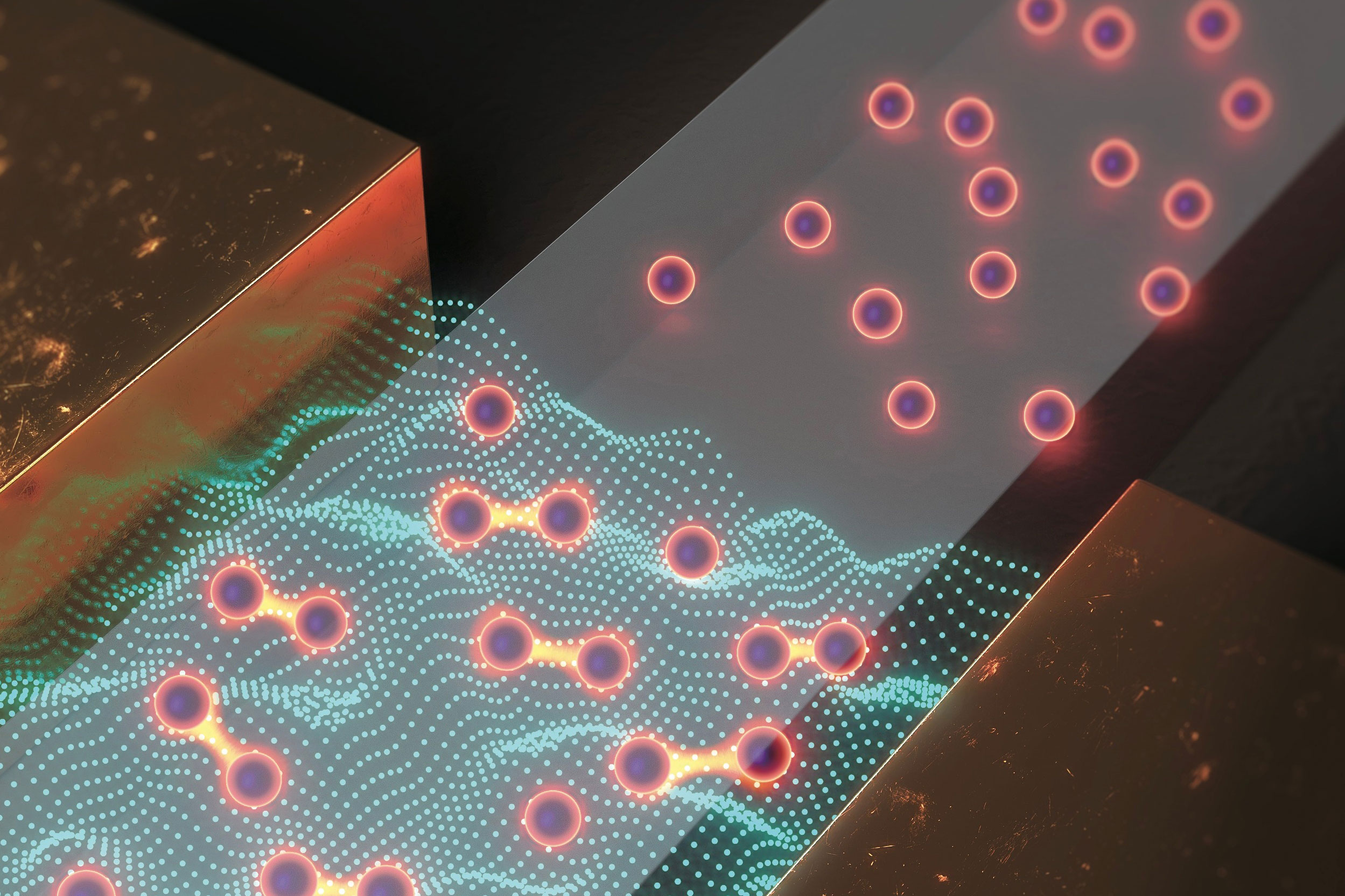
Researchers point out that vacuum fluctuations in ordinary free space are usually too weak to have a significant impact on macroscopic condensed matter systems. To solve this problem, they designed a terahertz split-ring resonator, a so-called "dark cavity." This special cavity can change the surrounding electromagnetic environment and significantly enhance vacuum fluctuations.
The researchers then placed the superconducting material NbSe₂ inside the terahertz dark cavity, constructed a device coupling the superconductor to the dark cavity, and compared it with similar materials outside the cavity. Experimental results show that after entering the dark cavity, the superconducting critical temperature of NbSe₂ increases significantly. In the six-layer NbSe₂ device, the critical temperature increased by up to 5.4%. At the same time, the critical current and critical magnetic field also increased significantly near the superconducting transition.
Superconducting critical temperature is an important indicator for judging the performance of superconducting materials. Only when the material temperature falls below this critical value can it enter the superconducting state. An increase in the critical temperature means that the material can remain superconducting at a higher temperature, while an increase in the critical current and critical magnetic field means that the superconducting state can withstand larger currents and magnetic fields.
To confirm that this enhancement was not caused by other ordinary physical factors, the researchers conducted a large number of controlled experiments. They systematically changed the geometry and characteristic frequency of the dark cavity, while changing parameters such as material thickness, dielectric material, and metal strip structure. Experimental results rule out factors such as strain, material degradation, material inhomogeneity, and metal shielding as the main reasons.
The most critical evidence comes from changes in the characteristic frequency of the dark cavity. When the researchers changed the characteristic frequency of the dark cavity, the superconducting enhancement effect did not simply change with frequency, but showed an obvious peak. When the characteristic frequency of the cavity reaches a specific range, the superconducting performance is most enhanced.
The researchers believe that this peak behavior, which is closely related to the optical properties of the cavity, is an important experimental basis for the coupling between the superconducting state and the dark cavity mode. In other words, the research results do not simply show that "putting a superconducting material into a special cavity will make it stronger", but show that there is an interaction with resonance characteristics between the superconducting state and specific electromagnetic modes in the cavity.
In order to further explain the experimental phenomenon, Jiang Qingdong’s team, Wilczek and others established a theoretical model. They used the Ginzburg-Landau theoretical framework to propose that the superconducting state can interact with the dark cavity through virtual photons. This interaction can reduce the energy of the superconducting state, thereby making the superconducting state more stable and ultimately enhancing superconducting properties.
When the characteristic energy of the dark cavity mode matches the low-energy fluctuation in the superconducting system, the coupling between the two reaches a resonance state, so the peak of the superconducting enhancement effect appears in the experiment.
The most special thing about this study is that the researchers did not enhance superconductivity through external driving in the traditional sense, but achieved control by changing the quantum vacuum environment in which the material is located. In other words, the vacuum itself is no longer just a passive background hosting physical phenomena, but can become an active tool to influence the quantum state of matter through carefully designed cavities.
The researchers said that this method provides a new way to control quantum materials in a non-contact manner. Instead of directly applying external electric fields, magnetic fields or other driving methods, researchers mainly change the electromagnetic vacuum environment around the material by designing the cavity structure, thereby affecting the superconducting state.
If the dark cavity structure and the material system used can be further optimized in the future, the coupling between vacuum fluctuations and quantum materials may be further enhanced and is expected to be extended to more types of quantum states and quantum materials.
This research also means that the way humans use "vacuum" may be changing. In the past, vacuum was regarded more as an environment that needed to eliminate interference in experiments, but the development of quantum physics has proven that vacuum is not really "nothing". This experiment further shows that by artificially designing a vacuum environment, originally weak quantum fluctuations can even be transformed into a tool for regulating macroscopic quantum materials, providing a new exploration direction for future superconducting technology and quantum material research.
Comments