
Abstract:
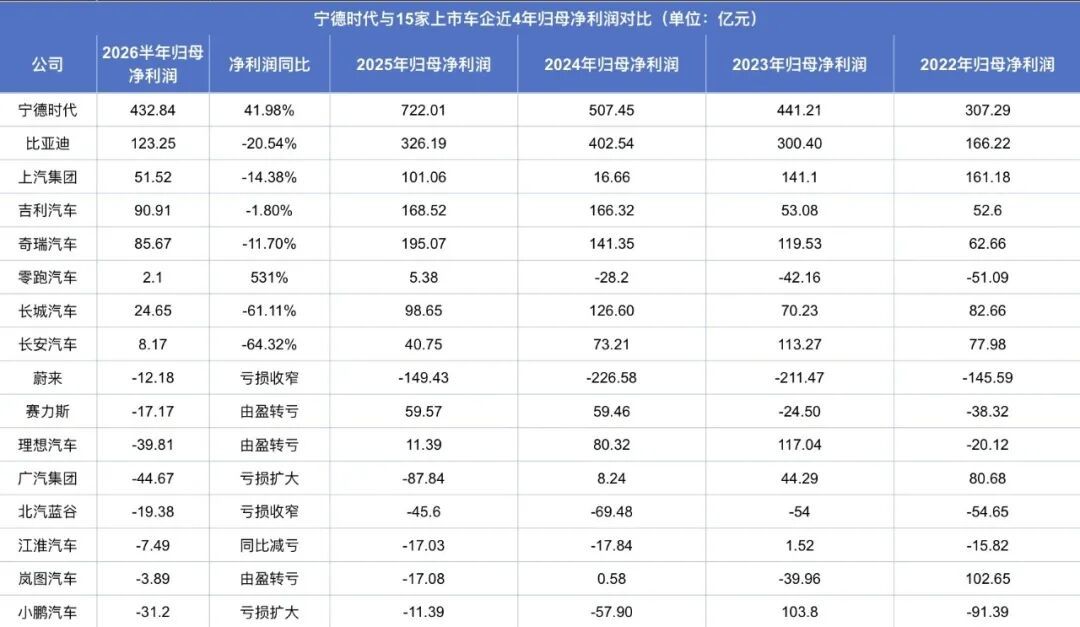
Recently, 15 mainstream car companies listed on A-shares and Hong Kong stocks have successively announced their half-year results for 2026. 9 car companies have experienced an increase in operating income, but 11 car companies have experienced a decline in net profit attributable to their parent companies or sustained losses. In other words, mainstream car companies generally have a situation of "increasing revenue without increasing profits." According to statistics, the total net profit attributable to parent companies of 15 mainstream car companies was 21.048 billion yuan, compared with the total net profit attributable to parent companies in the first half of last year of 35.131 billion yuan, a year-on-year decrease of 14 billion yuan.
What is even more serious is that the total net profit attributable to the parent company of 15 mainstream car companies in the first half of 2026 is 21.048 billion yuan, which is lower than the 43.248 billion yuan net profit attributable to the parent company of a battery manufacturer in CATL during the same period, and the net profit attributable to the parent company of Ningde Times is twice the total net profit attributable to the parent company of the 15 mainstream car companies.
Car companies cannot make money from battery factories
In fact, the situation that car companies cannot make money from battery manufacturers has already appeared since 2022. That year, CATL’s net profit attributable to its parent company was RMB 8.168 billion, surpassing SAIC Motor, the most profitable car company (RMB 6.91 billion), for the first time. In 2022, the difference in total net profit attributable to parent companies between CATL and 15 mainstream car companies is only 6.2 billion yuan. By 2025, CATL’s net profit attributable to its parent company has completely surpassed the combined value of the 15 mainstream car companies, and will reach twice that of the 15 mainstream car companies in the first half of 2026.
At the 2022 Power Battery Conference, Zeng Qinghongfa, the former chairman of GAC Group, claimed that the price of power battery raw materials is too high, not generally high. The proportion of power battery cost in the total vehicle cost has increased from 30% to 60%, so he asked a classic question: "Am I not working for CATL?"
In four years, although battery-grade lithium carbonate has dropped from the highest level of 595,000 yuan/ton in November 2022 to the lowest level of 75,000 yuan/ton in 2025, the profits of leading battery manufacturers have far exceeded that of car companies. In the final analysis, under the influence of multiple factors such as price wars between car companies and rising raw materials, the profit margin of the automobile industry has dropped from 5.71% in 2022 to 3.6% in the first seven months of 2026, a record low in four years.
As it becomes increasingly difficult for car companies to make profits, the net profit gap between battery manufacturers such as CATL and domestic car companies is getting wider and wider. At the 2026 Power Battery Conference, Liu Jincheng, chairman of Yiwei Lithium Energy, said: "When I met the chairman of the industry recently, their expressions were very bright. Most battery companies have very good half-year performance. This is a very rare time."
But the chairman of car companies are in a different situation. Yin Tongyue, chairman of Chery Holding Group, said: "We promised to share risks and results, but now we have to enjoy the results of the battery factory more."
Lu Fang, chairman of Lantu Automobile, said that core components such as batteries and chips have concentrated most of the industry's profits, squeezing the space for vehicle companies to iterate in R&D, technological innovation and market operations.
He said: "Car companies are under great pressure. All raw materials are rising in price. Memory, batteries, and petrochemical products are all rising. Aluminum is rising, and steel is also rising." He also said that lithium carbonate, the core raw material of power batteries, was only 75,000 per ton at the end of 2025. By mid-May 2026, it directly exceeded 200,000, an increase of more than 160%.Since the beginning of this year, the price of battery raw materials has shown a volatile increase. According to SMM spot quotations, taking battery-grade lithium carbonate as an example, the spot quotations of battery-grade lithium carbonate showed a trend of rising and falling in the first half of 2026. It climbed to a maximum of 200,500 yuan/ton on May 13 and fell back to 156,500 yuan/ton at the end of June. Last week (August 31st to September 3rd), the spot price of lithium carbonate showed an overall downward trend, rising first and then falling, with the average price reaching 152,000 yuan/ton.
SMM stated in last week's report that upstream lithium salt plants have fallen due to price fluctuations, and the quotations for bulk orders have remained at 165,000 yuan/ton and above. Among downstream material factories, the willingness to purchase bulk orders at 155,000 yuan/ton and below continues to pick up, and the enthusiasm for bargain hunting is high; however, after the price rises, there is insufficient willingness to pursue higher prices, and procurement tends to be cautious. Overall, market inquiries and actual transactions are relatively active, but there are still differences between upstream and downstream intended prices.
He Xiaopeng, chairman of Xpeng Group, previously said that making cars is painful, and price increases in any link in the industry chain will affect car companies
. This also means that car companies not only need to bear the rising costs from the battery side, but also need to bear the impact of rising costs for many components such as chips, further reducing profits.In addition, the price war, one of the important reasons affecting the profits of car companies, has also affected power battery companies. Liu Jincheng said that any industry will have high points and low points, and the battery industry has also gone through a very tortuous road in the past few years. "There have been ups and downs in various battles in the industry before, but peers will never be beaten to death because of these struggles. Whether a company lives or dies depends entirely on its own strategy." He also said that it is better to remind peers who are going wrong and to congratulate peers who are going fast than to kill each other.
Profits are concentrated in battery leaders
While the profits of the automotive industry have been further devoured and reached historical lows, the profitability of leading battery companies remains relatively stable. Cui Dongshu, head of the China Passenger Car Association Branch, said that in the first half of 2026, China's automobile industry is in the midst of deep transformation and fierce competition for stock. As the penetration rate of new energy continues to increase, the industry as a whole presents a pattern of “increasing revenue without increasing profits” and “ice and fire”. Although the revenue of domestic car companies has maintained growth, the growth rate has slowed down significantly, and the scale gap with international giants still exists; at the same time, the profits of the industry chain are highly concentrated in the upstream battery leaders, while downstream dealers are facing pressure to survive.
Cui Dongshu's statistics show that the net profit of upstream "battery summary" soared from 37.6 billion yuan in 2023 to 68.3 billion yuan in the first half of 2026, and the net profit rate rose to 9%; of which CATL exclusively owned 47 billion yuan (net profit rate 17%). Although BYD earned 12.3 billion yuan, its net profit margin dropped to 4%, and its profits are highly concealed.
The profits of domestic auto companies are under severe pressure, with sharp profit differentiation. Chery, Geely, and SAIC are supporting the profit market; while GAC's gross profit margin has plummeted to -1% (a loss of 5.9 billion yuan), BAIC Blue Valley's loss rate is 23%, and new forces such as Ideal, Xpeng, and NIO continue to suffer deep losses. He said: "Combined with the high sales and R&D expenses of car companies, domestic car companies are trapped in a price war, and their gross profit margins are swallowed up by high expenses. There is a large gap between the net profit margins of international car companies."
Cui Dongshu believes that the most important way to break the situation is for car companies to go overseas. As the pressure on the domestic consumer market increases, overseas profits are very high. The overseas sales of most car companies are growing rapidly, and overseas gross profits are significantly higher than domestic ones.
In terms of gross profit, data provided by Cui Dongshu said that the gross profit of the upstream battery sector surged from 30.2 billion yuan to 157.4 billion yuan, with a gross profit margin of around 20%; while the gross profit of the downstream service sector was only 16.5 billion yuan, with a gross profit margin of only 8% to 11%. This reveals that the industry is undergoing a deep reshuffle, and the downstream living space is infinitely compressed. Affected by price wars and high inventory, the industry-wide capital chain and supply chain accounting problems have become increasingly prominent.
In terms of the accounts payable cycle, Wind data shows that [the calculation formula is 360×(beginning accounts payable and notes payable balance + ending accounts payable and notes payable balance) ÷ operating costs], in the first half of 2026, among 15 mainstream car companies, Xiaomi's payment cycle is 125 days, Guangzhou Automobile Group's payment cycle is 129 days, and the turnover days are shorter; BYD's payment cycle is 141 days, Geely Group's payment cycle is 155 days, while Leap Motors, Changan Automobile, Xpeng Group, and Cyrus's payment cycles are all higher than 200 days.
According to data collected by Cui Dongshu, the total accounts payable of domestic car companies in the first half of 2026 has exceeded 1.1 trillion yuan, and the turnover days are as high as 321 days, which is 35 times that of international car companies, which is 91 days. He said: "In the context of price wars and high inventories, although the cash flow pressure of automakers has been relieved in the short term, the essence is to force the financial pressure to be passed on to upstream parts suppliers."
In contrast, Cui Dongshu's data stated that the aggregate accounts payable of nine battery companies soared from 490.1 billion yuan in 2024 to 764.1 billion yuan, and the turnover days were as high as 348 days. Among them, Ningde Times increased from 210.4 billion yuan to 355.5 billion yuan; during the same period, battery companies' accounts receivable were only 242.8 billion yuan, greatly passing on financial pressure to upstream raw material manufacturers.
Comments