
Abstract:
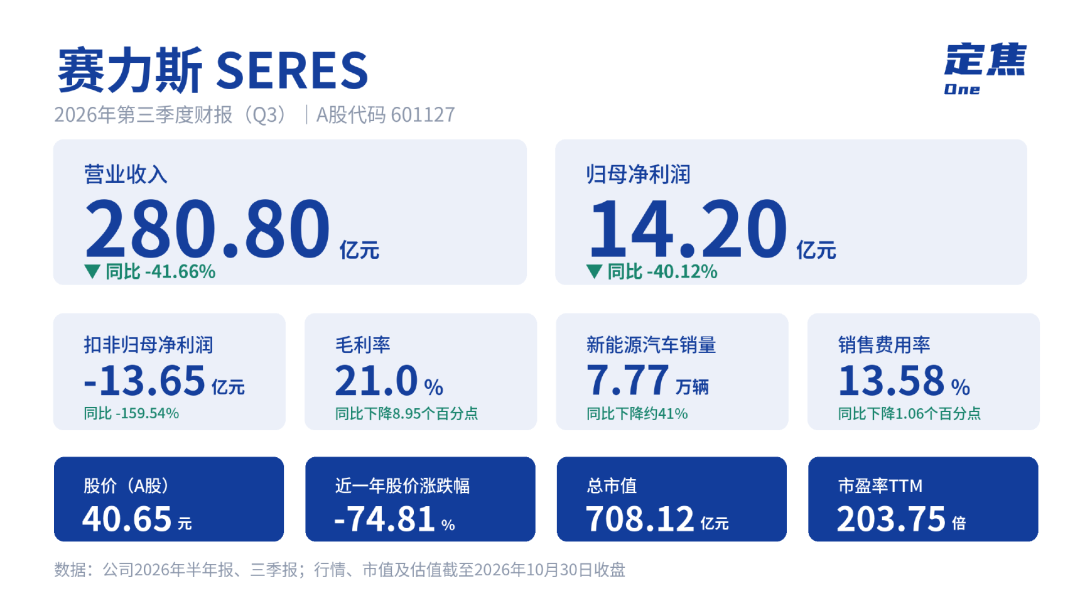
After Cyrus and Huawei announced the adjustment of the division of labor in industry cooperation, the first financial report is here. On the evening of October 30, the financial report released by Cyrus showed that operating income in the third quarter was 28.08 billion yuan, a year-on-year decrease of 41.7%; net profit attributable to the parent company was 1.42 billion yuan, a significant improvement from the loss of approximately 2.471 billion yuan in the second quarter. However, after deducting non-recurring gains and losses, the company still lost 1.37 billion yuan.
The difference between the two calibers is 2.8 billion. The bulk of the difference was a 2.61 billion yuan "gain and loss on the disposal of non-current assets", and the government subsidy included in non-recurring gains and losses was 250 million yuan. This income is mainly related to the fact that Saidou Technology is no longer consolidated. In July this year, Saidou Technology (formerly Blue Power) completed the capital increase and share expansion. Sailish's shareholding was reduced to approximately 32.96%, control rights were handed over, and the remaining equity was calculated according to the equity method, and the difference in fair value recalculation was included in the current profit and loss in one go.
Thales is stripping off inefficient assets and focusing resources on the industry. It relies on the income from asset disposal to cover the losses in its main business and achieve book profits for the quarter.
The capital market’s expectations for Cyrus have dropped significantly in the past year.
A year ago, it was one of the most watched automobile companies in the A-share market. At that time, its stock price was 162.94 yuan and its market value was once close to 300 billion yuan. On October 30 this year, the stock price had dropped to 40.65 yuan, with a total market value of approximately 70.8 billion yuan. It fell 75% in one year.
While the stock price fell, the cooperation methods between Cyrus and Huawei also underwent adjustments. On September 15, Hongmeng Zhixing and Wenjie announced that Wenjie’s product definition, design, brand marketing, channel retail and service system will be led by Cyrus, with Huawei terminals participating in the empowerment. Yu Chengdong later made it clear that the new Wenjie cars to be launched in 2026 will still be designed by the Huawei team, and the official switch of leadership will not occur until January 1, 2027. On September 30, the two parties signed a new five-year cooperation agreement and will form an exclusive team for Wenjie business.
Therefore, this third quarterly report mainly reflects the operating situation before the new division of labor is fully switched. What the market wants to know is nothing more than two aspects: has the profit structure improved, and whether Thalys's own trading ability can withstand the test.
01. If the car is sold more expensive, why is it still not making money?
Excluding this one-time gain, why is the main business losing money? It will be more intuitive if you disassemble it into a bicycle.
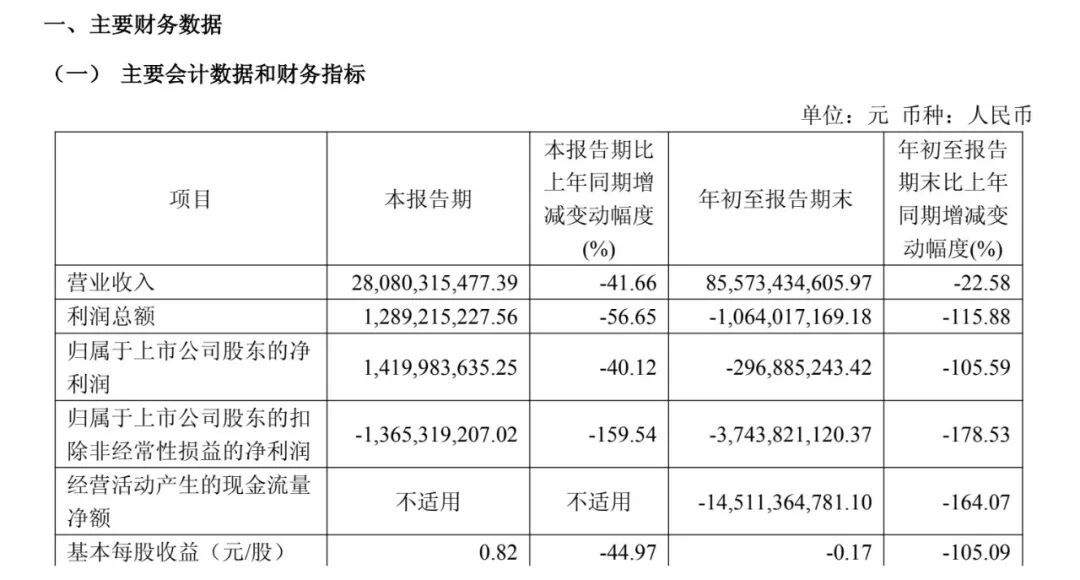
Main financial indicators picture source / Thalys third quarter report
Calculate bicycle income first. Thalys' third quarter report did not disclose its automotive business revenue separately, only the consolidated revenue of 28.08 billion yuan. Divide this by the sales volume of 77,700 new energy vehicles. A rough calculation shows that the revenue from bicycles is about 360,000 yuan, which is more than 40,000 yuan higher than the approximately 317,000 yuan in the second quarter.
The average price can go up, which may be related to the increase in the proportion of high-priced cars. Product cadence supports this. M9 Ultimate will be delivered in mid-September, and the new generation of M9 continues to climb. More expensive cars are sold.
In the third quarter, Cyrus Automobile (Wenjie series) sold approximately 66,500 vehicles, a year-on-year decrease of 46%; the entire new energy sector (approximately 77,700 vehicles) declined slightly, also by 41%. Among them, the M9 is still around 30,000 units, indicating that other relatively low-priced models are declining rapidly. The M8 and the facelifted M7, which were both popular last year, have entered the latter part of the product cycle. The M6 is still climbing, and the new M8 will have to wait until November. Expensive cars are selling for a lot of money, while cheap cars can’t be sold anymore, so the average price has been pushed up.
The car sold more expensively, but no money was made.
In the third quarter of last year, non-standard profits of 2.29 billion yuan were deducted, and a year later it became a loss of 1.37 billion yuan, a difference of 3.6 billion yuan.
Continue to calculate the bicycle account and see where the money is spent.
The gross profit of the bicycle is about 76,000 yuan. After deducting the bicycle sales expenses of about 49,000 yuan, the research and development expenses of about 25,000 yuan, and the management expenses of about 12,000 yuan, the book has turned negative. A car sold for 360,000 yuan is no longer profitable before other expenses are taken into account.
Why did gross profit drop?
The gross profit margin in the third quarter was only 21%, about 9 percentage points lower than the same period last year.
The reasons are twofold, rising costs and declining scale.Look at the cost first. This round of price increases in 2026 is industry-wide. Car-grade memory chips have increased by about 180% from March to June, and lithium carbonate has surged from 75,000 yuan per ton to more than 200,000 yuan. What Cyrus sells is high-end smart driving, lidar, large computing power platform, and multi-screen cockpit. The amount of memory chips used in high-end smart cars is four to eight times that of ordinary entry-level cars, so the impact of price increases will naturally be greater.
In terms of scale, overall sales have dropped by 40%, but costs such as factory depreciation are relatively fixed. They are spread over fewer vehicles, driving up the cost of a single vehicle.
The loss was 2.48 billion in the second quarter and 1.37 billion in the third quarter. How was this loss reduction achieved?
In the second quarter, nearly 1.8 billion yuan was provided for asset impairment, which was equivalent to accounting for the loss that some assets were not worth as much as they originally were. The losses in the quarter were therefore magnified. In the third quarter, this type of loss dropped to about 90 million yuan, and expenses shrank again, so the book loss was naturally smaller. In other words, the loss reduction in the third quarter was due to the concentrated loss recognition in the previous quarter, and the profit from car sales itself did not recover significantly.
02. Cutting sales expenses in half does not mean that the new model is more effective
The less provision for impairment is only a one-time thing, and the gross profit will not improve in the short term. Has there been any improvement on the expense side?
It looks like there is.
Sales expenses in the third quarter were 3.81 billion yuan, compared with 7.05 billion yuan in the same period last year, a year-on-year decrease of approximately 46%, nearly halved.
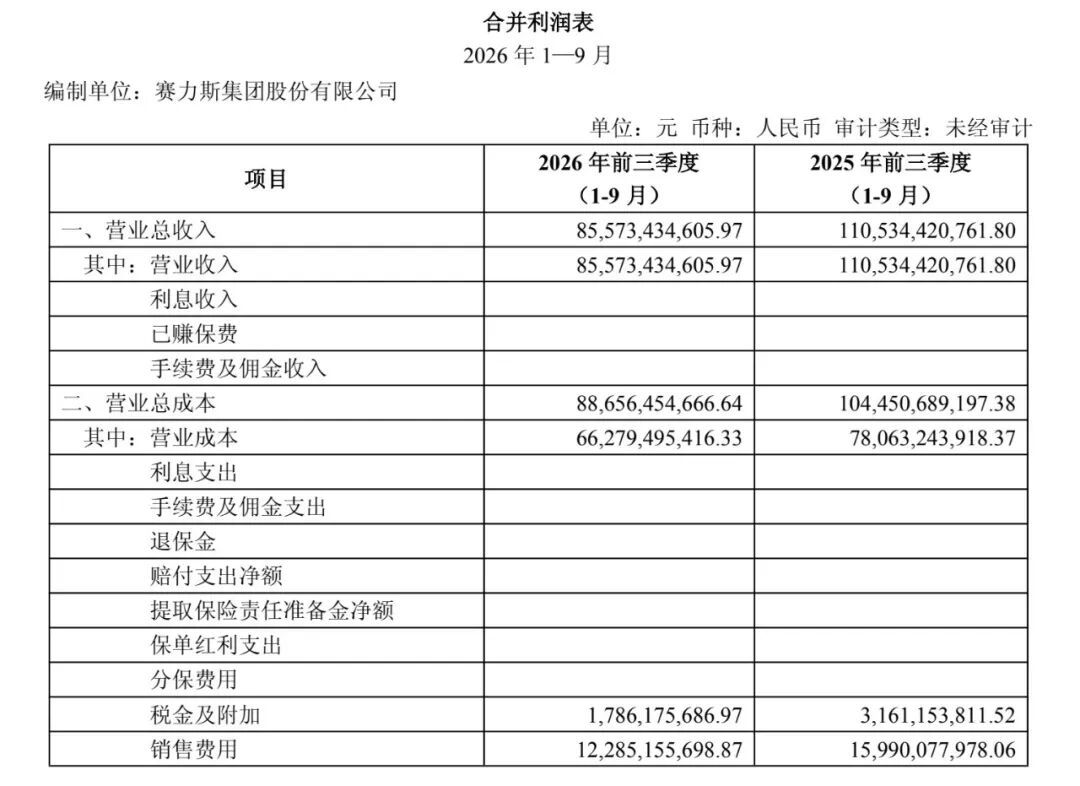
Consolidated Income Statement Revenue Cost and Selling Expenses Source/Three Quarterly Report
But the conclusion changes when looking at the expense ratio. In the third quarter of last year, revenue was 48.13 billion yuan, with a sales expense ratio of 14.6%; in the third quarter of this year, revenue was 28.08 billion yuan, with a sales expense ratio of 13.6%. The absolute amount of expenses has been reduced by half, and the expense ratio has only dropped by 1 percentage point. This is not enough to prove that cost efficiency has improved significantly. It may just be that the income plate has become smaller and the expenses have shrunk accordingly.
The high expenses in the third quarter of last year are also related to the product cycle.
At that time, new cars such as the new M7 facelift were launched intensively, and promotion, channels, and launches raised sales expenses to a high of 7 billion yuan. In the third quarter of this year, there were fewer new cars and sales were increased, so costs naturally dropped.During this period, on September 15, Cyrus and Huawei had just announced adjustments to the division of labor in industry cooperation. Many people read this decrease as a signal: the new model is beginning to take effect, and Cyrus manages its own channels, saving money.
This judgment is untenable for two reasons.
First, expenses and revenue fell simultaneously. Revenue fell by 41.7%, and expenses fell by about 46%. This is the result of a decrease in scale, not an increase in efficiency.
More importantly, the official switch of dominance will not occur until 2027, and it is still in the transition period.
Whether the new model can reduce costs depends on channel service fees. Under the old Zhixuan cooperation model, according to the framework of Thalys's Hong Kong stock prospectus and calculations by various media: Thalys paid Huawei Terminal BG a channel marketing service fee of 8% of the vehicle's selling price, and paid Yinwang Smart a technology licensing fee of 2% of the vehicle's selling price. Based on a rough calculation based on the average bicycle price of 360,000 yuan, the channel service fee alone will cost nearly 30,000 yuan for one vehicle.
As for taking back the initiative, it is an opportunity but also comes with a price.
An investor who follows Cyrus said that with its own arrangements for channels and marketing, there is room for improvement in bicycle profits. But in the past five years, Cyrus has traded profits for scale and given part of the profits to Huawei. When sales increased rapidly, this strategy worked well, but when growth slowed down, the pressure became greater.
A large part of Wenjie's brand premium comes from the ecological endorsement of "Huawei" and Hongmeng Zhixing. Taking back the leadership is equivalent to taking over the burden of brand marketing. On September 15, the day the news was announced, Thalys' stock price fell 5.09%. The market obviously did not regard this as a pure positive.
So it is too early to draw conclusions about whether the new model will succeed. It depends on whether the sales expense ratio can really go down after 2027; after the channel is transferred to Thalys, the same marketing investment can be exchanged for the same sales volume and premium.
Comments