
Abstract:
On October 30, Intel fell nearly 30% intraday. The day before, the company had reported its strongest data center growth in fifteen years. What’s falling in the market is not the current quarter’s report card, but next quarter’s PC, gross profit margin, and external foundries that still cannot be included in the valuation model.
In the conference call a few hours ago, Bank of America did not praise the results first, but directly asked the external foundry:
When will the customer move from evaluation to formal tapeout - when the design is finalized and handed over to the fab for production - when can external revenue be written into the model.
CEO Lip-Bu Tan said that customer details will not be disclosed; on the packaging side, "someone will be ready to announce it in the next two quarters." Both 18A and 14A said "we will talk about it later," and there is no timetable and no figures that can be modeled.Intel’s financial report for this quarter is not bad, but the problem is next quarter: revenue and earnings per share guidance are significantly lower than the relative consensus expectations, and PCs are held back by memory. Another incident occurred at an Israeli factory. Fab 28 in Kiat Gat in the south was one of the company's main 10-nanometer mass production companies in the early years. It still carries a batch of 10-nanometer products for servers. An explosion occurred at the beginning of this month and production was suspended for about two weeks.
Some analysts asked how much capital expenditure will be next year and when will free cash flow turn positive? Chief Financial Officer Dave Zinsner said the numbers aren't locked in yet and that next year is an investment year and "probably there won't be positive free cash flow."
The company's stock price fell by nearly 30%. The decline was caused by the weakening of PCs, the decline of gross profit margin, and the "will talk about it later" external foundry.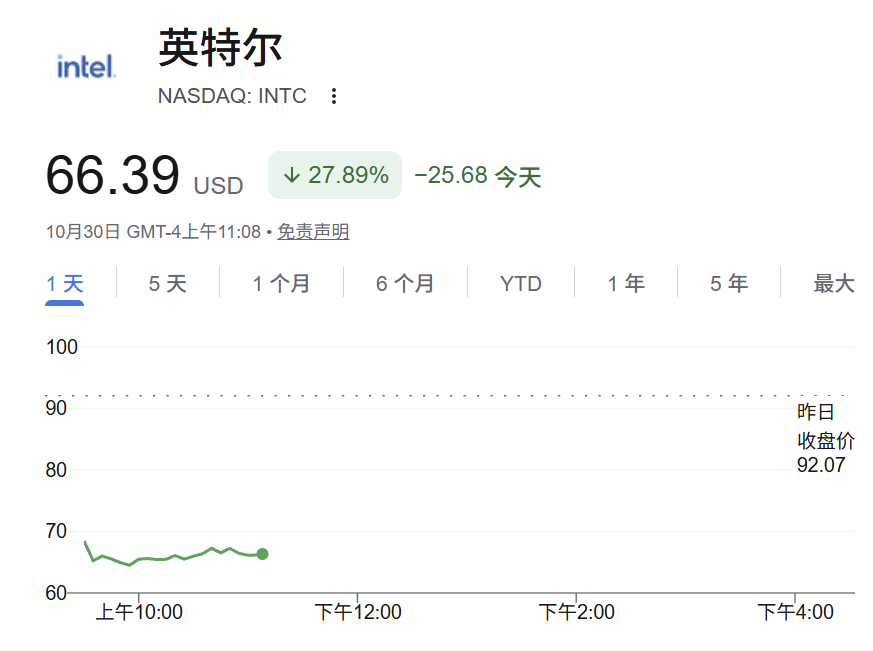
OEM stories support valuation, PC drags down guidance
Intel once relied on PCs to make a living, but after its manufacturing processes fell behind step by step, former CEO Pat Gelsinger bet on IDM 2.0: not only would its own fabs be made for itself, but it would also be able to take external orders, spend money to build factories, and pursue advanced manufacturing processes.
One and a half years after Chen Liwu took office, the market once speculated that he would cut off foundry manufacturing to save financial statements, but he did not cut down on it. Instead, he raised the priority of foundry manufacturing even higher. Around August, the company issued an additional RMB 23 billion, and the cash on its books became thicker. The market was more willing to bet on the valuation line of "the shortage will ease, 18A will ramp up, and external customers will pay."
The real problem this quarter is the client business. Client business (CCPG, which mainly sells CPUs for PCs and laptops) had revenue of US$8.097 billion this quarter, down 5% year-on-year and 9% month-on-month, lower than the company's expectations; operating profit was 2.285 billion, with a profit margin of about 28%. It still has the largest revenue, but its volume has declined first.
QoQ in the fourth quarter, the company expects to drop by more than 20%.
The CFO also warned,“Looking ahead, we expect the PC slowdown to continue at least until the first half of next year,” and destocking will be delayed until at least the first quarter.
The company's own industry standards are even colder: PC unit TAM will drop by approximately 12% in 2026, and will drop by more than 20% in the second half of the year; it is expected to drop by another 10% in 2027. The increase in memory prices has raised the overall bill of the machine, and also suppressed the willingness to replace the machine. For the same piece of memory, data centers are willing to increase prices to grab the goods, but complete PCs cannot be sold due to rising costs - Intel, which sells CPUs, is the first to be hit.
Morgan Stanley has calculated an account,
The continued deterioration of the client business will cause a drag on the company’s consensus revenue expectations of approximately US$3 billion to US$4 billion.
This season exceeded expectations, but there will be problems next season
Intel’s revenue for the quarter was US$16.513 billion, a year-on-year increase of 21%, almost equal to the relative consensus estimate of approximately US$16.5 billion; non-GAAP earnings per share were US$0.52, relative to the consensus estimate of approximately 0.40, and the company’s own guidance of approximately 0.38, which greatly exceeded the company’s own guidance of approximately 0.38.
Zinsner opened by saying, "We delivered another solid quarter...including the strongest data center revenue growth in fifteen years."
Then there was a problem with the guidance:
Fourth quarter revenue guidance was 15 billion to 16 billion, relative to the consensus estimate of about 17.1 billion; non-GAAP earnings per share was $0.25, relative to the consensus estimate of about 0.43.
Some optimistic analysts once pushed the median revenue of the fourth quarter to 17.1-17.5 billion before the financial report. Once the guidance was implemented, the deduction was directly invalidated.Someone asked during the conference call: The guidance was about 1.8 billion less than the consensus estimate. How much of the drag on Israeli factories and PC sales each accounted for?
CFO Zinsner responded: According to preliminary assessment, the Israeli factory accident accounted for approximately 300 million in fourth-quarter revenue, almost all of which fell on 10-nanometer server products, and dragged down gross profit margin by about 200 basis points; the revenue impact in the first quarter may be similar, and most wafer scrapping is included in the fourth quarter, and the bulk is still dragged down by PC sales.
The data center has its best season, but the OEM still doesn’t give a timetable
Intel’s data center and AI (DCAI, which mainly sells server CPUs and AI accelerators) revenue this quarter was US$7.318 billion, a year-on-year increase of 78% and a month-on-month increase of 17%; operating profit was 3.039 billion, with a profit margin of approximately 42%, and the profit amount has exceeded CCPG.
Chen Liwu said: "Despite the headwinds in the near-end PC industry, our demand for CPUs remains strong... The top priority is to open up additional supply to meet the extraordinary demand of the Xeon family."
The supply issues are not limited to fabs. Management mentioned that Intel 3 output is climbing, but there is a shortage of advanced organic substrates in the industry, and EMIB advanced packaging is constrained -
The wafers have been made, but the packaging materials cannot keep up, and server CPUs still cannot be delivered.
The company predicts that industry server CPU shipments will grow by more than 30% annually in 2026 and 2027, and the tension may continue until the end of 2027 or even into 2028; the full-year DCAI, management said, is expected to be approximately 10 billion higher than expected at the beginning of the year.
For this set of strong server numbers, Morgan Stanley believes that although the expectations are good, it is still skeptical: strong numbers are highly dependent on the shortage environment, and Intel's flagship products are still weak relative to peers.
The peer comparison is even more dazzling. Someone pointed out during the conference call that
AMD's server-related revenue guidance is about 70% higher, and the Arm architecture is also competing for servers. Opponents are talking about revenue slope and share, but Intel only says that share depends on whether supply can keep up - the share will only move as much as supply improves.
When there is a shortage of substrates and packaging, the shortage brings delivery pressure. The demand is rising, but the specific share point is never given.The foundry part (mainly undertaking internal and external wafer manufacturing and packaging) has revenue of 6.697 billion this quarter, most of which are internal orders; external foundry revenue is 411 million, 118 million more than the previous quarter, mainly from one-time customer projects, with an operating loss of 1.853 billion.
TSMC is still the benchmark for external OEMs. Only when customers are willing to continue paying for advanced manufacturing processes can the OEM story be established.
SemiAnalysis analysis shows that although Intel's 18A has been shipped, its transistor density is not ahead of TSMC's same-level process, and high-end GPU and I/O chips still need to use TSMC's production capacity. Morgan Stanley even bluntly stated that
The market's confidence in foundry is mostly betting on the implementation of the 14A node in 2028 or 2029. Currently, the commitments from external high-volume customers are still very small. They are more worried about Intel's lack of structural capabilities. If it cannot even meet its own needs, it will be the worst advertisement.
Cash has to wait for OEM, there is no timetable for OEM yet
Intel issued an additional RMB 23 billion in August, with cash plus short-term investments of approximately RMB 54 billion at the end of the quarter; diluted share capital is approximately 5.3 billion shares, and fourth-quarter guidance is fully diluted to approximately 5.44 billion shares, with interest-bearing liabilities totaling approximately 50.1 billion. There is no shortage of cash, but what is missing is when external OEMs will become modelable income.
This is what Bank of America is chasing in the Q&A. In the report, Chen Liwu said that he would not disclose customer details; in the Q&A, he asked when the tape-out would be officially released and when modeling would be possible, but he still said "we will talk about it later."
The gross capital expenditure in 2026 will still be about 20 billion, and will "increase significantly" in 2027. The company has not locked in an absolute amount, and the higher round figures circulated in the market are just rough estimates.
Zinsner put it very bluntly: There is a high probability that next year will not be a year of positive free cash flow.
The single-quarter adjusted free cash flow is still 1.6 billion - operating cash flow is about 5.1 billion, and gross capital expenditure is about 4.2 billion. Coupled with adjustments such as government incentives and partner investment, this positive number will not last until next year. The money comes from operating repayments and additional issuance in August, and is mainly spent on wafers, packaging production lines, and the foundry division that is still losing money. Faced with such a financial model, Morgan Stanley judged that even if the subsequent figures are revised upward, the current pricing of this stock is roughly overvalued.
Server orders are still being queued, and AI demand has not collapsed. What has changed is pricing: PCs are held back by memory costs, gross profit margin guidance has moved downwards, external OEMs still cannot be included in the model, and free cash flow is likely to turn negative again next year. The market is no longer willing to pay for the foundry schedule and PC recovery slope that have yet to materialize.
Comments