
Abstract:
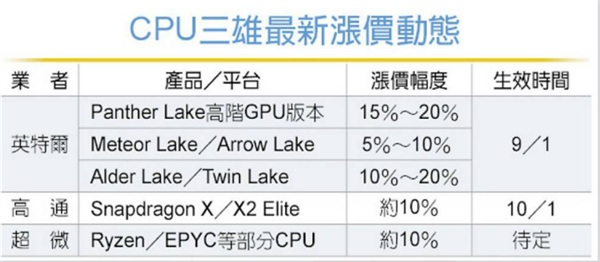
The CPU market is ushering in a new round of price increases recently. The three major manufacturers, Intel, Qualcomm, and AMD, have successively adjusted prices, and the price increase pressure has been transmitted from the wafer manufacturing end to PCs, servers, and terminals. Intel has taken the lead in raising prices since September 1, which is its third round of price increases since the end of last year.
Adjustment based on product line differentiation: the high-end Panther Lake model has the largest increase, reaching 15% to 20%; Meteor Lake and Arrow Lake have increased by 5% to 10%; Alder Lake and Twin Lake for the entry market have increased by 10% to 20%.
It is worth noting that the prices of all Panther Lake series are not rising simultaneously. This round of price adjustments is concentrated on products equipped with high-end GPU Tile produced by TSMC N3E process. The CPU computing module of this chip is produced by Intel's own 18A process, and the GPU graphics module is outsourced to TSMC. This also highlights the direct impact of foundry costs on the final quotation of the CPU.
Qualcomm followed suit and raised the shipping prices of PC processors such as Snapdragon X and Snapdragon X2 Elite by about 10% starting from October 1. Qualcomm is expanding from mobile phone SoCs to the PC and edge computing markets. The specifications of CPUs, GPUs, and NPUs are simultaneously improving. The reliance on advanced processes and packaging continues to increase, and the overall cost structure further increases.
AMD has also issued notices to many cooperative customers and plans to increase the prices of its entire series of chips by approximately 10% starting from the fourth quarter of 2026. This price adjustment covers AI acceleration chips, consumer-grade GPUs and motherboard chipsets. Although Ryzen CPU is not explicitly included, given its high reliance on TSMC for foundry, the risk of upward price cannot be ignored. AMD plans to fully pass on the increase in TSMC's foundry costs to downstream customers.
The root cause of the relay price increases by the three major manufacturers points to the same driving force behind the scenes: TSMC has notified customers that it has increased its chip foundry quotations by about 10% because manufacturing costs continue to rise.
Whether it is Intel's Panther Lake high-end GPU Tile, Qualcomm's Snapdragon X series, or AMD's Ryzen and EPYC processors, they all rely heavily on TSMC's advanced processes. The continued increase in AI chip orders has led to long-term full capacity of advanced process production, and wafer foundry is shifting from a buyer's market to a seller's market with supplier-led pricing.
Comments