
Abstract:
Supply chain news shows that Intel has implemented a new round of price increases on multiple processor product lines, involving multiple generations of products such as Panther Lake, Arrow Lake, Meteor Lake, Alder Lake and Twin Lake. At the same time, AMD is also reported to be evaluating raising the prices of some Ryzen and EPYC processors, which may usher in a new round of chip price increases in the global PC and server markets.
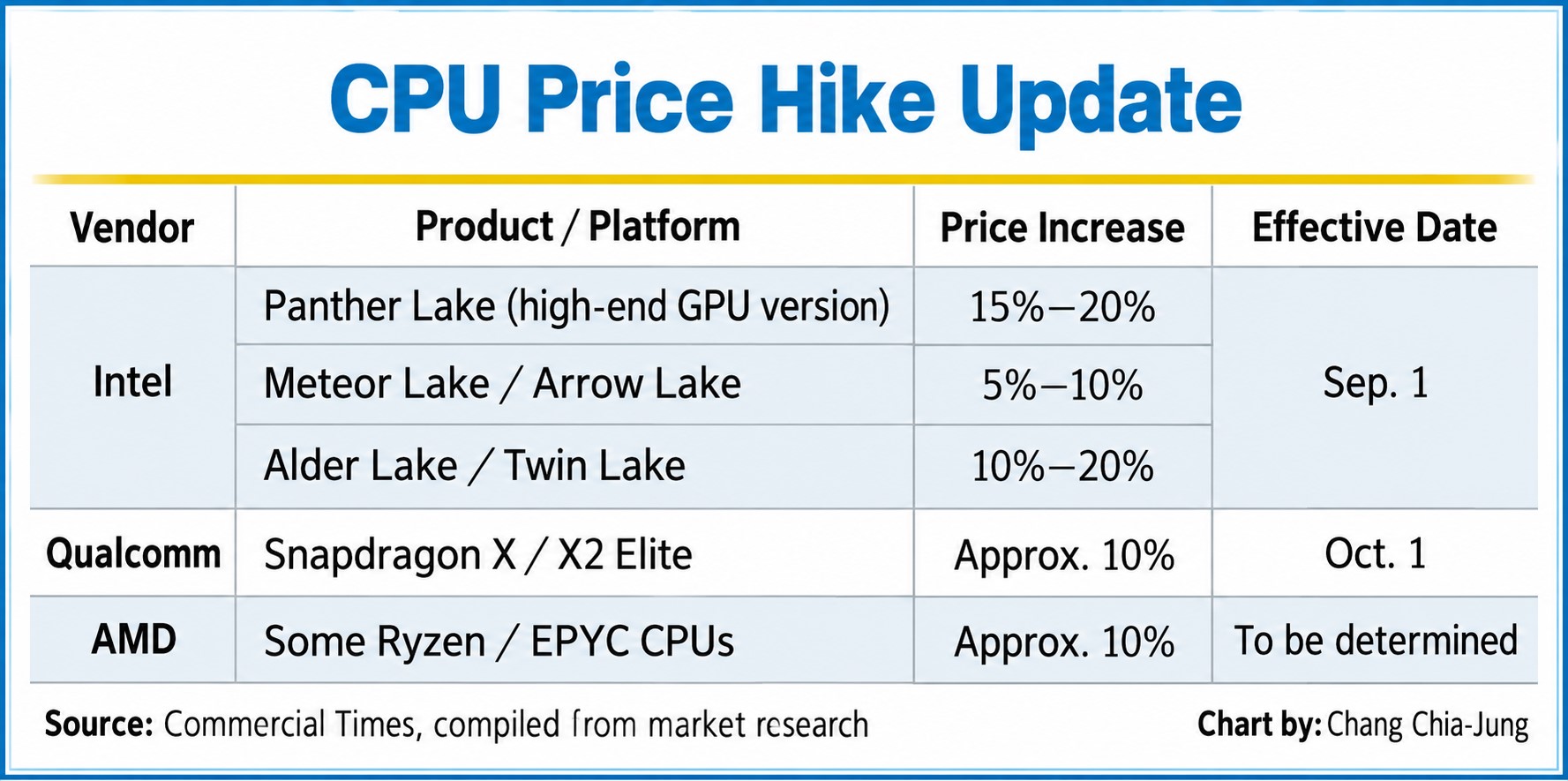
According to Taiwan supply chain news, Intel's processor price adjustment measures originally planned to be implemented in October have actually been implemented in September. The price increase covers multiple product generations, with the latest Panther Lake series becoming one of the biggest increases.
The report pointed out that the Panther Lake models equipped with high-end integrated graphics cards (iGPU) have the most obvious price increases, with price increases of approximately 15% to 20%. While it's unclear whether all models have seen price increases simultaneously, it's widely believed that the entire Panther Lake product line may be affected.
In addition to Panther Lake, Meteor Lake in the previous generation Core Ultra platform and Arrow Lake processors that are still on sale have also been exposed to price increases of 5% to 10%. Twin Lake and 12th-generation Alder Lake products for the entry-level market will increase between 10% and 20%, which means that the prices of notebook and desktop products using these chips may also increase in the future.
It is worth noting that this price adjustment is not limited to Intel. Qualcomm has announced that it will increase the price of Snapdragon X and Snapdragon X2 Elite platforms starting from October 1, with an overall increase of approximately 10%. As competition in the AI PC market becomes increasingly fierce and advanced process chip manufacturing costs continue to rise, more and more manufacturers are beginning to re-evaluate product pricing strategies.
At the same time, AMD is also believed to be planning to increase the prices of some Ryzen and EPYC processors. Currently, AMD has multiple product series such as Ryzen 5000, Ryzen 7000, Ryzen 8000 and Ryzen 9000 on the market. The industry predicts that some of these models may see a price adjustment of about 10% in the future. However, as of now, AMD has not officially announced a specific price increase plan.
Industry insiders generally believe that the core reason for this round of CPU price increases is related to the rising cost of TSMC’s advanced process wafers. As the demand for artificial intelligence continues to grow and competition for advanced process production capacity continues to intensify, chip manufacturers are facing higher manufacturing and packaging cost pressures and are gradually transferring some costs to the end market.
If this trend further expands, in the next few months, whether it is consumer-grade PCs, AI PCs or enterprise-grade server platforms, they may face varying degrees of cost increases. For consumers and businesses planning to upgrade computer hardware or purchase server equipment, the current period may be an important window before price adjustments.
Comments