
Abstract:
Canonical officially releases the beta version of Ubuntu 26.10 "Stonking Stingray", which is an important milestone before the official release of this version. Ubuntu 26.10 is expected to be officially released on October 15. Currently, the Beta version is open for download and testing for Ubuntu Desktop, Server and various official community derivative versions.
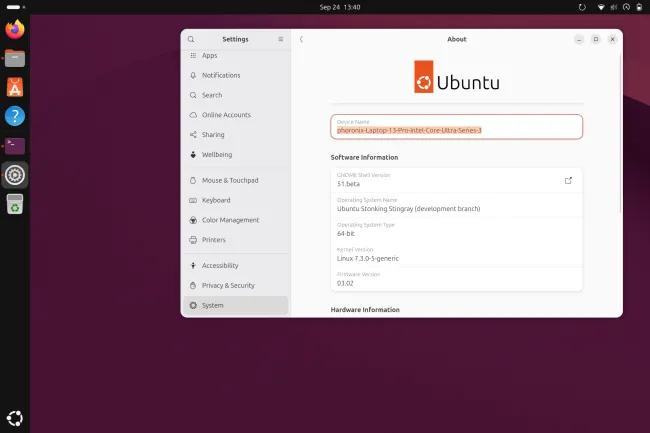
One of the most noteworthy changes in Ubuntu 26.10 is the upgrade of the default kernel from the originally planned Linux 7.2 to Linux 7.3. Canonical had originally planned to use Linux 7.2 for Ubuntu 26.10. However, due to the smooth progress of the upstream Linux kernel development, there was no significant delay in the development cycle of Linux 7.3. Therefore, Canonical finally decided to directly follow up with Linux 7.3 so that the new version can obtain more complete latest hardware support and kernel functions.
Ubuntu 26.10 desktop version uses the latest GNOME 51 desktop environment. GNOME 51 brings a large number of updates to desktop components and user experience, and Ubuntu continues to work on its own interface and system integration on this basis, making Ubuntu 26.10 the most aggressive generation of current Linux desktop distributions that tracks the latest GNOME and Linux kernel versions.
In terms of graphics stack, Ubuntu 26.10 is equipped with Mesa 26.2 open source graphics driver stack. The combination of Linux 7.3 and Mesa 26.2 is of great significance for the new generation of AMD, Intel and other GPU hardware, especially to improve hardware support for recently launched new processors and integrated graphics platforms.
For devices using Intel's latest generation of low-cost processors, Ubuntu 26.10 has also shown better performance than Ubuntu 26.04 LTS. Previous tests on Intel Core 3 Wildcat Lake have shown that the new version can achieve a certain degree of performance improvement on this new platform by updating the kernel, Mesa and other software components. Ubuntu 26.10 is also optimized to support new generation hardware such as Intel Panther Lake.
Another important change in Ubuntu 26.10 is the official completion of the Rust Coreutils migration. Starting from Ubuntu 25.10, Canonical has gradually used uutils Coreutils written in Rust to replace the traditional GNU Coreutils. Previously, due to compatibility issues, several core commands such as cp, mv and rm still retained the GNU version.
As of Ubuntu 26.10, these three last remaining core commands have also been switched, so Ubuntu's default core tools have been 100% migrated to Rust Coreutils. This means that traditional system operations including file copying, moving, and deletion are now handled by their Rust-implemented counterparts by default.
One of the important reasons why Canonical promotes this migration is that Rust has advantages in memory safety. System components implemented in traditional C language have long been at risk of memory security vulnerabilities. Using Rust to rewrite core system tools can reduce the possibility of such vulnerabilities to a certain extent. However, Rust Coreutils and GNU Coreutils still need to maintain a high degree of compatibility, so Canonical has spent a long time solving the behavioral differences between different commands.
Ubuntu 26.10 also further improves desktop system behavior under memory pressure. When the system's available memory is insufficient, Ubuntu will more actively manage resources based on the current memory pressure, thereby reducing the risk that the entire desktop environment will experience severe freezes or even become unresponsive due to memory exhaustion.
Artificial intelligence-related functions are also one of the areas worth paying attention to in Ubuntu 26.10. Canonical is introducing more natural voice interaction capabilities to the Ubuntu desktop and building infrastructure around speech-to-text and future context-aware desktops. The Ubuntu development team has previously launched the Myna speech-to-text solution, and Ubuntu 26.10 has also begun to lay the foundation for more intelligent desktop interaction.
Ubuntu 26.10 has also been tweaked in terms of installation and new user experience. Canonical continues to simplify the system installation process and improve the boot experience when starting up for the first time, hoping to reduce the learning cost for new Linux users when using Ubuntu for the first time.
In terms of hardware support, Ubuntu 26.10 also pays special attention to the latest ARM notebook platform. Canonical recently released the Ubuntu Concept ISO for Qualcomm Snapdragon X series processors, which has begun to add preliminary support for Snapdragon X2 notebooks and continues to improve the compatibility of Snapdragon X1 devices. This means that Ubuntu is trying to further expand its support for new PC platforms in the Windows on Arm era.
Ubuntu 26.10还继续推进amd64v3软件包的实验性支持。 For newer processors that meet the x86-64-v3 instruction set requirements, Canonical is trying to provide software packages optimized for the more modern CPU instruction sets in order to take full advantage of the additional hardware capabilities provided by the new processors.不过这一功能目前仍属于实验性质,并不意味着所有Ubuntu用户都会默认使用amd64v3软件包。
The development cycle of Ubuntu 26.10 is consistent with Ubuntu's traditional half-year release rhythm. After the Beta version, Canonical plans to enter the final freeze phase on October 8 and prepare candidate versions, with the final stable version scheduled to be released on October 15.
Compared with Ubuntu 26.04 LTS released in April this year, Ubuntu 26.10 is not a long-term support version, but is more focused on technical updates and new feature verification. Therefore, Canonical is more actively adopting the latest Linux kernel, GNOME, Mesa and Rust system components in this version to prepare for the next generation Ubuntu technology stack.
Ubuntu 26.10 Beta currently provides multiple installation images including AMD64 desktop version and server version. At the same time, Kubuntu, Lubuntu, Ubuntu Budgie, Ubuntu Studio, Ubuntu Unity, Xubuntu and other official derivative versions are also gradually providing Beta versions.
For ordinary users, Ubuntu 26.10 Beta is still mainly suitable for testing and development purposes, and is not recommended for direct use in production environments that require higher stability. In particular, Linux 7.3 is still in the integration stage before the final version of Ubuntu is released, and some drivers, third-party software, and hardware compatibility may still change.
If the final version is released according to the current development progress, Ubuntu 26.10 will become a non-LTS version with a larger technical update in recent years. Linux 7.3, GNOME 51, Mesa 26.2, 100% Rust Coreutils migration and support for new generation Intel, ARM and other hardware platforms together constitute the major technical upgrades of this version. The stable version is expected to be officially released on October 15th.
Learn more:
https://lists.ubuntu.com/archives/ubuntu-announce/2026-October/000329.html
Comments