
Abstract:
The reporter learned from Harbin Institute of Technology that the extraterrestrial environment physics and intelligent detection team of the school's national major scientific and technological infrastructure "Space Environment Ground Simulation Device" has developed a new type of solar concentrator that may be able to melt and sinter lunar soil into "lunar bricks" in the future, helping to "use local materials" for building houses on the moon.
This is a reflection compensation system composed of three special mirrors. It can accurately focus sunlight like a "magnifying glass" and increase the focus temperature to 892 degrees Celsius in outdoor measurements. The relevant results were published online in the academic journal "Engineering" on October 30.
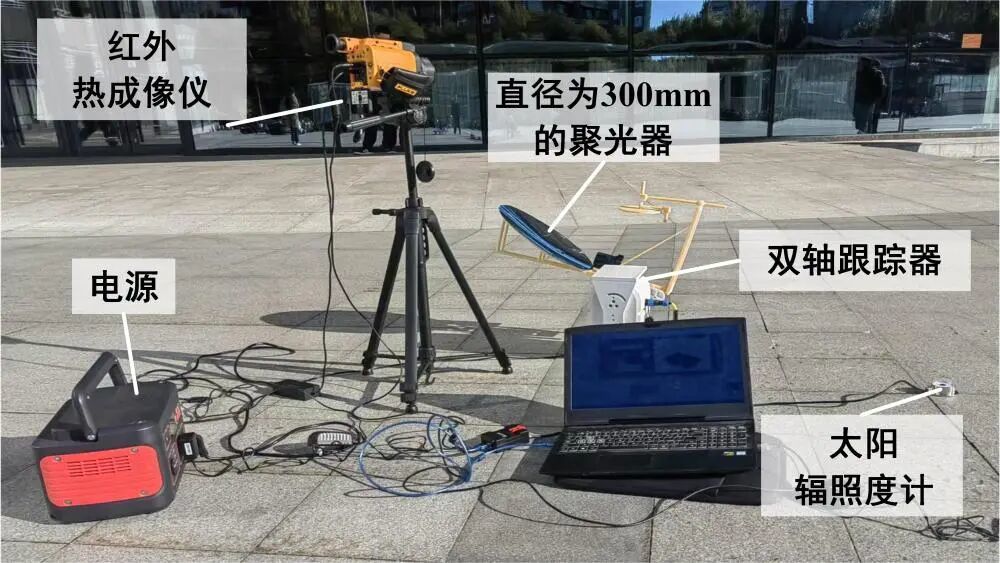
This is the experimental scene of this new solar concentrator. Published by Xinhua News Agency (Photo courtesy of Harbin Institute of Technology)
"It is like a 'solar furnace', providing a new high-temperature heat source solution for future lunar base construction and in-situ resource utilization such as lunar soil melting." Li Lifang, a professor at Harbin Institute of Technology and leader of the extraterrestrial environment physics and intelligent detection team of the National Science Facility, said, "For example, heating and melting the lunar soil can not only be used to 'burn bricks' to build houses, but also to prepare mechanical components."
According to reports, although traditional light concentrating equipment can generate high temperatures, if the angle is slightly off, the light concentrating efficiency will drop significantly. This system is like wearing a pair of "corrective glasses" on the condenser, reducing the deviation when light is concentrated and focusing the light into a small area.
Experiments show that in an environment with a temperature of 5 degrees Celsius, this 300 mm diameter device can increase solar irradiance more than 500 times, with the focus temperature stabilizing above 800 degrees Celsius, with a peak value of 892 degrees Celsius. According to theoretical calculations based on the conditions of no atmosphere and strong radiation on the lunar surface, scientific researchers predict that its core temperature is expected to reach 1326 degrees Celsius, which is expected to meet the energy needs of high-temperature processes such as lunar soil melting and brick making.
Li Lifang introduced that using sunlight to "use local materials" to heat and melt the lunar soil into building materials is a way to build houses on the moon. Compared with traditional equipment, this new technology approximately doubles the tolerance range of receiving angle deviations and can proactively adapt to the extreme lunar environment, thereby reducing equipment manufacturing difficulty and transportation costs. The team will further carry out lightweight prototype development and lunar soil melting tests to promote this technology to be applied on the moon as soon as possible.
Comments