
Abstract:
Blue Origin, an American aerospace company, recently publicly demonstrated a concept plan for a lunar solar power generation system called "Power Tower". This equipment is designed to solve one of the most realistic and critical challenges for future lunar bases - stable power supply and provide basic energy support for long-term lunar surface activities.
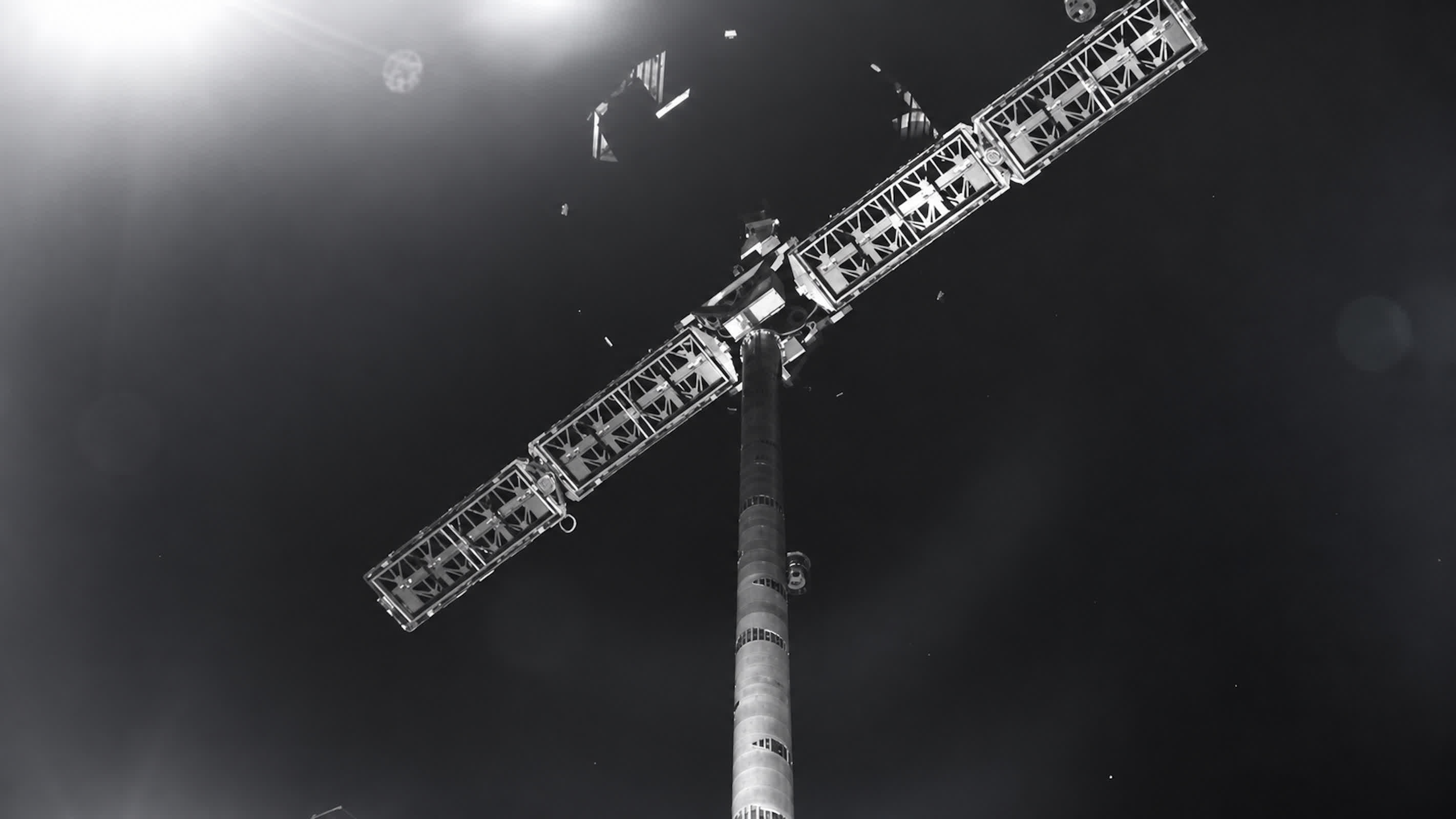
According to information released by Blue Origin, the power tower is a vertically deployed solar array system with a height of approximately 20 meters (65 feet). After being transported to the lunar surface, the device can automatically deploy and provide more than 10 kilowatts of power output. The company stated that the system is mainly aimed at base operation needs in the lunar south pole region, which is also the target area of focus for the National Aeronautics and Space Administration (NASA)'s "Artemis" lunar landing program.
Blue Origin also released a demonstration animation showing the unfolding process of the power tower after landing on the moon. The animation shows that the equipment first raises the central mast from the base, then unfolds multiple sets of arms outwards and deploys solar panels to the working position, ultimately forming a towering power generation structure.
This design addresses the unique power supply problems in the lunar environment. Due to the lack of mature energy infrastructure on the moon, power generation and transmission have always been core challenges for future lunar surface activities. Especially in the lunar south pole region, where the angle of sunlight is low, craters, ridges and complex terrain will form large shadow areas, and the lighting conditions between different locations may even change significantly within a short distance.
Compared with traditional tiled solar panels, the vertical deployment structure allows the battery array to be elevated above surface obstacles to obtain better lighting conditions. At the same time, the design can also reduce the occupied floor area. In the future lunar landing site, the limited space needs to accommodate the lander, scientific experiment equipment, communication system, and future habitation module and lunar rover at the same time, so it is of great significance to save surface resources.
Blue Origin stated that the power tower adopts a modular architecture design and can not only provide power for the lander itself, but also transmit energy to a wider range of lunar surface facilities. The company believes that this power supply capability is critical for future permanent or semi-permanent lunar bases. Communication equipment, temperature control systems, scientific research instruments, computing equipment, and lunar surface transportation vehicles will all rely on continuous and stable energy support.
However, the 10 kilowatts of electricity generated by a single power tower is not enough to support the operation of large-scale lunar settlements. Industry analysts believe that this type of equipment is more suitable as the power supply core of a small base or becomes part of a larger-scale lunar energy network in the future.
It is worth noting that the power tower appears to be based on previous research and development results by Honeybee Robotics, a subsidiary of Blue Origin. The company has developed the "Lunar Array Mast and Power System" (LAMPS) and participated in the "Vertical Solar Array Technology" (VSAT) project promoted by NASA. Relevant research mainly focuses on developing efficient solar power supply solutions suitable for long-term lunar surface residency missions.
At present, Blue Origin has not announced the lunar launch schedule of the power tower, and the project is still in the early development stage. However, as global space agencies and commercial space companies gradually shift their focus to building long-term lunar surface infrastructure, this type of energy system is being regarded as an indispensable and important component of future lunar bases. From transporting equipment to the lunar surface to ensuring its continued operation, the power tower represents an important step towards the reality of lunar infrastructure construction.
Comments