
Abstract:
Underwater solar power generation has long been regarded as an insurmountable engineering forbidden area by the scientific community due to severe light attenuation and water erosion problems. However, a latest scientific research development is overturning this traditional understanding. By customizing the design of new perovskite photovoltaic materials, a multinational scientific research team has successfully developed a solar cell that can operate stably in an underwater environment and achieve high photoelectric conversion efficiency, opening up a new path for energy self-sufficiency for ocean observation sensors, autonomous underwater vehicles (AUV), and long-term underwater monitoring networks.
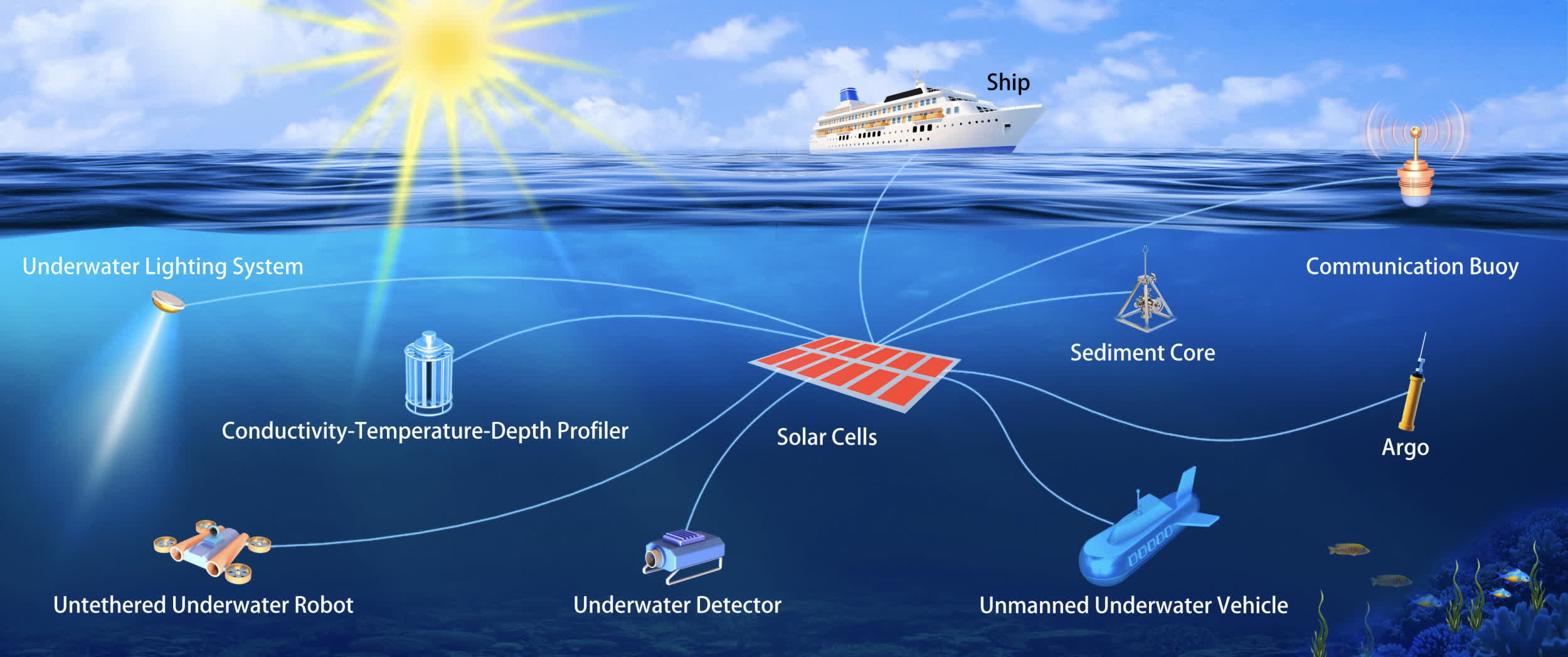
In traditional knowledge, underwater photovoltaic utilization faces two major natural barriers. The first is the dramatic change in spectral characteristics. Water, as a strong absorbing medium, will quickly absorb most of the infrared and red light spectrum, causing the light penetrating underwater to be mainly concentrated in a narrow blue-green band. Traditional silicon-based solar cells designed for full-spectrum sunlight have an extremely mismatched absorption spectrum under water, and their efficiency declines sharply. The second is the issue of material stability. Perovskite materials, known for their high efficiency, are easily degraded by moisture. Placing them in water-rich or even high-salinity marine environments for long-term work faces huge physical and chemical challenges.
In order to overcome these problems, the scientific research team redesigned the energy band structure and chemical composition of the perovskite material for the underwater blue-green light spectrum, and precisely adjusted the band gap so that its optical absorption peak highly overlaps with the underwater filtered blue-green spectrum, thus achieving maximum capture and energy conversion of deep water penetrating photons. At the same time, the research team has made key innovations in battery packaging and interface protection layers, using new hydrophobic polymers and multi-layer dense barrier film technology, which not only completely isolates water molecules and dissolved salt ions from penetrating and corroding the perovskite light-absorbing layer, but also ensures efficient refraction and entry of light on the battery surface.

Experimental test data shows that this new perovskite underwater battery demonstrates photoelectric conversion efficiency and anti-attenuation performance that significantly exceeds traditional silicon-based batteries under simulated blue-green light environments of different water depths. Even under the harsh conditions of continuous immersion in water and a certain water pressure, the battery can still maintain stable power output for a long time, verifying its engineering feasibility in complex real water environments.
With the rapid growth of global demand for deep-sea exploration, marine ecological monitoring, and intelligent offshore aquaculture, the power supply bottleneck of underwater electronic equipment has become increasingly prominent. Traditional underwater equipment usually relies on heavy-duty battery packs for power supply, which require frequent salvage and replacement or wired replenishment from mother ships, making operation and maintenance costs extremely high. If underwater perovskite photovoltaic technology can be further industrialized and deployed on buoys, underwater robots and fixed seabed sensors, it is expected that underwater equipment can achieve long-term in-situ self-power supply with the help of natural sunlight or even offshore diffuse light, greatly expanding the boundaries of human capabilities for long-term, low-cost continuous detection of the marine environment.
Comments