
Abstract:
Researchers from Suzhou University of Science and Technology and other institutions have developed a flexible artificial synapse array that can simulate the changes in the strength of biological synaptic connections and rapidly decompose under specific chemical treatments. The device uses hydrogen-bonded organic framework materials as the functional layer, MXene as the electrode, and polyimide (PI) film as the flexible substrate. The research team used solution processing to create a 10×10 array, containing a total of 100 synaptic units. Relevant research was published in the International Journal of Extreme Manufacturing.
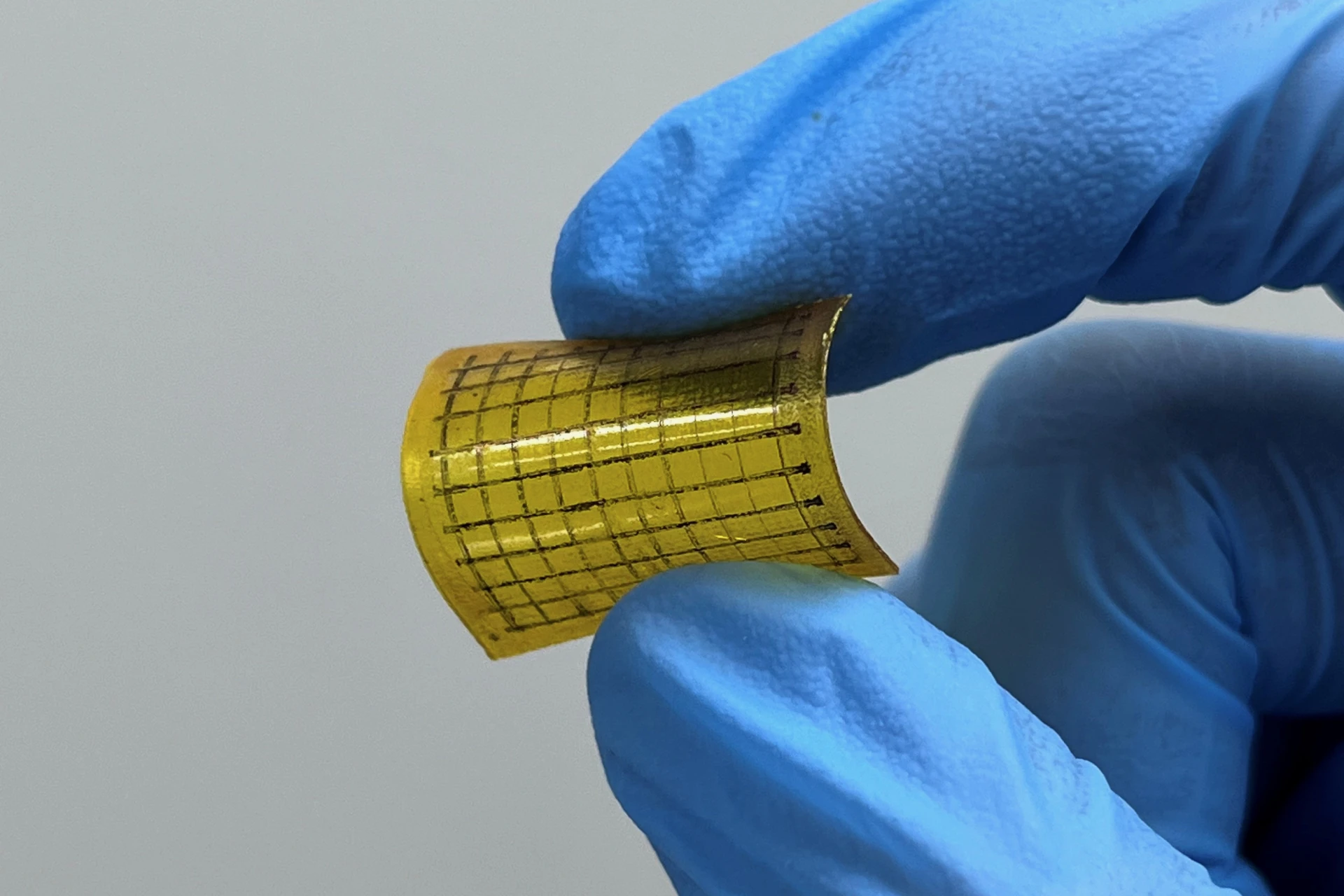
The core material TCPP-HOF is composed of porphyrin-based organic molecules, which form an ordered two-dimensional structure through hydrogen bonds. When a forward voltage is applied, charges are trapped and the device conductance increases; when a reverse voltage is applied, charges are released and the conductance decreases. Through this adjustable change, the device can exhibit synaptic-like enhancement and inhibition, including learning-related characteristics such as long-term enhancement and long-term inhibition, and can set 10 different conductance states. The electrical switching time was experimentally measured to be 26 nanoseconds.
The researchers also used the electrical characteristics of the device to evaluate the convolutional neural network's ability to recognize MNIST handwritten digits. The accuracy rate reached a maximum of 97.23%, and the software benchmark was 99.24%. The neural network described in the paper contains approximately 120,000 synapses, but the actual physical array is 10×10 with a total of 100 devices; therefore, this set of results shows the potential of device characteristics for brain-like computing, and does not mean that the entire 120,000 synapse network has been integrated on this small array.
In the flexibility test, the array still worked after being bent around a radius of about 5 mm 200 times, and the handwritten digit recognition accuracy was 96.33%. The PI substrate designed by the researchers can also be decomposed in a heated amine chemical solution, converting into soluble monomers after about 6 minutes of treatment, leaving a small inert residue. This process requires specific chemical solutions and heating conditions, and it does not mean that the device will disappear on its own after contact with water or the natural environment.
The team believes that the characteristics of flexibility, solution processing and controllable decomposition may be used in wearable sensors, flexible electronic skins, soft robots or short-term electronic devices in the future, and can also provide ideas for temporary storage and information destruction. However, the current results are still laboratory prototypes, and the scale of the array is limited. Researchers still need to solve the impact of moisture on device stability, expand the array, and test long-term reliability and manufacturing consistency. It is not yet a complete computing system that can directly replace traditional processors or commercial AI chips.
Comments