
Abstract:
The Indian digital certificate authority eMudhra/emSign was recently discovered by security researchers to have leaked the private keys of eight intermediate certificates. These intermediate certificates are used to issue subordinate certificates. Therefore, attackers who obtain the private keys can issue certificates for any website or service to perform man-in-the-middle hijacking.
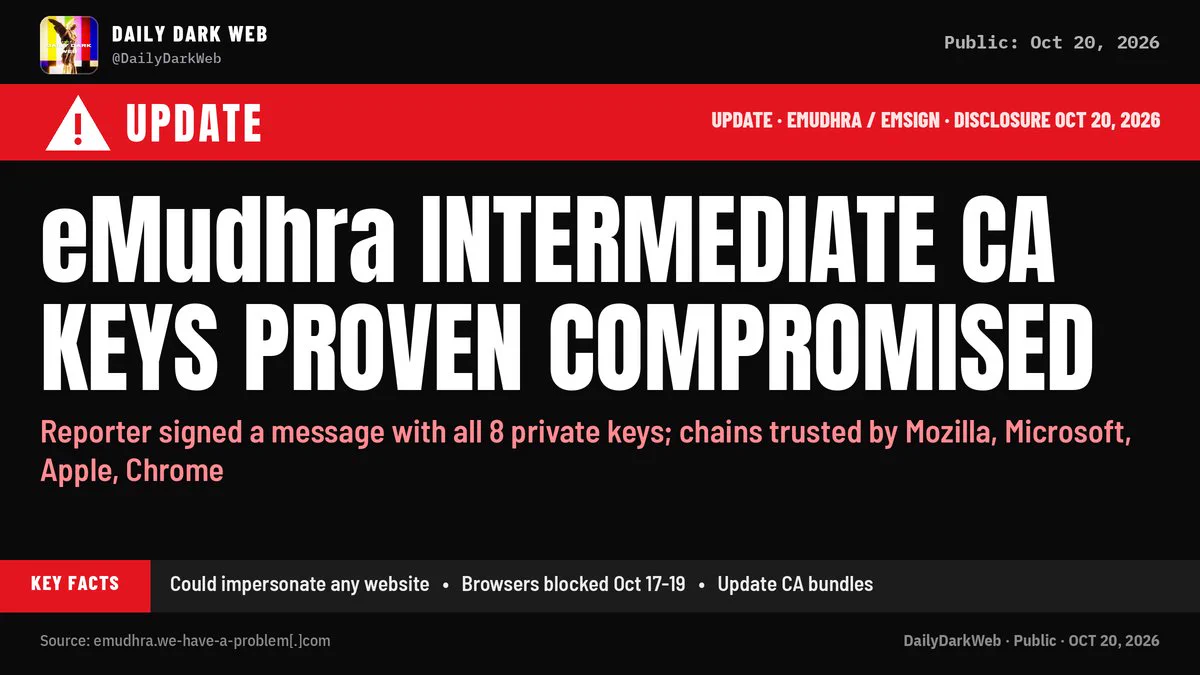
What’s even more outrageous is that the private key of the certificate only has four characters. Normally, the content of the private key is very long. No one knows how this Indian company could be outrageous enough to issue a certificate with only a four-digit private key, and then use this intermediate certificate to sign certificates for other websites and services.
In order to prevent man-in-the-middle hijacking, Firefox browser, Google browser, Apple and Microsoft are currently urgently releasing updates or updating the certificate blocking list to revoke all eMudhra's problematic certificates. That is, any subordinate certificate signed by the problematic certificate is currently not trusted by mainstream browsers, and users will see an interception prompt when accessing.
The problem is that some software does not provide a certificate revocation mechanism, so these certificates can only be blocked by releasing new versions. Currently, software updates have been released including Go, NSS, Python certifi, Rust, Electron, etc. It is recommended that users of these software upgrade to the latest version immediately.
Based on the current known information, the private keys of these problematic certificates are not leaked, but defective private key generators are used from the time of issuance. Analysis published by the Mozilla Foundation shows that the integers corresponding to the eight affected P-384 elliptic curve private keys are all less than 256, and the actual values are 4, 56, 66, 115, 155, 156, 230, and 237.
While a normal P-384 private key should have about 384 bits of randomness, these keys only have a few bits of valid information, so the real key can be quickly found through exhaustive methods. Of course, even if security researchers do not publish the private key now, others can still find the private key through exhaustive methods, so these certificates are no longer secure.
Based on certificate issues, it is recommended that users update their browsers in a timely manner and not use old versions for a long time. Some old versions may not be able to update the revocation list and therefore cannot block old certificates, which may cause serious security problems for daily access.
Comments