
Abstract:
Danish scientists have discovered that a German submarine that sank for nearly a century is still releasing explosives such as TNT into the surrounding waters. The pollutants have entered the seawater, seabed sediments, and starfish and mussels living on the sunken ship. Researchers warn that as the shipwreck corrodes further, more explosives buried in the mines may be exposed, and the risk of contamination may intensify.
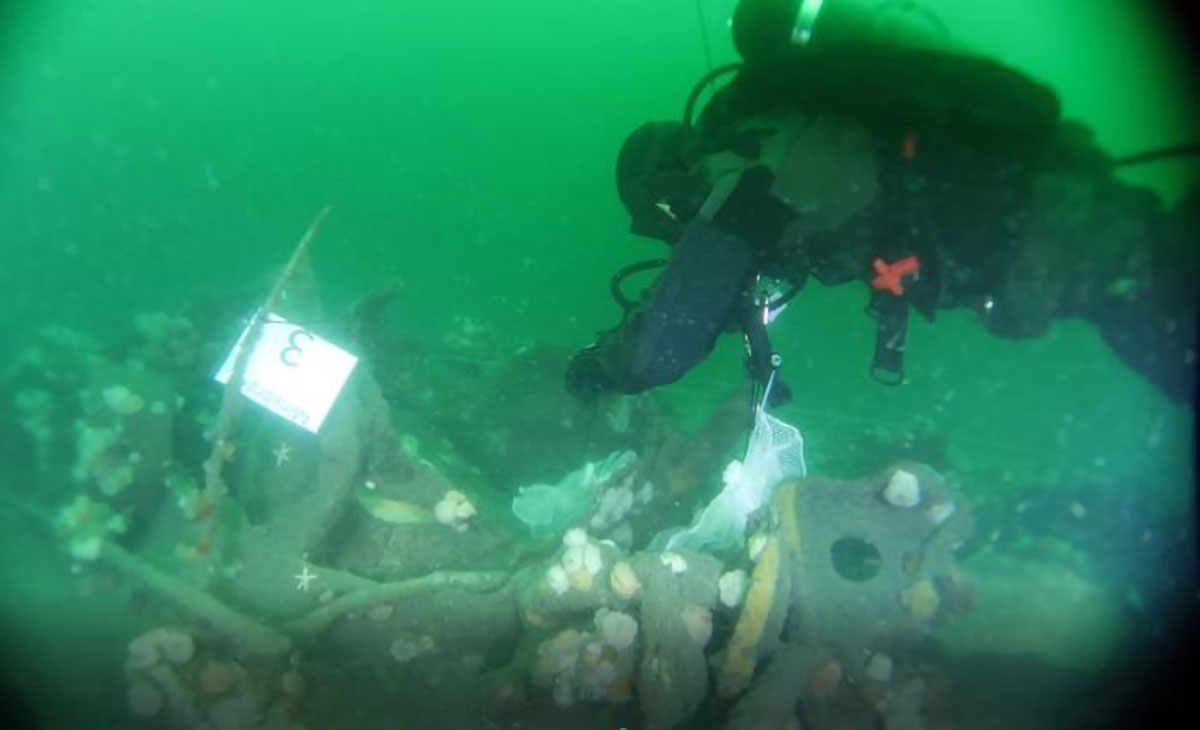
In April 1917, the German submarine UC-30 sailed underwater in the North Sea near the Danish island of Romo. The submarine was originally on a mission to Ireland, but was forced to return to Germany due to engine failure. On April 19, UC-30 hit a British mine and sank, killing all 27 crew members on board. At that time, the submarine was equipped with 18 mines and 6 torpedoes.
The submarine lay dormant on the seabed for nearly a century until it was discovered by Danish diver Gate Norman Andersen in 2016. Later, UC-30 became one of the investigation sites for the large-scale research project "North Sea Shipwrecks" participated by Katrina Yule Andresen, a professor at the Department of Earth Sciences at Aarhus University.
Since civilian divers are not allowed to enter the sunken area, Andresen's team, with the assistance of Danish Navy divers, collected samples of seawater and seabed sediments around the sunken ship, as well as samples of starfish and mussels living directly on the sunken ship. Divers also took video and photos to assess mine exposure and the corrosion of the wreck.
Sample analysis shows that explosives remaining inside the UC-30 are contaminating the marine environment around the sunken ship. Andreasen said that researchers have detected traces of TNT in wildlife, seabed sediments and water bodies, and contamination has clearly occurred. It is unclear how severe the impact of the contamination will be and how far it will spread from the wreck.
Researchers believe that the sunken ship is likely to be a relatively local source of pollution at present, but as the hull continues to be damaged and more explosives inside the mines are exposed, the pollution situation may worsen.
During World War I, the North Sea was of strategic importance to both Germany and Britain. Controlling the North Sea means being able to restrict the flow of goods between the two countries, and even force opponents to submit by cutting off supplies. Early in the war, Germany, with its smaller fleet, attempted to use submarines to get close to British ships and sink them.
Germany and Britain also laid thousands of mines in the North Sea in the hope that enemy ships would strike them. It is estimated that some 190,000 mines were deployed in the North Sea during World War I.
One of the largest naval battles in history, the Battle of Jutland, also took place in the North Sea during World War I, near Hansterholm in the northern part of the Jutland Peninsula. The German and British navies clashed in the battle, in which more than 25 ships were sunk and nearly 10,000 sailors lost their lives. Today, numerous shipwrecks related to the war and its associated actions remain on the ocean floor.
The UC-30 is not the only historical shipwreck in Danish waters that may have caused pollution. In 2024, Andresen wrote a report for the Danish Environmental Protection Agency, mapping shipwrecks in Danish waters, assessing the environmental risks they may pose, and studying how to prevent or reduce pollution.
The report shows that there are 10,127 shipwrecks in Danish waters, about 15% of which were sunk before, during and after the two world wars, that is, between 1910 and 1920 and between 1940 and 1945. That's a significant amount, Andresen said.
The Danish Environmental Protection Agency commissioned the study to assess how Denmark meets the requirements of the EU's Water Framework Directive. Andreasen noted that the findings suggest that more targeted measures may be needed in the future to deal with the pollution caused by these shipwrecks. She said that it is unclear whether the Danish Environmental Protection Agency has further advanced relevant work after the release of the 2024 report, but studies have proven that these sunken ships are indeed a source of pollution to the local marine environment.
Germany has invested heavily in salvaging some sunken ships and ammunition left in the Baltic Sea during World War II. After the war, the Allies dumped large amounts of ammunition into the sea to prevent the weapons from falling into the wrong hands. Today, these abandoned munitions are polluting the marine environment, as are the munitions left inside sunken ships.
Andresen said that Germany is already ahead of Denmark in dealing with such issues. Germany sometimes removes explosives from sunken ships and detoxifies them, but this process is very expensive.
However, removing explosives from a sunken ship is not necessarily risk-free. In some cases, detonating munitions directly underwater could spread contamination or even worsen environmental problems. The exact impact depends on the area where the wreck and ordnance are located, with ocean currents and seafloor topography all playing an important role. In some cases, detonation may cause more harm than leaving it undisturbed.
Andresen is currently working with international researchers through the EU-funded REMARCO project to explore ways to remove historic shipwrecks and the munitions inside them. The research team hopes to find solutions with minimal environmental impact, but she points out that there is no easy cleanup for the problem.
Some researchers in the project are developing robots that can crawl along the seafloor to locate dangerous munitions, allowing for more precise monitoring of individual shipwreck sites. In some cases, these robots can also grab objects, fish them out of the sea and dispose of them harmlessly, which may become one of the possible solutions in the future.
However, not all shipwrecks require immediate intervention. Some shipwrecks are fully or partially buried in seafloor sediments, and covering them with sand can significantly reduce the risk of contaminants entering the surrounding sea. Researchers believe the key is to identify the wrecks that pose the greatest environmental threat and then decide whether it is necessary to remove their munitions.
Comments