
Abstract:
The latest report released by market research organization Counterpoint Research shows that global smartphone sales fell 16% year-on-year in the third quarter of this year. The memory supply crisis has had a serious impact on the entry-level market, while pushing up the prices of high-end models. As a result, the market structure of major operating systems has also undergone significant changes.
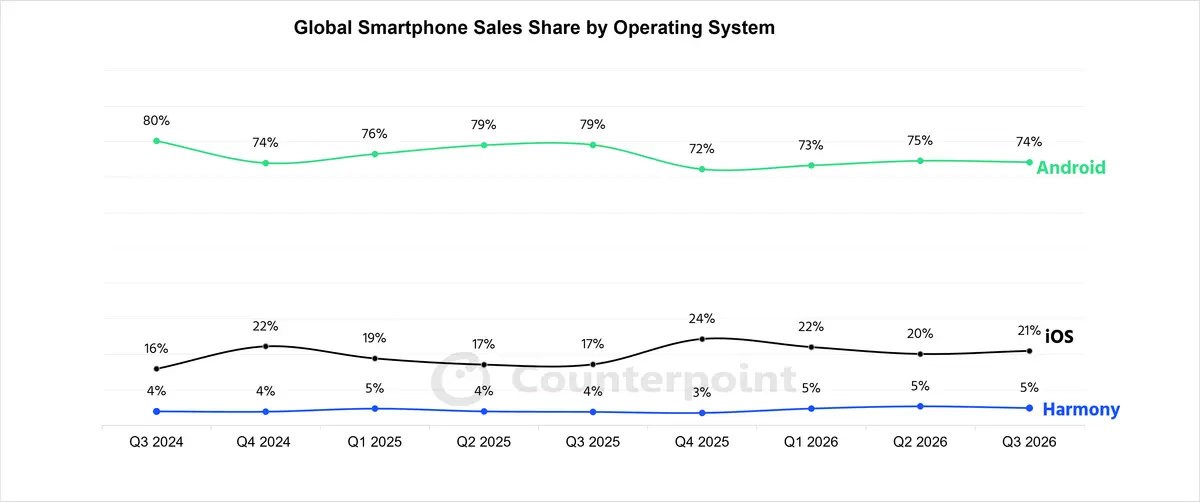
The report pointed out that the Android system occupied 74% of the global market share in the third quarter, which was lower than 79% in the same period in 2025 and hit the lowest level in the third quarter in history. Android spans every price range, making it more vulnerable to market slowdowns. However, the new flagship phones launched by Oppo, vivo and Xiaomi, as well as Samsung’s latest folding screen products, have alleviated the impact to a certain extent.
iOS’s performance was relatively impressive, with its global share reaching 21% in the third quarter, higher than 17% in the same period last year, setting a record for the third quarter in history. iPhone sales increased by about 2% year-on-year. Counterpoint Research said that the iPhone 18 Pro series performed better than the iPhone 17 Pro series. Although the prices of the entire series have increased, market demand remains strong. In the US market, iOS's share is 54%, slightly lower than the 55% in the same period last year; in the Indian market, it is 8%, the same as the same period last year.
The global share of Hongmeng System remains at 5%, but it performed well in the Chinese market, with its share increasing from 17% in the same period last year to 22%. Huawei's sales in mainland China increased by 12% year-on-year, while the overall market in mainland China fell by 10% during the same period. However, Counterpoint Research believes that Huawei's price increase in September may slow down its growth momentum in the coming quarter, and it remains to be seen whether this trend can continue.
Comments