
Abstract:
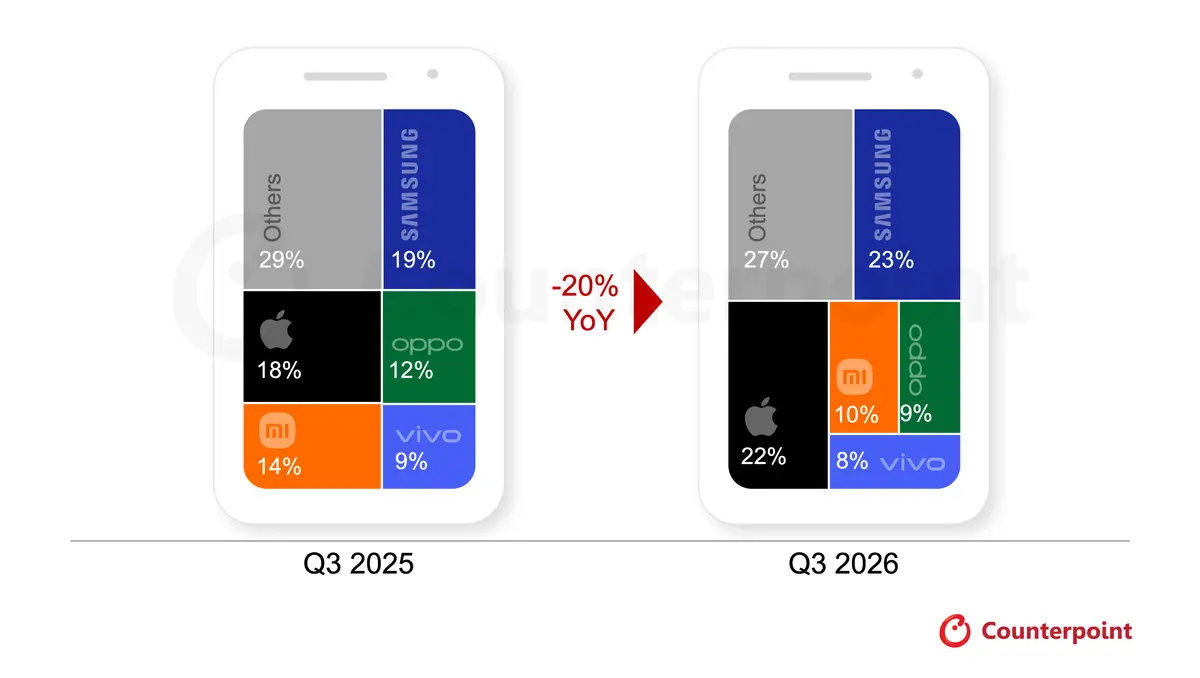
The latest data from market research firm Counterpoint Research shows that global smartphone shipments fell 20% year-on-year in the third quarter of 2026, falling to the lowest level in the same period since 2012. This number not only marks the worst performance in the third quarter in the past 14 years, but also reflects that the smartphone industry is facing the most severe market pressure in recent years.
The report pointed out that the continued surge in memory chip prices and supply shortages are the main reasons for this round of market decline. As the AI infrastructure construction boom continues, more and more DRAM and NAND production capacity are prioritized for data centers and artificial intelligence server markets, resulting in a reduction in storage resources for the smartphone industry and a significant increase in costs.
Faced with rising component prices, mobile phone manufacturers are forced to increase the selling price of terminal products, reduce the scale of shipments, and shift their business focus from pursuing sales to maintaining profit margins. Rising prices have further weakened consumer demand, especially in the mid- to low-end markets.
Counterpoint senior analyst Shilpi Jain said that the cycle for consumers to replace their mobile phones is continuing to lengthen. More and more users are choosing to continue using their existing equipment, and the market for refurbished machines is also becoming more receptive. In addition, consumers tend to choose products with higher value and longer service life when purchasing machines, rather than frequently upgrading equipment.
From the perspective of manufacturer performance, Samsung continues to maintain its number one position in the world, with a market share of 23%. Thanks to the market demand for Galaxy Z Fold8 series folding screen products and the stable supply of parts for mid-range models, Samsung still maintains its lead despite a 3% year-on-year decline in shipments.
Apple became one of the most watched manufacturers this quarter, with its market share rising to 22%, breaking the 20% mark for the first time in the third quarter. However, Apple's overall shipments are still down compared to the same period last year. Analysts believe that due to the lack of standard models in the initial launch of this year's iPhone 18 series, compared with the complete iPhone 17 series product lineup of the previous generation, the scale of channel stocking at the initial launch of the new model has been reduced, thus affecting the overall shipment performance.
Chinese brands in the Android camp are under greater pressure. Both OPPO and vivo’s shipments fell by more than 20% this quarter, while Xiaomi’s decline was more than 30%. In order to protect profit margins, Xiaomi has reduced the layout of some low-priced products and reduced some overseas market operations, reducing its global market share to 10%.
Research institutions believe that the rapid expansion of the AI industry and the competition for storage resources have become an important variable affecting the consumer electronics industry. As memory chip prices remain high, mobile phone manufacturing costs will still be difficult to alleviate in the short term, and the market downturn may last for a long time.
The industry expects that high-end flagship mobile phones will be relatively less affected because these users are less sensitive to price increases and have more ample profit margins. In contrast, brands that rely on entry-level and mid-range markets will face greater challenges, and the global smartphone industry may continue to experience shrinking sales and market consolidation for some time to come.
Comments