
Abstract:
Nvidia CEO Jensen Huang has every reason to actively develop new customers by investing in various new cloud service providers and AI companies. Despite the company's success, Nvidia's sales are increasingly concentrated among a handful of customers, some of whom may scale back purchases in the future.
Looking through Nvidia's public disclosure documents over the past few years, which list the number of customers that contribute more than 10% of revenue, this risk is clearly evident. Three customers accounted for 44% of the company's total revenue in the first half of the fiscal year that ended in July. Two customers contributed 36% of total revenue last fiscal year. Looking back to fiscal year 2023, Nvidia does not yet have a single customer accounting for more than 10% of its revenue. (See chart below for details)
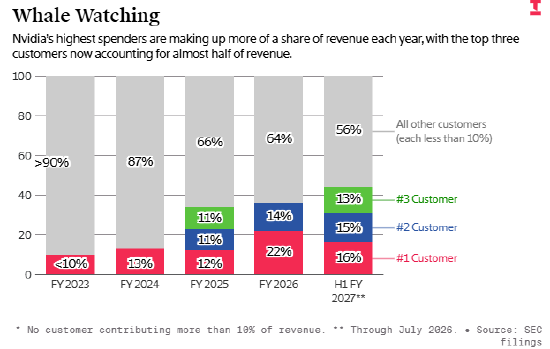
Data support: The Information in-depth research
With the explosive growth of its business, Nvidia's dependence on a few large customers continues to increase. Since fiscal year 2023, Nvidia’s data center business (which counts revenue from AI chips sold to data centers) has surged from US$15 billion to US$193.7 billion last year, and this business revenue is expected to double again this year.
This issue has caused concerns among investors. Michael Burry, known for his accurate prediction of the 2008 subprime mortgage crisis, has viewed Nvidia's rising customer concentration as a major risk in recent months.
Of course, analyzing Nvidia's customer concentration is inherently complicated. The three major customers mentioned in the latest financial report are likely to include Dell or Hon Hai (Foxconn). These two companies purchase NVIDIA chips to assemble servers and then resell them to a large number of downstream companies. For example, Dell recently disclosed that its “AI optimized server” revenue doubled year-on-year in the second quarter, reaching $16.4 billion, driving the company’s overall revenue to surge by 58%. Hon Hai also said that its revenue in the first half of the year increased by 35% year-on-year, driven by a surge in sales of AI equipment.
But Nvidia is also highly dependent on some cloud vendors. In February this year, Nvidia Chief Financial Officer Colette Kress said that the five major cloud vendors and ultra-large-scale cloud companies (the expression most likely includes Meta and SpaceX) together account for more than 50% of data center business revenue.
It is unclear how many of these five companies are among Nvidia's top three customers. The top three customers may include SpaceX, Meta or Microsoft, all of which are aggressively building new AI data centers equipped with Nvidia chips. Google and Amazon also purchase large quantities of Nvidia chips, but both use self-developed AI chips on a large scale, so their probability of entering Nvidia's largest customer list is relatively low.
Microsoft, Meta, and SpaceX are all promoting self-developed chips, which means that they may reduce their purchases of Nvidia chips in the future. This also explains why Nvidia is so focused on cultivating new customers and expanding its customer pool by investing in new cloud service providers such as CoreWeave and Nebius.
NVIDIA has also set its sights on expanding customers overseas. For example, on Wednesday, NVIDIA included several Australian companies in the "AI Factory" project to supply chips and network equipment to companies that build and operate data centers. This year, Nvidia is also promoting similar projects in India and Armenia, hoping to cultivate more sovereign project customers and new cloud service providers in addition to its core major customers in the United States.
Hidden dangers in payment period
Despite NVIDIA's efforts to promote customer diversification, the risk of excessive customer concentration may continue to rise. Nvidia disclosed in July that
70% of its accounts receivable (money to be collected from product sales) came from five customers
. For comparison, in January this year, three customers accounted for 56% of total receivables; at the end of fiscal 2025, only two customers accounted for 33% of receivables.It is worth noting that Dell recently disclosed that as of the end of July, the company's accounts payable to suppliers surged 48% in the first half of the year, reaching $49.7 billion, and a large part of the debt owed is likely to be Nvidia.
At the same time, at least part of the reason for the increase in NVIDIA's accounts receivable comes from the company's relaxation of payment terms for customers. Nvidia disclosed at the end of August that its accounts receivable in the first half of the year surged 64% to US$63 billion due to the “extended payment terms of large cross-quarter agreements for some investment-grade customers.”
Last quarter, Nvidia extended its billing period from 45 days to 60 days. In the securities declaration documents submitted during the same period, it was stated that the account period may be further lengthened in the future.
"Customers generally complete payment shortly after product delivery. For large purchase orders from investment-grade customers, we have and will continue to provide extended payment terms of up to one year and 90 days starting based on the scale of the data center construction project in the future to support customers' large-scale data center construction." Nvidia wrote in the document.
Relaxing the account period will bring risks: on the one hand, it will compress Nvidia's operating cash inflow in a single quarter; on the other hand, the chip manufacturer's operating conditions will become increasingly dependent on the financial health of these customers who enjoy deferred payment privileges.
Comments