
Abstract:
On August 31, the Financial Times reported that U.S. technology giants received more than $160 billion (approximately 1 trillion yuan) in unexpected gains from investments in other AI companies last quarter. These gains beautified their financial reports and also raised concerns that the actual intensity of the AI craze may be exaggerated by paper gains.
U.S. technology giants make huge fortunes from investments
In their recently released financial reports, Google parent companies Alphabet, Amazon, Nvidia and Microsoft all reported that their pre-tax profits increased significantly due to the "other income" items in their accounts, and these incomes mainly come from the increase in valuations of equity investments in other leading AI companies.
These one-time valuation gains largely stem from the market’s enthusiasm for AI. At a time when investors are closely scrutinizing technology company earnings and trying to judge the health of the entire AI ecosystem, these earnings may distort the company's true financial health.
“A few years ago, investors began to question the cyclical nature of the revenue of technology giants.” Ben Snider, chief U.S. equity strategist at Goldman Sachs, said.
He added that today's profit growth from AI investments "raises the question of whether the growth reported by these companies is due to real underlying demand or is in some way misleading."
Investment income magnifies profits
In recent quarters, technology giants’ investments in OpenAI and Anthropic have become increasingly visible in their financial reports, as accounting standards stipulate that changes in the value of equity investments at the end of each quarter must be included in the company’s profits or losses.
But this year, with the listing of SpaceX, the equity investment income of large technology companies has further increased significantly. Alphabet and Nvidia both hold shares in SpaceX. SpaceX acquired Musk's xAI before going public, making the orbital AI data center an important selling point in its listing promotion. The listing significantly increased the value of shares held by existing investors.
Last quarter, the contribution of "other income" to the technology giant's profits was more than double the approximately US$69 billion in the previous quarter. This phenomenon is expected to continue next year if Anthropic and OpenAI go to market as scheduled.
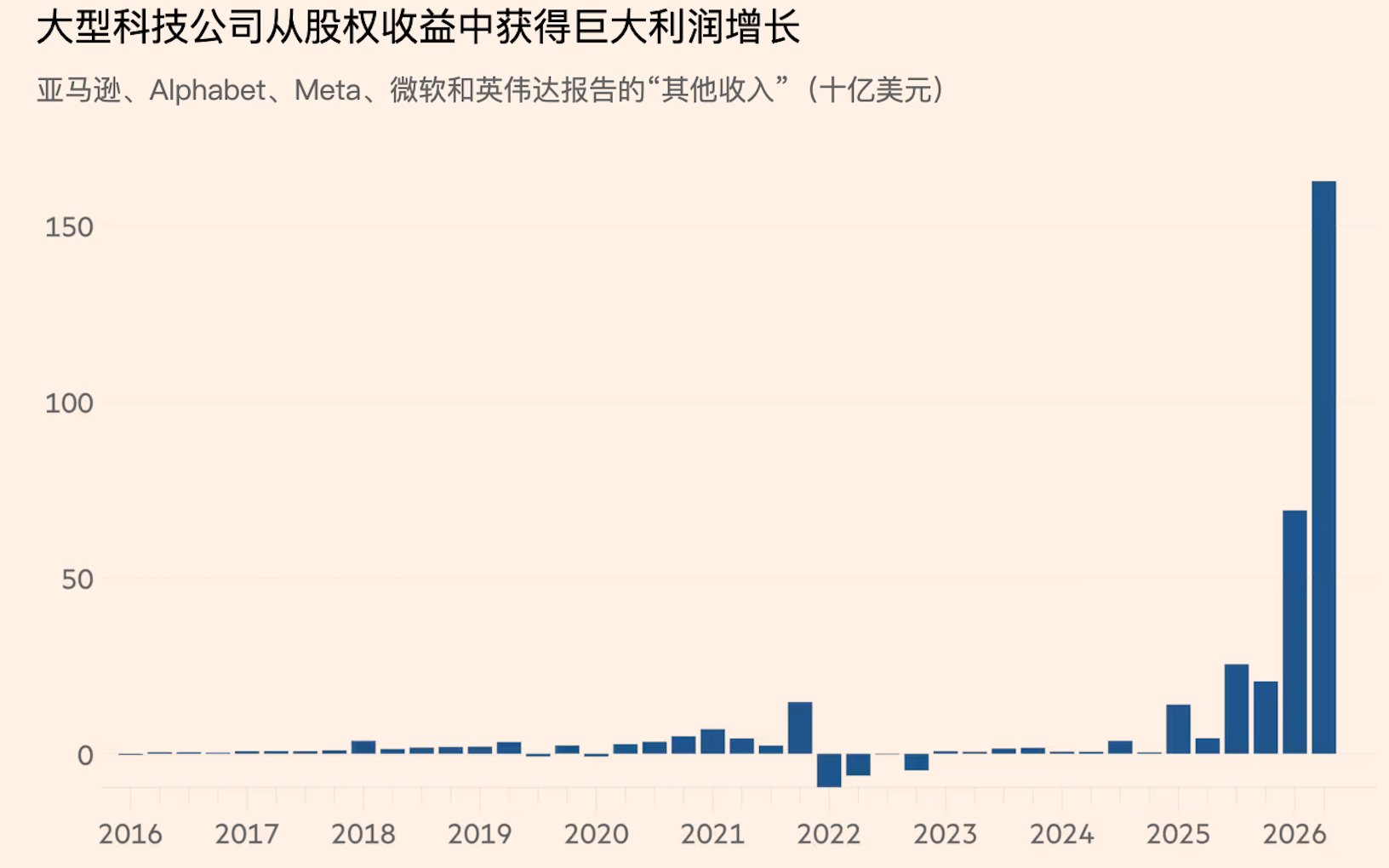
Investment income significantly boosts profits of technology giants
In the latest round of financial reports, the pre-tax profits of many large "hyper-scale cloud service providers" hit record highs. But the main source of profit growth for Alphabet and Amazon is "other income" brought by the appreciation of SpaceX and Anthropic's equity, rather than new business lines or actual new cash flow generated.
In the three months ended June 30, Google parent Alphabet's "other revenue" more than doubled from the previous quarter to $97.9 billion. Amazon's "other revenue" more than tripled to $53.4 billion.
Nvidia has a huge equity investment portfolio, and at the end of June it disclosed that it held nearly 123 million SpaceX shares. In the three months to the end of July, the company recorded $7.7 billion in "other revenue." That's down from the previous quarter, when Nvidia reaped huge gains as its stake in Intel rose in value.
Hide the real operation
Analysts pointed out that the core business profitability of the U.S. technology industry remains strong, and the industry plays a vital role in the overall stock market performance. However, AI investment returns have obvious volatility and discontinuity, making it more difficult for investors to see the true profitability of these technology companies.
Manish Kabra, head of U.S. equity strategy at Societe Generale, said the gains raised "questions about the quality of earnings," which also prompted the market to cut the companies' price-to-earnings ratios from about 25 times to 20 times.
Kasper Elmgreen, chief investment officer of Nordic Asset Management's fixed income and equity business, said that the first-half financial report "clearly overestimates the repeatable profitability of the company" and that the "cyclical effect" behind these AI gains is also a matter of concern.
These companies revalue their holdings only after the private companies they invest in complete a new round of financing. However, shareholdings of listed companies are adjusted quarterly. This could create a distorted impression of earnings growth for investors and analysts who focus solely on macro financial indicators without adjusting for these factors on a company-by-company basis.
“For investors who make investment decisions at a macro level, these investments within the technology industry are really concerning,” Kabra said.
Louise Dudley, global equity portfolio manager at Federated Hermes, said the changes were "too big to ignore" and not only made the analysis more complex but "undoubtedly introduced additional risks."
But she added that these companies "deserve some recognition for investing in and partnering with very successful businesses."
The large one-time equity valuation adjustments seen so far this year could create unprepared downside risks for the next few earnings periods. "The earnings contribution from these types of gains sets the stage for potentially negative growth next year," said Scott Chronert, Citi's U.S. equity strategist.
Comments