
Abstract:
Nvidia plans to invest in d‑Matrix, according to three people with knowledge of the deal. This 7-year-old company focuses on the research and development of server chips for artificial intelligence, and its product goal is to compete with Nvidia. This proposed investment is an initiative by Nvidia to promote compatibility of its own technology with competing chip designers and bring competitors into its dominant hardware ecosystem, even as Nvidia's share of the AI inference chip market continues to rise.
This is also Nvidia’s first deal with an AI inference chip startup since it signed a $20 billion technology licensing agreement with Groq in December last year. This shows that Nvidia does not intend to bet on just this one company.
Three months ago, Nvidia launched a cooperation model with its chip competitors, allowing the two companies' chips to work together and share different tasks in the same set of AI inference workloads. The goal is to improve the operating efficiency of such computing tasks.
It is difficult for competitors to shake Nvidia's huge lead, so more and more manufacturers are choosing to work with Nvidia's GPUs instead of completely replacing them. NVIDIA promotes competitors to connect to its own ecosystem, and it can also benefit its network hardware products; these products can interconnect multiple groups of server racks as an overall system to complete high-load AI calculations. This technical solution is parallel computing.
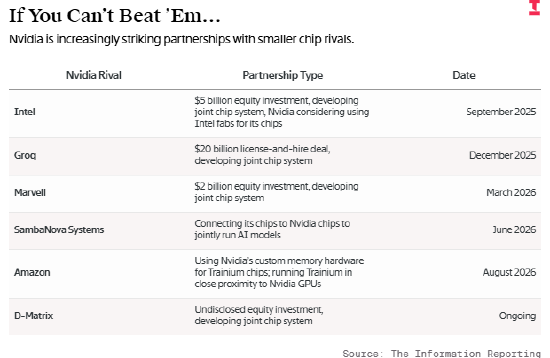
In the past 12 months, Nvidia has completed multi-billion-dollar investments in Intel and Broadcom, two other larger AI chip competitors, partly to promote the integration of Nvidia GPUs with these two enterprise chips. It’s unclear when such integrations will be available on a large scale. People from several start-up chip companies revealed that Nvidia has also promoted solutions to several other chip start-ups, hoping that their chips can be compatible with GPUs equipped with Nvidia network technology.
In August this year, Amazon also proposed a similar integration idea: Let Nvidia GPU and Amazon's self-developed Trainium AI chip coexist and run simultaneously in the same data center using a server rack with a unified architecture; at the same time, the Trainium chip can also call Nvidia's network and memory hardware.
SambaNova Systems, another chip start-up, also demonstrated in June a solution for interconnecting its own chips with NVIDIA GPUs to run AI models together. While promoting the above-mentioned heterogeneous integration, NVIDIA is also independently developing a chip system that combines GPU with Groq's dedicated AI inference chip. Previously, NVIDIA also absorbed Groq's founding team and many employees through this US$20 billion technology licensing transaction.
The U.S. Department of Justice is looking into whether Nvidia designed the Groq deal in a way to circumvent a formal Justice Department investigation into the deal’s impact on the chip market, according to sources familiar with the investigation. The news was first reported by the New York Times.
Calling chips from different manufacturers to jointly process the same AI task is a fairly new industry concept, which is called
disaggregated inference
AWS Neuron. Although NVIDIA is actively developing decoupled inference solutions with smaller rivals, NVIDIA has publicly stated that it can still handle almost all AI workloads most efficiently with its own chips alone.Even so, cloud service providers and leading AI development companies such as Anthropic and OpenAI do not want to rely entirely on a single chip supplier. In addition to purchasing chips from other manufacturers to reduce their dependence on Nvidia, these two AI companies are also developing their own AI inference chips.
The technical focus of d‑Matrix is
speculative decoding
, this technology can improve the running speed of AI models. In this joint system to be launched by NVIDIA, the d-Matrix chip will run a small AI model and predict in advance the output results that the large model should give to the user; while the large model will run on the NVIDIA GPU to verify the guessed results and confirm their adoption.The Information previously reported that d‑Matrix was seeking a new round of financing at the time, with a target post-money valuation of US$5 billion; it is currently uncertain whether Nvidia’s funding will be included in this round of financing. d‑Matrix’s last round of funding took place in November 2025, raising $275 million, with a post-money valuation of $2 billion. The company completed mass production of its first-generation chips this summer and is currently testing its second-generation chips.
Comments