
Abstract:
On October 12, the Washington Post reported that although the U.S. government and technology companies often describe the development of artificial intelligence as a winner-take-all competition, the U.S. AI industry maintains deep ties with China. From low-cost Chinese models adopted by U.S. companies, to data center equipment, smart glasses and robot parts, Chinese companies are providing important support for the development of U.S. AI.
“We are so closely connected and there is a lot of actual dependence.” Kyle Chan, an AI research expert at the Brookings Institution in the United States, said in an interview with the newspaper.
Why American companies choose Chinese models
The Washington Post used The Dark Side of the Moon as an example to demonstrate this intertwined relationship between competition and cooperation.
At the Dark Side of the Moon headquarters in Zhongguancun, Beijing, conference rooms are named after American rock bands such as Metallica and Led Zeppelin. According to reports, the company’s English name Moonshot comes from founder Yang Zhilin’s love for Pink Floyd’s album “The Dark Side of the Moon.” Yang Zhilin received his PhD from Carnegie Mellon University in the United States, and the company's Kimi model also uses his English nickname.
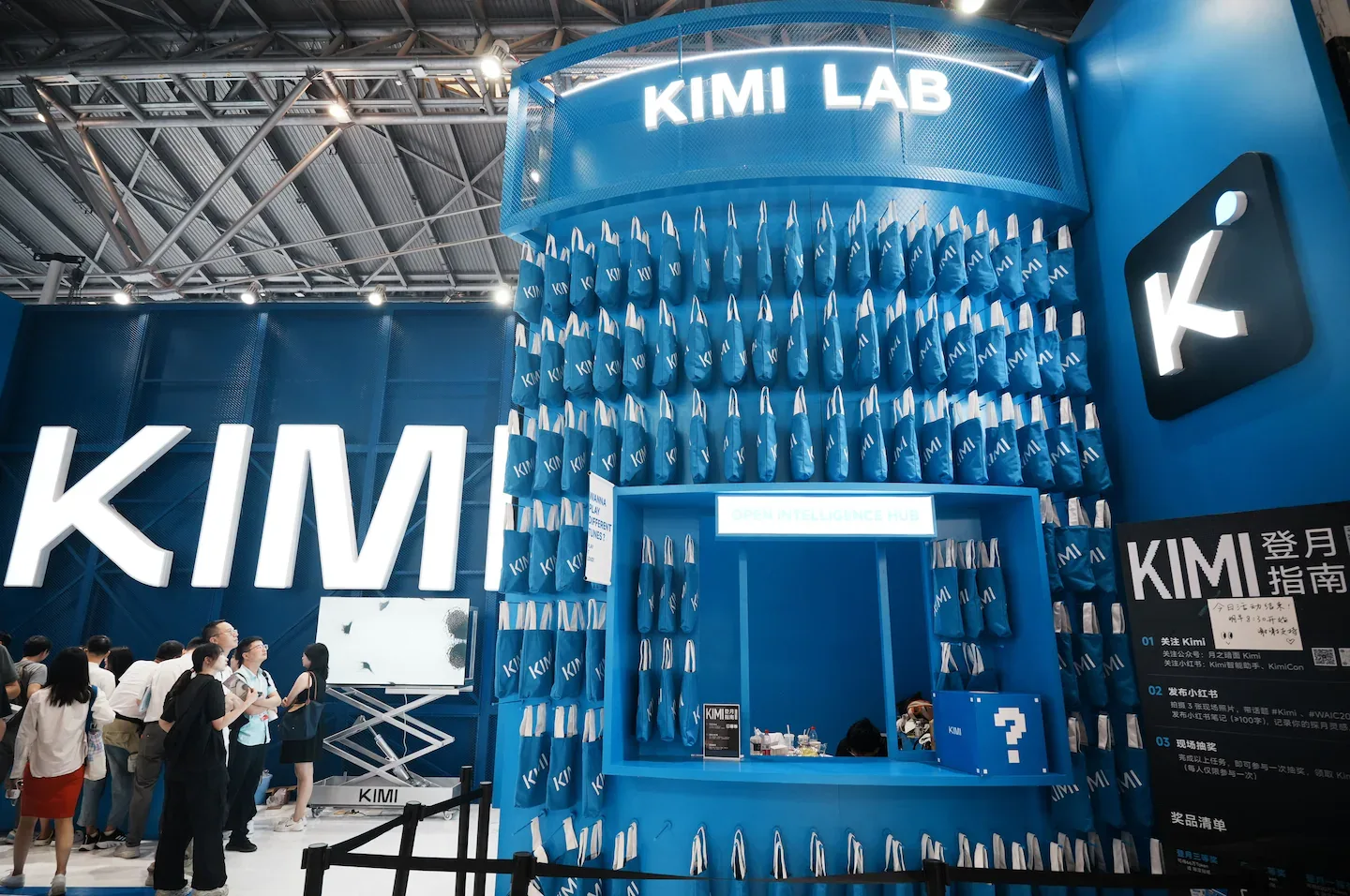
Reports indicate that many American companies regard Dark Side of the Moon’s Kimi K3 as a low-cost alternative to Silicon Valley products. The open weight models launched by Chinese companies such as Dark Side of the Moon, DeepSeek, and Alibaba allow users to customize them, and the cost is much lower than the closed-source models provided by companies such as Anthropic and OpenAI.
According to the newspaper’s description, although the U.S. closed-source model is more advanced, U.S. companies such as DoorDash and Airbnb have found that the Chinese model is sufficient to handle many daily tasks. The Washington Post also disclosed that it has a content partnership with OpenAI.
Demand in the U.S. market also creates resistance to policies restricting Chinese models. According to reports, in July this year, when the Trump administration was considering banning the use of Chinese AI on national security grounds,
a coalition of nearly 300 U.S. companies publicly opposed
.Counterpoint Research analyst Sun Wei believed in an article quoted by the newspaper that US customer demand for Kimi K3 marks the beginning of the open model itself becoming a geopolitical dependence.
Paul Triolo, a partner at Washington consulting firm DGA-Albright Stonebridge Group, said that Chinese models pose a competitive threat to closed-source model companies such as Anthropic and OpenAI, which makes the US government face a difficult problem on how to respond.
At the same time, the United States continues to make accusations against Chinese models. According to the newspaper, the U.S. Congress began investigating the use of Chinese AI models by U.S. companies in April this year, citing so-called national security risks. Last month, the FBI, the National Security Agency, and the Department of Homeland Security’s cybersecurity agencies issued a joint notice accusing Dark Side of the Moon, DeepSeek, Alibaba, MiniMax, Stepstar, and Wisdom of using U.S. models for training without authorization and violating the terms of use of U.S. companies. The above content is an accusation made by a US agency.
Chinese AI companies first look for applications that are willing to pay
The Washington Post believes that one difference between the Chinese and American AI industries lies in their emphasis on models and hardware.
Hao Chen, a researcher at Harvard University's Kennedy School of Government, said that the United States places more emphasis on the importance of models, while China believes that models are as important as hardware, and China has advantages in manufacturing.
The report pointed out that the leading AI companies in the United States regard general artificial intelligence as a core goal, while many Chinese companies pay more attention to applying AI to industry, government services and daily life. Hotel service robots, Beanbao-powered home assistants, and AI-generated short videos are all examples.
According to the newspaper, China's State Council updated the "Artificial Intelligence +" action last year, proposing to promote the extensive and in-depth integration of AI with various industries and fields of the economy and society. By 2030, the penetration rate of intelligent agents and intelligent terminal applications in six key areas, including science, government governance, and industrial development, will reach 90%.
The business of Beijing Tashan Technology provides a specific sample. The company develops tactile processing chips that allow robots to distinguish the weight of objects and use appropriate grip strength. Reports describe applications including picking up eggs without crushing them, packing electronic parts into shells, and separating crayfish heads from bodies.
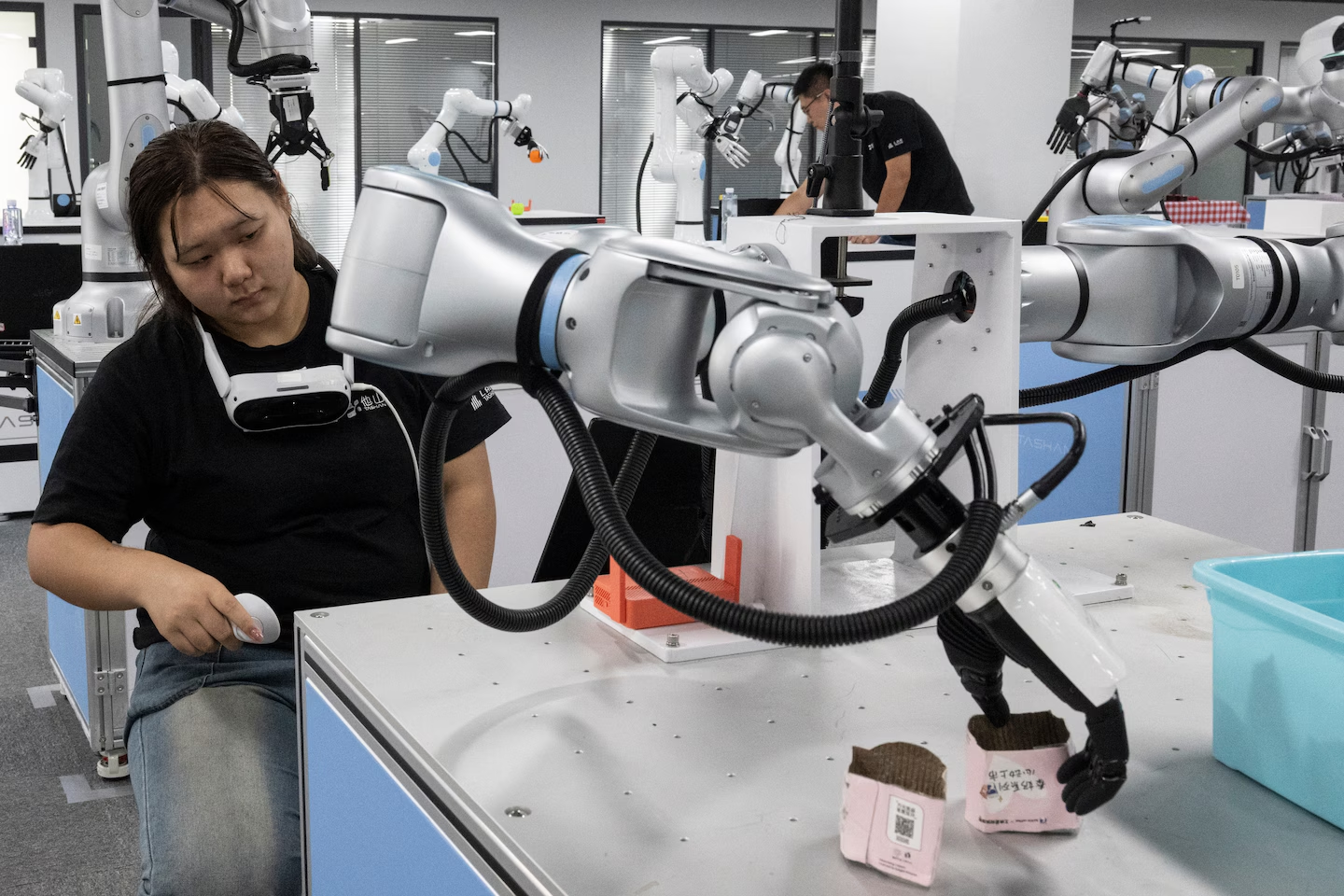
Tashan Technology is developing robots with fine motor skills
At its research and development center, staff train robots to wipe up kitchen spills and pick up items from mock store shelves. A near-finished product is designed to allow hotel robots to deliver items from room service orders directly to guests.
Chen Jinlin, head of international business of Tashan Technology, said that American customers often put forward ambitious visions or goals at the beginning of the project, while there are customers in China who are willing to pay for products that can only complete a single task.
The newspaper believes that this gradual advancement strategy is also related to resource constraints. According to data from research firm Epoch AI, the total annual revenue disclosed by China's six leading AI companies is approximately equivalent to 10% of the combined annual revenue of Anthropic and OpenAI.
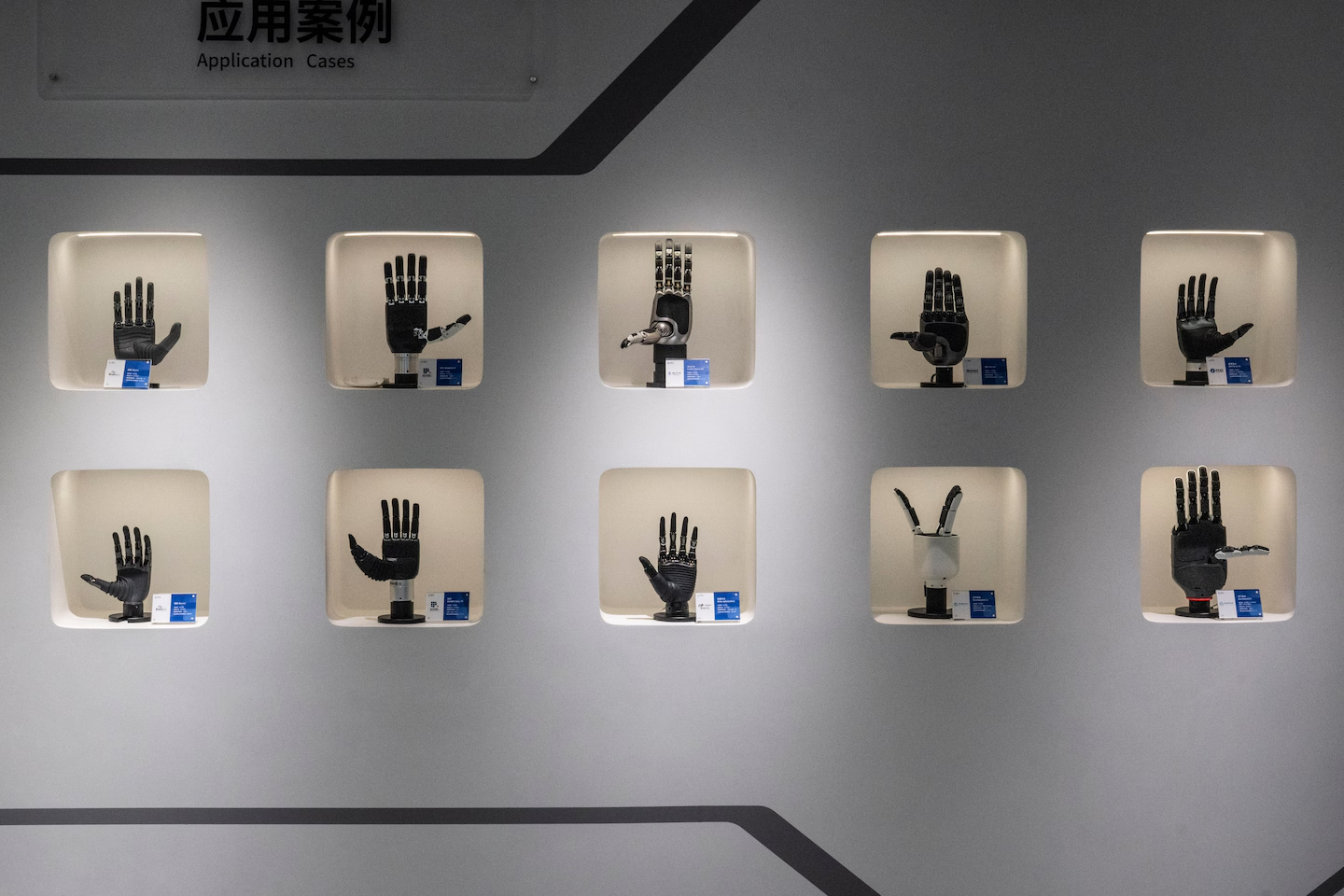
The robot hand with tactile feedback exhibited by Heshan
There is also a gap between financing and computing power. The newspaper cited a report from Bloomberg that week that Dark Side of the Moon plans to list in Hong Kong early next year and may raise up to US$5 billion; Anthropic expects an IPO later this year to raise 20 times that amount. The above figures are all reported expectations.
The newspaper also quoted a report released by the U.S. non-profit Institute for Progress in August this year, saying that due to the U.S. export controls on advanced chips, U.S. companies have an approximately 10-to-1 advantage in the computing power required to develop, test, and run AI models.
The advantages of Chinese manufacturing behind a robot
In addition to the model, China’s huge manufacturing system provides another competitive advantage for AI hardware such as robots.
The report pointed out that the electronics supplier network formed in Shenzhen, Shanghai, Hangzhou and other places can provide motion controllers, sensors and inertial measurement units to support rapid prototyping, testing and improvement of products. Some suppliers serve both the robotics and electric vehicle industries.
The newspaper quoted Morgan Stanley estimates as saying,
The material cost of using Chinese suppliers to manufacture Tesla's Optimus 2 humanoid robot is about US$46,000; using a non-Chinese supply chain, the material cost is nearly three times higher, reaching US$132,000
. This comparison points to material costs, not the robot's selling price or full production cost.Tashan Technology also reflects the connection between the automotive industry and the robotics industry. The company started in 2017 by developing electronic products for automobile companies. Its customers include BYD. One of its early products was a sensor that allows drivers to open the trunk through foot movements.
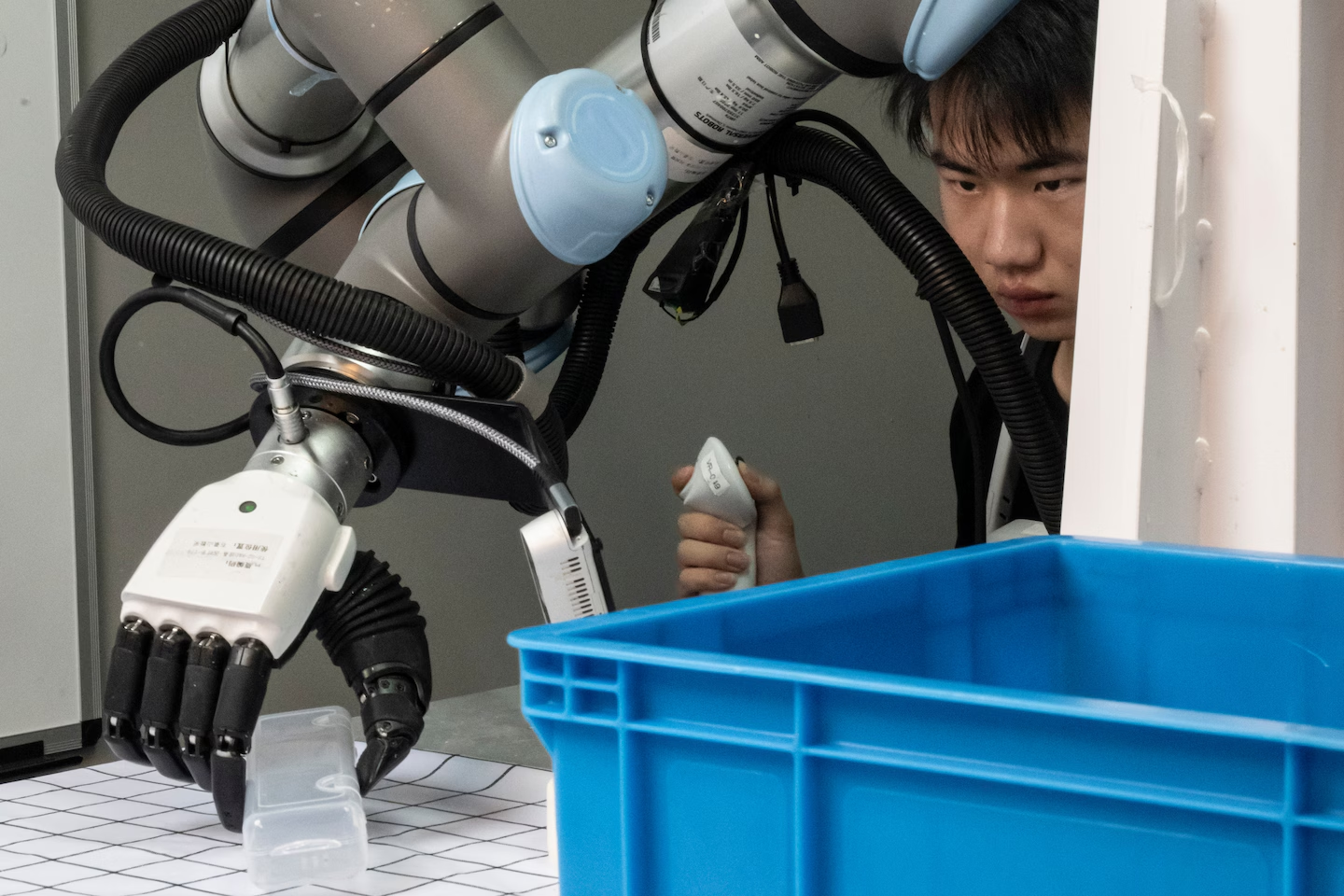
Workers are training robots to have the proper grip strength to pick up items from store shelves
Tashan Technology said that it currently occupies 80% of China's tactile sensor market, has more than 200 customers, and cooperates with NVIDIA in the field of robot simulation. Market share and number of customers are self-reported by the company.
Kai-fu Lee, CEO of Zero One Thousand and former head of Google China, told the newspaper that China has obvious advantages in manufacturing, supply chain, cost and product launch speed. He believes that Chinese companies can manufacture, iterate and improve products at a speed that may be four times that of similar American companies.
U.S. data centers are still purchasing Chinese equipment
Made in China’s support for the US AI industry is also reflected in the construction of consumer equipment and data centers.
Reports indicate that many of Meta’s smart glasses are produced in Chinese factories, and the Pebble Index smart ring, which can record voice notes and transmit them to mobile phones, is also made in China.
The newspaper cited a recent paper by Michael Waugh, an economist at the Federal Reserve Bank of Minneapolis, saying that
Large U.S. cloud computing companies imported about $45 billion in AI-related goods from China last year
, including computer hardware, electrical equipment, heating and cooling systems, and fire protection equipment. Two years ago, that amount was about $55 billion.The share of Chinese goods in total U.S. AI-related imports is declining faster. Waugh said that this proportion will drop to 7% by 2025, about half of the previous level, and further fell to 3% in the first half of this year. The role of suppliers in Taiwan and Vietnam has increased, and he speculated that some Chinese goods may enter the United States through these regions.
One of the Chinese companies benefiting from the expansion of U.S. data centers is optical module manufacturer Zhongji InnoLight. According to reports, nearly 60% of its business comes from U.S. customers, including Alphabet, Amazon and Nvidia.
In June this year, the U.S. Department of Defense added Zhongji Innolight to its list of companies it identified as having ties to the Chinese military. The newspaper also cited a Reuters report that the Trump administration was considering a ban on the import of new Chinese-made data center equipment. The latter is still a reported policy consideration, not a ban that has been implemented.
Kyle Chan said that building data centers and training American models require a large number of data center components from China. When discussing decoupling or dependence, one only needs to dig a little deeper to see connections between Chinese components and Chinese companies throughout the U.S. AI supply chain.
Comments